Saturday, May 24, 2008

Idiocy From The Past

In 2000....
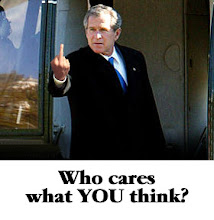
Gov. George W. Bush of Texas said today that if he was president, he would bring down gasoline prices through sheer force of personality, by creating enough political good will with oil-producing nations that they would increase their supply of crude.

''I would work with our friends in OPEC to convince them to open up the spigot, to increase the supply,'' Mr. Bush, the presumptive Republican candidate for president, told reporters here today. ''Use the capital that my administration will earn, with the Kuwaitis or the Saudis, and convince them to open up the spigot.''
Link.

Just imagine... just increase supply a little and *poof!* happy days are here. Like cutting a 19¢ gas tax would accomplish much.

But nothing about the exponentially increased demand from growing economies....

So Beloved Leader was always a man of vision with a clear view of the world....

The History Of The Slinky

Action! Joe Slaps Joe

The modern age is an age of, well, bullshit, usual dishonesty in all areas. So it's refreshing when anyone cuts through the thick fog of crap we live in....
On Wednesday, Joe Lieberman wrote on this page1 that the Democratic Party he and I grew up in has drifted far from the foreign policy espoused by Franklin Roosevelt, Harry Truman and John Kennedy.

In fact, it is the policies that President George W. Bush has pursued, and that John McCain would continue, that are divorced from that great tradition – and from the legacy of Republican presidents like Ronald Reagan and George H.W. Bush.

Sen. Lieberman is right: 9/11 was a pivotal moment. History will judge Mr. Bush's reaction less for the mistakes he made than for the opportunities he squandered.

The president had a historic opportunity to unite Americans and the world in common cause. Instead – by exploiting the politics of fear, instigating an optional war in Iraq before finishing a necessary war in Afghanistan, and instituting policies on torture, detainees and domestic surveillance that fly in the face of our values and interests – Mr. Bush divided Americans from each other and from the world.

At the heart of this failure is an obsession with the "war on terrorism" that ignores larger forces shaping the world: the emergence of China, India, Russia and Europe; the spread of lethal weapons and dangerous diseases; uncertain supplies of energy, food and water; the persistence of poverty; ethnic animosities and state failures; a rapidly warming planet; the challenge to nation states from above and below.

Instead, Mr. Bush has turned a small number of radical groups that hate America into a 10-foot tall existential monster that dictates every move we make.

The intersection of al Qaeda with the world's most lethal weapons is a deadly serious problem. Al Qaeda must be destroyed. But to compare terrorism with an all-encompassing ideology like communism and fascism is evidence of profound confusion.

Terrorism is a means, not an end, and very different groups and countries are using it toward very different goals. Messrs. Bush and McCain lump together, as a single threat, extremist groups and states more at odds with each other than with us: Sunnis and Shiites, Persians and Arabs, Iraq and Iran, al Qaeda and Shiite militias. If they can't identify the enemy or describe the war we're fighting, it's difficult to see how we will win.

The results speak for themselves.

On George Bush's watch, Iran, not freedom, has been on the march: Iran is much closer to the bomb; its influence in Iraq is expanding; its terrorist proxy Hezbollah is ascendant in Lebanon and that country is on the brink of civil war.

Beyond Iran, al Qaeda in Afghanistan and Pakistan – the people who actually attacked us on 9/11 – are stronger now than at any time since 9/11. Radical recruitment is on the rise. Hamas controls Gaza and launches rockets at Israel every day. Some 140,000 American troops remain stuck in Iraq with no end in sight.

Because of the policies Mr. Bush has pursued and Mr. McCain would continue, the entire Middle East is more dangerous. The United States and our allies, including Israel, are less secure.

The election in November is a vital opportunity for America to start anew. That will require more than a great soldier. It will require a wise leader.

Here, the controversy over engaging Iran is especially instructive.

Last week, John McCain was very clear. He ruled out talking to Iran. He said that Barack Obama was "naïve and inexperienced" for advocating engagement; "What is it he wants to talk about?" he asked.

Well, for a start, Iran's nuclear program, its support for Shiite militias in Iraq, and its patronage of Hezbollah in Lebanon and Hamas in Gaza.

Beyond bluster, how would Mr. McCain actually deal with these dangers? You either talk, you maintain the status quo, or you go to war. If Mr. McCain has ruled out talking, we're stuck with an ineffectual policy or military strikes that could quickly spiral out of control.

Sen. Obama is right that the U.S. should be willing to engage Iran on its nuclear program without "preconditions" – i.e. without insisting that Iran first freeze the program, which is the very subject of any negotiations. He has been clear that he would not become personally involved until the necessary preparations had been made and unless he was convinced his engagement would advance our interests.

President Nixon didn't demand that China end military support to the Vietnamese killing Americans before meeting with Mao. President Reagan didn't insist that the Soviets freeze their nuclear arsenal before sitting down with Mikhail Gorbachev. Even George W. Bush – whose initial disengagement allowed dangers to proliferate – didn't demand that Libya relinquish its nuclear program, that North Korea give up its plutonium, or even that Iran stop aiding those attacking our soldiers in Iraq before authorizing talks.

The net effect of demanding preconditions that Iran rejects is this: We get no results and Iran gets closer to the bomb.

Equally unwise is the Bush-McCain fixation on regime change. The regime is abhorrent, but their logic defies comprehension: renounce the bomb – and when you do, we're still going to take you down. The result is that Iran accelerated its efforts to produce fissile material.

Instead of regime change, we should focus on conduct change. We should make it very clear to Iran what it risks in terms of isolation if it continues to pursue a dangerous nuclear program but also what it stands to gain if it does the right thing. That will require keeping our allies in Europe, as well as Russia and China, on the same page as we ratchet up pressure.

It also requires a much more sophisticated understanding than Mr. Bush or Mr. McCain seem to possess that by publicly engaging Iran – including through direct talks – we can exploit cracks within the ruling elite, and between Iran's rulers and its people, who are struggling economically and stifled politically.

Iran's people need to know that their government, not the U.S., is choosing confrontation over cooperation. Our allies and partners need to know that the U.S. will go the extra diplomatic mile – if we do, they are much more likely to stand with us if diplomacy fails and force proves necessary.

The Bush-McCain saber rattling is the most self-defeating policy imaginable. It achieves nothing. But it forces Iranians who despise the regime to rally behind their leaders. And it spurs instability in the Middle East, which adds to the price of oil, with the proceeds going right from American wallets into Tehran's pockets.

The worst nightmare for a regime that thrives on tension with America is an America ready, willing and able to engage. Since when has talking removed the word "no" from our vocabulary?

It's amazing how little faith George Bush, Joe Lieberman and John McCain have in themselves – and in America.
Link.

Hav-A-Laff!

MacUser, out of boredom, provides these:
“Apple vs. Microsoft”

Three Microsoft engineers and three Apple employees are traveling by train to a computer conference. At the station, the three Microsoft engineers each buy tickets and watch as the three Apple employees buy only a single ticket.

“How are three people going to travel on only one ticket?” asks a Microsoft engineer.

“Watch and you’ll see,” answers the Apple employee.

They all board the train. The Microsoft engineers take their respective seats, but all three Apple employees cram into a restroom and close the door behind them. Shortly after the train has departed, the conductor comes around collecting tickets. He knocks on the restroom door and says, “Ticket, please.”

The door opens just a crack and a single arm emerges with a ticket in hand. The conductor takes the ticket and moves on.

The Microsoft engineers saw this and agreed it was quite a clever idea. So after the conference, the Microsoft engineers decide to do the same on the return trip and save some money.

When they get to the station, they buy a single ticket for the return trip. To their astonishment, the Apple employees don’t buy any ticket, at all.

“How are you going to travel without a ticket?” asks one perplexed Microsoft engineer.

“Watch and you’ll see,” answers an Apple employee.

When they board the train the three Microsoft engineers cram into a restroom and the three Apple employees cram into another one nearby. The train departs.

Shortly afterward, one of the Apple employees leaves his restroom and walks over to the restroom where the Microsoft engineers are hiding. He knocks on the door and says, “Ticket, please…”


Three employees, one from Microsoft, one from Sun, and one from Apple are in a restroom, at the urinals. When the Microsoft employee is done he washes his hands, he dries his hands completely with 10 paper towels. “At Microsoft,” he says, “We’re very thorough.” The sun employee finishes, washes his hands, and dries them with one paper towel. “At Sun, we’re very thorough AND very efficient.” The Apple engineer leaves without washing his hands, and says, “At Apple, we don’t piss on our hands.”


Two geeks are talking over lunch. The first guy says “You wouldn’t believe what happened this morning. A girl rode up to me on her bike, took off all her clothes, and said ‘Take whatever you want!’ … So I took the bike.”

The second guy says “Good choice, her clothes probably wouldn’t have fit you.”


And really, how does one defend a monopoly-based company run by a madman?

Scarily Weird, Bizarre News Stories

A West Virginia woman was being transferred to the Cleveland Clinic after walking the line between life and death.
Doctors are calling Val Thomas a medical miracle. They said they can't explain how she is alive.

They said Thomas suffered two heart attacks and had no brain waves for more than 17 hours. At about 1:30 a.m. Saturday, her heart stopped and she had no pulse. A respiratory machine kept her breathing and rigor mortis had set in, doctors said.

"Her skin had already started to harden and her fingers curled. Death had set in," said son Jim Thomas.

They rushed her to a West Virginia hospital. Doctors put Thomas on a special machine which induces hypothermia. The treatment involves lowering the body temperature for up to 24 hours before warming a patient up.

After that procedure, her heart stopped again.

"She had no neurological function," said Dr. Kevin Eggleston.

Her family said goodbye and doctors removed all the tubes.

However, Thomas was kept on a ventilator a little while longer as an organ donor issue was discussed.

Ten minutes later the woman woke up and started talking.
Link.
Edward Smith, who lives with his current "girlfriend" – a white Volkswagen Beetle named Vanilla, insisted that he was not "sick" and had no desire to change his ways.

"I appreciate beauty and I go a little bit beyond appreciating the beauty of a car only to the point of what I feel is an expression of love," he said.

"Maybe I'm a little bit off the wall but when I see movies like Herbie and Knight Rider, where cars become loveable, huggable characters it's just wonderful.

"I'm a romantic. I write poetry about cars, I sing to them and talk to them just like a girlfriend. I know what's in my heart and I have no desire to change."

He added: "I'm not sick and I don't want to hurt anyone, cars are just my preference."

Mr Smith, 57, first had sex with a car at the age of 15, and claims he has never been attracted to women or men.

But his wandering eye has spread beyond cars to other vehicles. He says that his most intense sexual experience was "making love" to the helicopter from 1980s TV hit Airwolf.

As well as Vanilla, he regularly spends time with his other vehicles – a 1973 Opal GT, named Cinnamon, and 1993 Ford Ranger Splash, named Ginger.

Before Vanilla, he had a five-year relationship with Victoria, a 1969 VW Beetle he bought from a family of Jehovah's Witnesses.

But he confesses that many of the cars he has had sex with have belonged to strangers or car showrooms.

His last relationship with a woman was 12 years ago - and he could not bring himself to consummate it, although he did have sex with girls in his younger days.

Mr Smith, from Washington state in the US, kept quiet about his secret fetish for years, but agreed to be interviewed as part of a channel Five documentary into “mechaphilia”. He is shown meeting other enthusiasts at a rally in California

Talking about how his unusual passion developed, Mr Smith said: "It's something that grew as a part of me when I was a kid and I could not shake it.

"I just loved cute cars right from the beginning, but over the years it got stronger once I got into my teenage years and was my first having sexual urges.

"When I turned 13 and the famous Corvette Stingray came about, that car was pure sex and just an incredible machine. I wanted it.

"I didn't fully understand it myself except that I know I'm not hurting anyone and I do not intend to."

He added: "There are moments way out in the middle of nowhere when I see a little car parked and I swear it needs loving.

"There have been certain cars that attracted me and I would wait until night time, creep up to them and just hug and kiss them.

"As far as women go, they never really interested me much. And I'm not gay.”

Mr Smith is now part of a global community of more than 500 “car lovers” brought together by internet forums.
Link.

What Wingnuts Get Themselves Crazy Over

There is no greater issue facing this nation and the world, from the whackos' perspective than Rachel Ray wearing this.

Music Viddie Of The Day

Quote Of The Day

Via /.:
Old timer, n.: One who remembers when charity was a virtue and not an organization.
The Chinese curse has come true... we live in interesting times....

Even Time Says It's Worse Than You Think; Another Obituary For America

Time seems to think we need another FDR, or maybe even Ronnie Raygun (not so much, and with another Paul Volker)... well, we're getting neither this cycle....
In the waning minutes of his only TV debate with Democratic incumbent Jimmy Carter in 1980, Ronald Reagan looked straight into the camera and asked, "Are you better off than you were four years ago?"

It was a defining question of the campaign — and of late 20th century American politics. It was also pretty easy to answer. The "misery index," a then popular measure that added the unemployment rate to the inflation rate, had skyrocketed during Carter's tenure. Taxes had risen sharply. There were other issues on voters' minds, like the Iranian hostage crisis and those dang cardigans Carter used to wear. But the economy was crucial to Reagan's victory. After taking office, he responded by ushering in a new era in economic policy — cutting tax rates, slashing regulation and tirelessly preaching the gospel that individual Americans were better suited to make economic decisions than bureaucrats in Washington were.

This election year, the economy is again at the forefront of voters' minds. The misery index is no longer the problem; at 9% and change, it's miles below the 20% of late 1980. But Americans have a new menu of economic woes — among them a real estate crash, a credit crisis, a broken health-care system and nagging job insecurity. Poll after poll shows a vast majority convinced that the economy and the country are headed in the wrong direction.

The first and most obvious thing to be said is that this represents a big stumbling block for Republican John McCain. He's not the incumbent, so the "four years ago" line doesn't apply directly to him. But history shows that slow economic growth is among the best predictors of a change in party control of the White House — and right now the economy is barely growing at all.

The bigger issue for voters to wrestle with, though, is not what the economy can do to the presidential race but what the next President can do to the economy. Usually it's not so much. But every once in a while, like when Franklin Delano Roosevelt was elected in 1932 and Reagan in 1980, the effect can be dramatic. Reagan's policies, together with some luck and the inflation-killing zeal of Federal Reserve Chairman Paul Volcker, helped the U.S. economy break out of its 1970s malaise into a new era of flexibility, innovation and growth. And this era didn't end when Reagan left office in 1989. Subsequent Presidents, even Democrat Bill Clinton, followed more or less in Reagan's footsteps.

Economic eras don't last forever, though, and there are signs that the current slowdown is a harbinger of something bigger: an end to America's 25-year love affair with tax cuts and deregulation. A lot of the cracks that have emerged during that time, because of global economic shifts or our own neglect, have become impossible to ignore — stagnant incomes, a federal budget gone way out of balance, soaring energy prices, a once-in-a-lifetime housing crash and growing financial risks in retirement and from health care.

What it adds up to is a generalized sense of economic insecurity that has dimmed many Americans' optimism about their future. So there's a chance that this election could turn out to be a major economic turning point, just like 1980's was. A significantly new direction in economic policy seems much more likely if Barack Obama (or Hillary Clinton, on the off chance that she returns from the political dead yet again) prevails in November. But throw John McCain together with a Democratic Congress, and who knows what might pop out? Economic trouble begets economic change. Here's what may be in the offing.

INCOME
-$991
THE OTHER 99% OF AMERICA COULD REALLY USE A RAISE

If you feel as if you've been going backward, you haven't been imagining it. According to the U.S. Census Bureau, the median American family made $58,407 in 2006. That's $991 less, when you adjust for inflation, than the median in 2000, and indications are that things haven't gotten any better in 2007 or this year.

Recessions — like the one in 2001 and the one we might be in now — always reduce incomes. The problem since 2000 is that even when the economy was growing, the fruits of that growth landed almost exclusively in the pockets of the wealthiest Americans. According to economists Thomas Piketty and Emanuel Saez, 75% of all income gains from 2002 to '06 went to the top 1% — households making more than $382,600 a year.

The gap between high and low earners has been growing since the late 1970s, and until recently, economists attributed virtually all of it to technological and demographic changes that increased the premium paid to those with advanced skills and education. If that were true, the only answer would lie along the arduous path of improving the education and skill levels of American workers. And you certainly wouldn't want to discourage people from getting an education by heavily taxing the rewards for it.

But according to Piketty and Saez, the really dramatic developments have all been at the very, very top — not the top 1% but the top 0.01%, who now control 5.46% of all income, their highest share on record. (The data go back to 1913.) Most of these people are well educated, but it's awfully hard to portray their riches purely as rewards for education or skill.

Many economists now believe at least two other factors have contributed to the growth in inequality: globalization and Reagan's big cuts in taxes on the rich. Even as it rewards those at the top of their fields worldwide with spectacular paydays, globalization holds down earnings for millions of Americans who compete with workers overseas — not only lower-skilled factory and phone-center workers but also engineers, lawyers and doctors. Public opinion has reacted to this with increasing distrust of free trade, a wariness that both Obama and Clinton have echoed in their campaigns. But this is touchy territory: trade may distort the income distribution, but economists remain almost unanimous in warning that restricting trade would slow overall growth. There are similar concerns about using the tax code to address inequality, although Princeton political scientist Larry Bartels demonstrates in his new book, Unequal Democracy: The Political Economy of the New Gilded Age, that the redistributive policies of Democratic administrations since World War II succeeded in delivering better income growth to low-income and middle-income Americans than Republican administrations did.

So what should be done about income disparity? In an April Gallup poll, 68% of respondents said wealth "should be more evenly distributed" in the U.S. — the highest percentage saying so since Gallup started asking the question in 1984. A smaller majority, 51%, agreed that "heavy taxes on the rich" were needed.

To the extent they talk about it at all, the two parties take different approaches to closing the income gap. Obama in particular has been explicit about wanting to shift more of the income-tax burden away from the middle class and onto those making more than $200,000 a year, while McCain has spoken mainly about creating better job-retraining programs for those displaced by globalization. Another potential path, although it hasn't been a theme in the campaign so far, would be a big effort to repair the country's crumbling infrastructure — which would create lots of jobs that couldn't be outsourced overseas and would also deliver long-term economic benefits. In any case, the income gap is an issue that's been danced around for too long. It's time to address it.
[more -- read the whole piece while you can!]

Read This And Weep; An Obituary For America -- And It's Just About All True

Thomas Frank in, of all places, Fox Bidness Journal:
Twenty years ago, when I started out as a writer, the problems of mass prosperity were the ones that intrigued me most. America was then, as I thought it would always remain, the great middle-class nation. And in the permanent affluent society, questions of taste and waste and marketing and alienation were what really mattered, now and forever. When moved to consider workplace issues in those days, I instinctively placed them in the category of brutal-things-settled-long-ago: Without even thinking about it, I connected the word "labor" to the word "history."

It's not a mistake anyone can make any longer, whether they are pondering the voting patterns of working-class Hoosiers or the driest statistics in the record book. Median "nonelderly" household income, we find, fell consistently through the first half of this decade, despite the solid economic growth enjoyed by the country as a whole.

Some nonmedian folks did just fine, of course: The top 20% of households earned more, after taxes, than the rest of the country combined in 2005, while the topmost 1% of the population took home more than the bottom 40%. The top-earning hedge fund manager of 2007, in fact, made about as much last year in nominal dollars ($3.7 billion) as J. Paul Getty, one of the richest men in the world, was worth in the mid-1970s.

Real hourly wages for most workers, on the other hand, have risen only 1% since 1979, even as those workers' productivity has increased by 60%. What's more, American workers now clock more hours per year than their counterparts in virtually every other advanced economy, even Japan. And unless you haven't read a newspaper for 15 years, you already know what's happened to workers' health insurance and pension plans.

I confess that I am fascinated by the mechanics of this huge social reconfiguration – in the same sense that I am fascinated by the industrial procedures of a slaughterhouse, or by the strategies that enabled small Confederate armies to win victories for slavery over much larger Union forces. How the big change was brought off is the subject of Steven Greenhouse's important new book, "The Big Squeeze," which is also my source for many of the statistics in the preceding paragraphs. Aside from the outsourcing, offshoring, and firing-at-will that make up the best-known weapons in the corporate arsenal, Mr. Greenhouse reveals how managers extract unpaid work through an array of ingenious tricks, from eliminating bathroom breaks to electronically erasing hours from workers' records.

The most extreme cases are described in a remarkable book by John Bowe called "Nobodies." Mr. Bowe's subject is "modern American slave labor," a term he uses without hyperbole, since his book tells how certain of our fellow Americans have actually forced others to work for them involuntarily. The trademark contrivance these bosses employ is debt bondage, the oldest management trick of them all. Their victims are generally migrant or "guest" workers, whose labor they have exploited from the tomato fields of Florida to the garment factories of Saipan.

The feeling I get from absorbing all these facts about the state of labor comes close to the nauseated dread that washes over me when I stay up late to read one of those what-if stories in which Hitler wins World War II. Could this really have happened to my country?

It has not merely "happened"; it has been done to us. The distinction is an important one to keep in mind as we survey the ruins of the affluent society. What has overtaken America's working people is not a natural disaster like "globalization," and not even some kind of societal atavism in which countries regress mysteriously to their 19th-century selves. This is a man-made catastrophe, a result that proceeded directly from the deliberate beatdown of organized labor and the wrecking of the liberal state.

It is, in other words, a political disaster, with tax cuts, trade agreements, deregulatory measures, and enforcement decisions all finely crafted to benefit one part of society and leave the rest behind. Few of the voters who gave Ronald Reagan his landslide victories, it is fair to say, intended for this to be the outcome. They wanted their country to stand tall again, certainly; they wanted the scary regulators off their backs, maybe; but I can recall no conservative who trumpeted those long-ago elections – or any of the succeeding contests, for that matter – as a referendum on plutocracy.

So let us have one now. Instead of pleasant talk about "change" and feats of beer drinking at the corner tavern, let us hear our candidates address this greatest issue of them all: What kind of country are we to be? A land of equality? Or a bankers' utopia – where the law of the land has achieved mystical oneness with the higher law of classical economics, and devil take the bottom 80%.

Friday, May 23, 2008

All Your Nightmares....

An Honest Commercial

Maybe, it just took too many takes with too many sips....

A Call To Arms

In the information age, we all have a data shadow.
We leave data everywhere we go. It's not just our bank accounts and stock portfolios, or our itemized bills, listing every credit card purchase and telephone call we make. It's automatic road-toll collection systems, supermarket affinity cards, ATMs and so on.
It's also our lives. Our love letters and friendly chat. Our personal e-mails and SMS messages. Our business plans, strategies and offhand conversations. Our political leanings and positions. And this is just the data we interact with. We all have shadow selves living in the data banks of hundreds of corporations' information brokers -- information about us that is both surprisingly personal and uncannily complete -- except for the errors that you can neither see nor correct.
What happens to our data happens to ourselves.
This shadow self doesn't just sit there: It's constantly touched. It's examined and judged. When we apply for a bank loan, it's our data that determines whether or not we get it. When we try to board an airplane, it's our data that determines how thoroughly we get searched -- or whether we get to board at all. If the government wants to investigate us, they're more likely to go through our data than they are to search our homes; for a lot of that data, they don't even need a warrant.
Who controls our data controls our lives.
It's true. Whoever controls our data can decide whether we can get a bank loan, on an airplane or into a country. Or what sort of discount we get from a merchant, or even how we're treated by customer support. A potential employer can, illegally in the U.S., examine our medical data and decide whether or not to offer us a job. The police can mine our data and decide whether or not we're a terrorist risk. If a criminal can get hold of enough of our data, he can open credit cards in our names, siphon money out of our investment accounts, even sell our property. Identity theft is the ultimate proof that control of our data means control of our life.
We need to take back our data.
Our data is a part of us. It's intimate and personal, and we have basic rights to it. It should be protected from unwanted touch.
We need a comprehensive data privacy law. This law should protect all information about us, and not be limited merely to financial or health information. It should limit others' ability to buy and sell our information without our knowledge and consent. It should allow us to see information about us held by others, and correct any inaccuracies we find. It should prevent the government from going after our information without judicial oversight. It should enforce data deletion, and limit data collection, where necessary. And we need more than token penalties for deliberate violations.
This is a tall order, and it will take years for us to get there. It's easy to do nothing and let the market take over. But as we see with things like grocery store club cards and click-through privacy policies on websites, most people either don't realize the extent their privacy is being violated or don't have any real choice. And businesses, of course, are more than happy to collect, buy, and sell our most intimate information. But the long-term effects of this on society are toxic; we give up control of ourselves.
Link.

What's There To Love About Corporatism?

It's evil:
An internal Cisco document (.pdf) leaked to reporters on the eve of a Senate human rights hearing reveals that Cisco engineers regarded the Chinese government's rigid internet censorship program as an opportunity to do more business with the repressive regime.

The 90-page document is an internal presentation that Cisco engineers and staffers in China mulled over in 2002 as the central government was upgrading its local, state and provincial public safety and security network infrastructure. Under the category "Cisco Opportunities," the document provides bullet point suggestions for how it might service China's censorship system called the "Golden Shield", and better known in the West as the Great Firewall of China.

The document is the first evidence that the networking giant has marketed its routers to China specifically as a tool of repression. It reinforces the double-edged role that Americans' technological ingenuity plays in the rest of the world. Companies including Cisco, Yahoo, Microsoft and Google have faced criticism for cooperating to various degrees with the repressive Chinese regime, and the document leak on Monday came one day before a Senate Judiciary subcommittee hearing into U.S. technology companies' participation in foreign government censorship programs.
[more]

It's written by idiots:


The raw data is here.

Viddie Of The Day #2


http://view.break.com/506192 - Watch more free videos

Viddie Of The Day

Another Victory For Corporatism, Another Defeat For America

Really, when are the, well, the people going to take back this country? Huh? Ever??

Off the front page of the Times (Hear, hear! Props to the Times):
On campuses nationwide, professors and administrators have passionately debated whether their universities should accept money for research from tobacco companies. But not at Virginia Commonwealth University, a public institution in Richmond, Va.

That is largely because hardly any faculty members or students there know that there is something to debate — a contract with extremely restrictive terms that the university signed in 2006 to do research for Philip Morris USA, the nation’s largest tobacco company and a unit of Altria Group.

The contract bars professors from publishing the results of their studies, or even talking about them, without Philip Morris’s permission. If “a third party,” including news organizations, asks about the agreement, university officials have to decline to comment and tell the company. Nearly all patent and other intellectual property rights go to the company, not the university or its professors.

“There is restrictive language in here,” said Francis L. Macrina, Virginia Commonwealth’s vice president for research, who acknowledged that many of the provisions violated the university’s guidelines for industry-sponsored research. “In the end, it was language we thought we could agree to. It’s a balancing act.”

But the contract, a copy of which The New York Times obtained under the Virginia Freedom of Information law, is highly unusual and raises questions about how far universities will go in search of scarce research dollars to enhance their standing. It also brings a new dimension to the already divisive debate on many campuses over whether it is appropriate for universities to accept tobacco money for research.
[more]

Viddie Of The Day

President McCain's BFF Is Also An Anti-Semite; Match That, Rev. Wright!

Jeez, what will Lieberman say to this? (What, and risk getting the veep nomination??)


(But see this....)

Thursday, May 22, 2008

Yentas Kvetching About Beloved Leader's Grandpappy's Nazi Ties

I know I never get enough of this.... Remember: It takes the scion of Nazi-generated wealth to call Obama an appeaser on the Knesset floor. Hey, B.L.: Your grandpappy was far more of an appeaser than anyone you were alluding to!