For years now, the U.S. political press corps has traveled with John McCain on his “Straight Talk Express,” buying into his image as a paragon of truth-telling. But the real truth is that McCain routinely makes stuff up, as he did on June 11 in lying about Barack Obama’s “bitter” comment.Link.
During a political talk in Philadelphia, McCain claimed that Obama had described “bitter” small-town voters as clinging to religion or “the Constitution” – when the second item in Obama’s comment actually was “guns.”
But the Arizona senator didn’t stop with a simple word substitution. He added that he will tell these voters that “they have trust and support the Constitution of the United States because they have optimism and hope. … That’s what America’s all about.”
In other words, McCain didn’t just make a slip of the tongue. He willfully accused Obama of disparaging the U.S. Constitution, a very serious point that, if true, might cause millions of Americans to reject Obama’s candidacy.
Still, when some of the U.S. broadcast networks – including NBC evening news – played the clip of McCain lashing out at Obama’s purported dissing of the Constitution, they didn’t correct McCain's falsehood.
That fits with a long-standing pattern of the political press corps giving McCain a break when he makes statements at variance with the truth. Even in the rare moments when he is caught in an inaccuracy – such as accusing Shiite-ruled Iran of training Sunni extremists in al-Qaeda – the falsehood is minimized as an unintentional gaffe.
However, McCain actually seems to be following a trail blazed by George W. Bush, saying what’s useful at the time even if it’s not true and then counting on the U.S. press corps to timidly look the other way.
Through all his misstatements, McCain’s “straight-talk” reputation survives.
Sweeping Denials
In another instructive case, McCain got away with sweeping denials in his reaction to a New York Times article on Feb. 21. The story led with unsubstantiated suspicions among some McCain staffers that their boss had gotten too cozy with female lobbyist Vicky Iseman, but McCain went beyond simply denying any sexual improprieties.
He put out a statement declaring that in his quarter-century congressional career, he “has never violated the public trust, never done favors for special interests or lobbyists.” But that simply isn’t true.
As the Times story already had recalled, McCain helped one of his early financial backers, wheeler-dealer Charles Keating, frustrate oversight from federal banking regulators who were examining Keating’s Lincoln Savings and Loan Association.
At Keating's urging, McCain wrote letters, introduced bills and pushed a Keating associate for a job on a banking regulatory board. In 1987, McCain joined several other senators in two private meetings with federal banking regulators on Keating’s behalf.
Two years later, Lincoln collapsed, costing the U.S. taxpayers $3.4 billion. Keating eventually went to prison and three other senators from the so-called Keating Five saw their political careers ruined.
McCain drew a Senate reprimand for his involvement and later lamented his faulty judgment. “Why didn’t I fully grasp the unusual appearance of such a meeting?” he wrote in his 2002 memoir, Worth the Fighting For.
But some people close to the case thought McCain got off too easy.
Not only was McCain taking donations from Keating and his business circle, getting free rides on Keating’s corporate jet and enjoying joint vacations in the Bahamas – McCain’s second wife, the beer fortune heiress Cindy Hensley, had invested with Keating in an Arizona shopping mall.
In the years that followed, however, McCain not only got out from under the shadow of the Keating Five scandal but found a silver lining in the cloud, transforming the case into a lessons-learned chapter of his personal narrative.
McCain, as born-again reformer, soon was winning over the Washington press corps with his sponsorship of ethics legislation, like the McCain-Feingold bill limiting “soft money” contributions to the political parties.
However, there was still that other side of John McCain as he wielded enormous power from his position as chairman of the Senate Commerce Committee, which helped him solicit campaign donations from corporations doing business before the panel.
The Times story reported that McCain did favors on behalf of Iseman’s lobbying clients, including two letters that McCain wrote in 1999 to the Federal Communications Commission demanding that it act on a long-delayed request by Iseman’s client, Florida-based Paxson Communications, to buy a Pittsburgh television station.
Rather than simply acknowledge this fact, McCain’s campaign issued another sweeping denial of impropriety, calling those letters routine correspondence that were handled by staff without McCain meeting either with Paxson or anyone from Iseman’s firm, Alcalde & Fay.
"No representative of Paxson or Alcalde & Fay personally asked Senator McCain to send a letter to the FCC," his campaign said.
McCain’s Own Words
But that also turned out not to be true.
Newsweek’s investigative reporter Michael Isikoff dug up a sworn deposition from Sept. 25, 2002, in which McCain himself declared that “I was contacted by Mr. Paxson on this issue. … He wanted their [the FCC’s] approval very bad for purposes of his business. I believe that Mr. Paxson had a legitimate complaint.”
Though McCain claimed not to recall whether he had spoken with Paxson’s lobbyist [presumably a reference to Iseman], he added, “I’m sure I spoke to [Paxson],” according to the deposition. [See Newsweek’s Web posting, Feb. 22, 2008]
McCain’s letters to the FCC, which Chairman William Kennard criticized as “highly unusual,” came in the same period when Paxson’s company was ferrying McCain to political events aboard its corporate jet and donating $20,000 to his campaign.
After the Feb. 21 Times article appeared, McCain’s spokesmen confirmed that Iseman accompanied McCain on at least one of those flights from Florida to Washington, though McCain had said in the 2002 deposition that “I do not recall” if Paxson’s lobbyist was onboard.
First Amendment lawyer Floyd Abrams, who conducted the deposition in connection with a challenge to the McCain-Feingold law, asked McCain if the benefits that he received from Paxson created “at least an appearance of corruption here?”
“Absolutely,” McCain answered. “I believe that there could possibly be an appearance of corruption because this system has tainted all of us.”
When Newsweek went to McCain’s 2008 campaign with the seeming contradictions between the deposition and the denial of the Times article, McCain’s people stuck to their story that that the senator had never discussed the FCC issue with Paxson or his lobbyist.
“We do not think there is a contradiction here,” campaign spokeswoman Ann Begeman told Newsweek. “It appears that Senator McCain, when speaking of being contacted by Paxson, was speaking in shorthand of his staff being contacted by representatives of Paxson. Senator McCain does not recall being asked directly by Paxson or any representative of him or by Alcalde & Fay to contact the FCC regarding the Pittsburgh license transaction.”
That new denial crumbled, too, when the Washington Post interviewed Paxson, who said he had talked with McCain in his Washington office several weeks before McCain sent the letters to the FCC.
The broadcast executive also believed that Iseman had helped arrange the meeting and likely was in attendance. “Was Vicki there? Probably,” Paxson said. [Washington Post, Feb. 23, 2008]
So, in the months ahead, there’s urgency for American voters to figure out whether John McCain is the maverick “straight-shooter” of his usual press clippings or a sanctimonious phony who’s just masquerading as the guy who tells it like it is.
Is John McCain like George W. Bush, someone who has learned that the mainstream news media – ever sensitive to accusations of “liberal bias” – is hesitant to call a prominent Republican politician a liar, regardless of the facts and the circumstances?
In this political/media climate, McCain appears to believe he can get away with falsifying key details of something even as heavily reported as Obama’s infamous “bitter” remark.
Monday, June 16, 2008
Recent Flip-Flopping


Whackos Or Just Out Of Their Minds Crazy?
We report, you decide (although this looks like a no-brainer (pun intended)).
Hey, look (and listen)!
Michael Reagan, radio talk show host and son of late president Ronald Reagan, could be investigated by the FBI after he called for the execution of Mark Dice, anti-war activist and founder of media watchdog group The Resistance, on the air.Link.
On the June 10th edition of his nationally syndicated Radio America show, Reagan called Dice and others in the “9/11 Truth” movement “traitors” after learning that they were sending letters, declassified documents and DVDs to troops in Iraq that they say point to government involvement in the attacks on the World Trade Center in 2001.
The effort is part of The Resistance’s “Operation Inform the Soldiers.”
“I don’t want the soldiers who are risking their lives in Iraq to be used as pawns in the creation of the New World Order,” Dice said in a recent press release. “I personally know U.S. Marines who believe 9/11 was an inside job, and they tell me that many Marines suspect that this is the case but are afraid to speak up out of fear of punishment.”
“We ought to find the people who are doing this,” Reagan said, “take ‘em out, and shoot ‘em. Really. Just find the people who are sending those letters…to demoralize our troops…they are traitors to this country…and shoot them. You have a problem with that? Deal with it. But anybody who would do that doesn’t deserve to live. You call them traitors–that’s what they are–and you shoot ‘em dead. I’ll pay for the bullet.”
“How about you take Mark Dice out,” Reagan continued, “and put him in the middle of the firing range? Tie him to a post, don’t blindfold him, and let it rip and have some fun with Mark Dice.”
“Now we know where the Ron Paul supporters went,” quipped a co-host.
On Sunday, Dice announced on his website that he received a personal apology from Reagan and will appear on Reagan’s show to receive an on-air apology Monday, June 16th, at 3:30pm Pacific.
“While I understand different political opinions can result in heated arguments, Reagan’s statements are completely unacceptable, un-American, and extremely dangerous,” Dice said. “Reagan has elevated the hate and rhetoric aimed at those who disagree with this war to new and unprecedented level. He must be fired immediately and no other radio or TV network should let his voice be heard, or his face be seen.
“Despite Reagan’s apology,” Dice continued, “the Pandora’s box that he opened can never be closed. The ramifications of his threats and suggestions are enormous and frightening. In an age where a few clicks of a keyboard can result in anyone’s home address being found, Reagan’s comments open the door for stalking, vandalism, and worse. Any threats made will be forwarded immediately to the FBI and the appropriate legal action will be taken.”
Hey, look (and listen)!
Sunday, June 15, 2008
The Gratitude Of The Most Morally Perfect Man In The World
Yeah, yeah, I know; only in his mind. He's really just trash....
Now that Joe Lieberman has emerged as John McCain's lead attack dog against Barack Obama -- even going so far as to suggest that Obama's judgment could pose a danger to our safety -- there's some very interesting behind-the-scenes back-story to the Lieberman-Obama relationship that you should know about.Link with more links to more of the story....
Specifically, a top official on Joe Lieberman's 2006 Senate reelection campaign tells me that Lieberman's staff practically begged Barack Obama to come in and endorse him at a critical moment -- requests that Obama agreed to, helping Lieberman minimize the damage from challenger Ned Lamont's recent entry into the contest.
This back-story is particularly relevant right now in light of Lieberman's harsh assaults on Obama's national security credentials.
The top Lieberman official, who was directly involved in securing Obama's help, tells me that the campaign was desperate for Obama to come to Connecticut in March of 2006, soon after Lamont entered the race.
"We needed him to strongly validate us as a candidate that liberal Democrats should not desert," the official tells me. "We went to the Obama operation with a very urgent plea for him to come out for us."
It's well known that Obama's 2006 endorsement was important. But it's not widely understood just how urgently the Lieberman people begged for Obama's help at a critical moment in Lieberman's career -- and in that light, just how much of a back-stabbing Lieberman's attacks on Obama now represent.
In response to the Lieberman camp's pleas for help, Obama subsequently endorsed him at a dinner of Connecticut Democrats later that month.
"I am absolutely certain Connecticut is going to have the good sense to send Joe Lieberman back to the U.S. Senate so he can continue to serve on our behalf," Obama said at the time.
"It was a favor as huge as we could have gotten -- it was like a drowning man getting thrown a life preserver," the Lieberman official continued. "Just when Ned was trying to establish himself as a credible alternative on the war, Barack Obama came in and said, `Hey, I disagree with him on the war, but you should send him back to the Senate.'"
Why Our Allies Love Us
Ingratitude... why don't they want to be liberated forever?
Iraqi lawmakers say the United States is demanding 58 bases as part of a proposed "status of forces" agreement that will allow U.S. troops to remain in the country indefinitely.[more]
Leading members of the two ruling Shiite parties said in a series of interviews the Iraqi government rejected this proposal along with another U.S. demand that would have effectively handed over to the United States the power to determine if a hostile act from another country is aggression against Iraq. Lawmakers said they fear this power would drag Iraq into a war between the United States and Iran.
How Our Leaders Keep Us Safe
God, this guy had better been about to commit a major otherwise unstoppable act of terrorism to justify this crap.... Oh, wait, Our Leaders require no justification....
Our Leaders make one so proud to be an American and everything this nation now represents... greed, thuggery, disrespect for others....
Our Leaders make one so proud to be an American and everything this nation now represents... greed, thuggery, disrespect for others....
The U.S. government has photographic evidence that a Guantanamo Bay inmate was tortured with a knife after being taken to Morocco by U.S. forces, a British human rights group said Tuesday.Link.
Reprieve said their client, Binyam Mohamed, had his genitals slashed repeatedly with a doctor's scalpel while in custody in Morocco after he was flown there from Pakistan by American officials in 2002. It also said his U.S. captors later took pictures of the abuse to show authorities that his wounds were healing.
Mohamed, an Ethiopian national and former British resident, is charged by the United States with plotting with al-Qaeda to bomb American apartment buildings.
Reprieve maintains the charge is based on information coerced from Mohamed using torture.
Reprieve quoted Mohamed as saying that an American female photographed his wounds before he boarded a plane in the Moroccan city of Rabat on the night of Jan. 21, 2004.
"When she saw the injuries I had she gasped. She said: 'Oh, my God, look at that!' Then all her mates looked at what she was pointing at and I could see the shock and horror in her eyes," Mohamed was quoted as saying. "Later, when I was in Afghanistan, they took more pictures. They were treating me, and one of them explained that the photos were 'to show Washington it's healing."'
Reprieve said Mohamed's account was confirmed by an unidentified journalist it says spoke with a U.S. intelligence agent who saw the photographs. The group has urged the United States not to destroy them.
Something To Ponder....
Politicians really have reached the point that it's only about them -- their egos, their pockets -- and we, the people, we're just the votes that keep them empowered. They now feel absolutely no need, no incentive, no desire, to do anything for us, really. It's really all about them and no more....
This is what set me off this morning.
I'm sure there are exceptions but nowhere near enough.
This is what set me off this morning.
I'm sure there are exceptions but nowhere near enough.
What Famous Peoples' Kids Learn At Harvard
Yet another example where a parent is so focused on personal ambition and success so that the child can be sent to Harvard (or wherever) that said child grows up pretty much un-parented. Just, you know my opinion....
 Don't believe this? Look here.
 Don't believe this? Look here.
Rudy: Class Act Or Utterly Venal Scumbag?
Well, it can only be one or the other -- not both. Answer: The other.
The crap people accept....
The crap people accept....
With the Republican Party in need of money for the November elections, former Mayor Rudolph W. Giuliani has offered to appear at fund-raisers around the country for G.O.P. candidates. But there is a catch: He wants some cash out of the deal.[more]
Mr. Giuliani’s aides have told the National Republican Congressional Committee and Congressional candidates that if he makes an appearance, he wants the candidates to help him get rid of his presidential campaign debt.
The unusual request underscores the financial predicament Mr. Giuliani finds himself in, after he ended his presidential bid this year with roughly $3.6 million in campaign debt. Traditionally, prominent party figures help lower-tier candidates by headlining fund-raising events in return for good will and future political alliances, but do not receive funds themselves.
Mr. Giuliani’s debt includes a $500,000 personal loan that he made to the campaign, according to his latest campaign finance report.
President McCain's Miracle Working Exorcist -- His Story, Unedited
Updated bio (2008): Bobby Jindal converted to Catholicism from Hinduism as a teenager. In 1992, he graduated from Brown University,where the following events took place. Afterwards, he received a master's degree in politics from New College, Oxford as a Rhodes Scholar. After serving two terms in the United States House of Representatives (R-Louisiana) he is now Governor of Louisiana. Some of the names in this article, but none of the details, have been altered by the author.Link.
Though she had not said anything, I knew something was wrong. Susan and I had developed an intimate friendship; indeed, our rela tionship mystified observers, who insisted on finding a romantic component where none existed. I called her after the University Christian Fellowship (UCF) meeting -- UCF is an Inter-Varsity Christian group composed of undergraduate and graduate students. Though the interdenominational group's weekly program of songs and prayers had produced the usual emotional high among most members, Susan had left the meeting in a very sullen mood. I asked her to join a group of us who were attending a Chris tian a cappella concert to be held on campus that same evening.
Despite our intimacy, Susan and I had not spent much time together this past year. We had succumbed to pressure from our friends and de cided we should not be so emotionally interdependent without a deeper commitment. To be honest, my fears of a relationship and the constraints of commitment had kept us apart; our friends' objec tions merely provided a convenient excuse. Still, I felt comfortable asking her to come to the concert, and she accepted the invitation. Though Susan ap peared composed throughout the concert, her sud den departure in the middle of a song convinced me otherwise and affirmed my earlier suspicions.
There was no doubt in my mind that I had to leave my friends and follow her outside. I was not exactly sure what I would do or say, but I knew I had to run after her. I found that she had not gone far, but was sobbing uncontrollably outside the auditorium. Since we had been very careful to avoid any form of physical contact in our friendship, I was not sure how to respond. My inaction and her sobs produced a very awkward situation. Fortunately, a female friend who followed us out was able to comfort Su san with hugs and soothing words of reassurance; her quick action was in stark contrast to my paraly sis. Once Susan had regained her composure and fell silent, I knew I had to intervene. The female friend meant well, but did not know Susan well enough to provide the advice Susan was sure to seek.
Not even knowing the cause of this raucous scene, I asked Susan if she would like to talk, and volunteered to walk her home. Wanting to avoid any additional embarrassing scenes, I thought it best to remain in silence while we walked. I dared not cause another emotional outpouring until we were safely behind closed doors. When we finally reached her dorm room, I promptly sat Susan on a bed and placed myself in a chair located several feet across the room. This physical arrangement was hardly conducive to the love and support I was supposed to be providing, but I was too scared and unsure of myself to get any closer.
Taking a very businesslike approach, I queried Susan as to the cause of her distress. At first the words were slow to come and the few that she ut tered made little sense. Gradually the words formed sentences and the sentences arranged themselves into a coherent story. A jumble of events was trans formed into a logical sequence with a common theme of cause and effect. She had noticed a lump on her scalp, had visited the university health clinic, and had a biopsy performed. "Biopsy!" One thought replaced all others -- "benign or malignant?" The results had indicated skin cancer. Cancer, in any form, is a disease with a very powerful ability to cap ture our attention and unleash great waves of fear within us all. The word itself, and the hopelessness it conjures up, causes us instinctively to whisper con dolences; our minds automatically turn to the hor rors of chemotherapy. Radiation, hair loss, and death all seemed very real. No wonder poor Susan was devastated.
I quickly collected my thoughts and returned my attention to Susan. Not only had the prognosis scared her, but she had found little or no comfort among her friends. They considered skin cancer a minor affliction, something that affects those whose vanity causes them to tan in the sun too long. The only friend who expressed concern was worried about the possibility of contagious cancerous cells. Her friends, many of them pre-meds aspiring to be compassionate and skilled physicians one day, noted that a simple operation would remove the tu mor, and then simply laughed the entire matter away. She had felt foolish about her worries and joined their laughter; however, her smile merely masked her inner worries and fears. It was these re pressed fears that had led to her emotional outburst earlier that night.
As I listened to Susan recount these events, I wondered how we had grown so far apart. There were now other guys in her life and many friends I had barely met. I had insisted on emotional distance to allow us to develop independence, but that was ri diculous. Susan was my best friend and I hardly knew what was happening in her life. I soon found myself breaking my silence; until this point, I had hardly needed to prompt Susan to speak and had not even provided soothing remarks. Now, I sud denly started comforting her and validating her feel ings. Of course I would be there for her. Of course I understood her fears and worries. Of course I would reach out and touch her?
The interaction of Susan's revelations and my assurances had produced another outpouring of emotion, hysteria, and tears. Against my will, I found myself reaching out and holding her hand. I promised to stand by her forever, to be the rock against which she could lean, to accompany her to the doctor's office and the operating room. I never stopped to think of the significance of my valiant pledges; I assumed any good friend would react similarly in the same situation. How could any de cent person turn away a desperate woman in such need?
The tears vanished as suddenly as they ap peared several times throughout the night. Susan was even stable long enough for me to buy her milk to ease the gastric pains caused by her anxiety. She was literally worrying herself sick. I realized my words of comfort were only temporary measures and were not enough to provide her with long-term support. However, I did not go far enough. Instead of directing Susan to depend on a source far more dependable and stronger than myself -- i.e., our Christian faith, her own inner strength, or even a professional care provider -- I continued trying to solve her problems myself.
During Susan's next wave of tears, I found my self putting my arm around her to provide both physical and emotional support. We were soon sit ting on the bed next to each other, and I told her a fairy tale. Instead of tackling all of her problems at once, we took each individual concern -- e.g., up coming finals -- and magically solved it. Her prob lems began to seem insignificant and our ability to overcome adversity soon assumed heroic propor tions. We were soon laughing, and despair was defi nitely vanquished, at least for the night. We were both startled to find my arm around her shoulder, but she asked that I continue to hold her for just a few moments longer. I happily complied and we embraced her problems away; along with my sooth ing words, the simple gesture of a hug was enough to bring peace to Susan's heart for one night.
Susan had finally found a friend willing to be lieve and understand her worries; she no longer had to pretend that cancer did not frighten her. She was terrified, and I understood. I was able to mix the almost contradictory states of empathy and aloofness; Susan needed me to share her fears and yet still be strong enough to comfort her. I was her partner in misery and yet also served as her knight in shining armor.
The peace and our renewed closeness were not to last long. Susan and I had consciously maintained a fairly distant friendship over the year and the night's openness was a glaring exception. Scared of her own feelings and dependence on me, Susan made it a point to avoid me the next few days and answered my queries about her well-being suc cinctly and coldly. Our relationship stayed in this détente mode for an entire month. During this time, Susan's doctors were preparing her for the opera tion. The relatively simple procedure would not in volve many days in the hospital and had a very high chance of success.
Susan and I may have never confronted each other had it not been, ironically, for our pride. We continued meeting for meals and engaged in super ficial conversation, focused on the weather, sports, and any other topic except for cancer and our friend ship. The catalyst for our confrontation was a silly misunderstanding over a dinner. Susan did not show up at the cafeteria at our agreed upon time and made little effort to warn me of the scheduling con flict that caused her absence. This inconvenience, minor under normal circumstances, proved to be the starting point of an intense struggle of wills. We fought to prove who could be the most stubborn and arrogant; the result was a tie, with both of us losing.
Waiting for an apology, I refused to talk with Susan for a week. She decided I was being silly and refused to admit any error on her part. Somehow, we finally searched deep and found the maturity to discuss our differences. The strain of our open hostility during the week and quiet indifference during the month had beaten down both of our wills. We could hold our breath no longer.
We quickly settled the matter about the dinner and then turned our attention to the real cause of the tension between us. For the first time in a month, one of us mentioned the night of the concert, the night I first heard of Susan's affliction. This talk was very different in character from our last serious discussion; whereas before I had provided support and comfort for a helpless Susan, this was truly a battle of wills between two strong and independent indi viduals. We discussed issues as varied as our true feelings for each other and Susan's upcoming op eration.
Then Susan confessed that she was disturbed by recent nightmares. I accepted this as a normal reaction to a very difficult semester. One of Susan's closest friends from home, her Bible study leader there, had committed suicide shortly before Susan found the lump. Adding insult to injury, she learned of his death through a newspaper article, since her family and friends were too scared to tell her. The operation alone would have been overwhelming for any emo tionally healthy individual. Given the loss of a dear friend from home, the tension with one's best friend at school, and the pressures of a very demanding academic schedule, it is a miracle that Susan remained sane; nightmares hardly seemed a cause for alarm.
Then Susan started saying words like "visions" instead of nightmares, and I began to get worried and scared. I had always known that Susan was a charis matic Christian, but had thought little of what such labels meant. She had told me of speaking in tongues during certain prayers and even seeing visions in her dreams as a child, but I had never pushed her to talk about such things. I figured that what I did not know could not hurt me. How wrong I was!
Susan started describing various odors (which others would later ascribe to the sulfur that supposedly accompanies the devil), sounds, and appearances that both she and her roommate had wit nessed. They had even called maintenance, which had found the odors but not the cause. Her roommate, neither charismatic nor Christian, had seen, heard, and smelled the same things, but had not known how to interpret the events. I was about to hear Susan's understanding of her visions and the accompanying disturbances.
A senior in UCF and a leader of my Bible study group had once asked me if I believed in angels, spirits, and other such apparitions. I had recently heard a priest confidently proclaim that the Bible's words on such phenomena were never meant to be inter preted literally; he had historical evidence that inci dents involving spirits were merely metaphors for tangible events. Being a new Catholic and very eager to avoid the subject, I had accepted the priest's views without question. After I related my doubts, the se nior proceeded to describe recent incidents involv ing mutual acquaintances -- e.g., a woman who claimed demons inflicted physical scars on her arms. I remained polite, but incredulous. The issue of spirits did not affect me, and I was thus content to leave its resolution to others. I had no opinions or feelings on the subject.
But Susan was forcing me to take a stand on the entire issue of spirits and charismatic Christians. Having given the subject little thought, I was hardly ready to present an informed opinion. Susan was my closest friend and I would have tried to believe her had she claimed Martians had kidnapped her; friends are supposed to believe in each other even when nobody else does. Despite my verbal reassurances and lack of condemnations, Susan knew me well enough to see that I was having problems ac cepting her visions and spirits. I was doing every thing I could to convey my support and sympathy; however, I was definitely in unfamiliar territory and was overwhelmed by the strength of her convictions. I wavered between my loyalty to Susan and the apparent irrationality of her claims.
I left the room we were in for a moment, on some flimsy pretense, made the sign of the cross in desperation, and pleaded with God for divine assis tance. Seconds after I re-entered the room, Susan angrily lashed out at me, telling me she never wanted to talk with me again since I did not love her, and ran out in tears. I tried following her, to no avail. I did not understand what I had done. All I could think was, "Gee, thanks God. So much for prayer." I realized that Susan had never fully presented her interpretation of the recent events in her life, and I had not had the chance to accept or reject her claims. The entire conversation remained very nebulous in my mind, and many of Susan's reactions made little sense. I had a vague sense that her anger and tears involved both my inability to care for her and also my inability to understand her recent experiences.
I was stunned, and so was hardly prepared for what was to follow the next day. While Susan's older sister flew in to provide comfort during this trying time, Susan visited the doctor for one last set of tests. UCF had organized a prayer meeting that night for Susan's upcoming operation and the intense emotional trials she had endured. I called Susan, in an attempt to make peace, but was greeted with cold indifference. As she was hanging up, I asked if she wanted my presence at the prayer meet ing. She declined the offer, but suddenly changed her mind just before the line was disconnected. I, along with several other students, gathered in a classroom, despite the hectic finals schedule, to of fer our prayers and support for Susan. Since she was a very active member and Bible study leader in UCF, many upperclassmen were in attendance. These stu dents, the most active and experienced Protestant leaders on campus, came from different churches with different creeds.
The meeting started, as did any other UCF gath ering, with group songs and a few prayers. We sat in a circle on the floor so we could face one another. Susan refused to acknowledge my presence when I entered. Though I was accustomed to feeling an emotional high during these meetings, I felt the initial songs were a bit dry. Given the circumstances, the group had lost much of its normal enthusiasm. Susan's sister then asked for a period of meditative prayer, the entire group would fall silent while individuals would pray aloud "as the Spirit led them." This is a common practice in both Bible studies and group meetings within UCF. My inexperience as a new Christian and my reserved nature prevented me from speaking dur ing these times; rather, I prayed silently.
After a period of group prayer, a student made a movement to end the meeting. Suddenly, Susan emitted some strange guttural sounds and fell to the floor. She started thrashing about, as if in some sort of seizure. Susan's sister must have recognized what was happening, for she ordered us to gather around and place our hands on Susan's prostrate body. I re fused to budge from my position and froze in hor ror. I will never forget the first comprehensible sound that came from Susan; she screamed my name with such an urgency that the chill still travels down my spine whenever I recall this moment.
Confused as to the events occurring before my very eyes, I responded to the desperation and cry for help so evident in Susan's voice. I wanted to rescue my friend from these horrible people who were holding her down and ridiculing her dignity. I tentatively ap proached the group and placed the edge of my finger tip on her shoulder, as if afraid of becoming infected with the disease that was ravaging her body. I had yet to realize that the affliction was ravaging her soul.
In a voice I had never heard before or since, Su san accused me: "Bobby, you cannot even love Susan." Before I even noticed the sound of her voice, I thought it funny that Susan would refer to herself in the third person. Then the full impact of the words hit me. Forgetting the frantic students around me and even poor Susan lying on the floor, I thought of our conversation the day before. The real argument had been whether I was capable of loving Susan. I needed the answer to be yes, more for my sake than ours. I have always been a closed and relatively unemotional person and needed to know that my best friend felt that I at least could love her, due to some very strong remarks made two years before by my former girl friend (hardly an objective source), I was beginning to doubt that I had the capacity for feeling.
Knowing that I was doing Susan no good, I quickly retreated to the opposite side of the room. Susan proceeded to denounce every individual in the room, often citing very private and confidential information she could not possibly have known on her own. It was information capable of hurting individuals -- attacking people, as she did, by revealing their hidden feelings, fears, and worries. The night was just beginning!
The students, led by Susan's sister and Louise, a member of a charismatic church, engaged in loud and desperate prayers while holding Susan with one hand. Kneeling on the ground, my friends were chanting, "Satan, I command you to leave this woman." Others exhorted all "demons to leave in the name of Christ." It is no exaggeration to note the tears and sweat among those assembled. Susan lashed out at the assembled students with verbal assaults.
Though I attempted to maintain a stoic attitude and an expressionless face, my inner fear must have been apparent to all present. I was the only one present who remained silent and apart from the group.
I repeated to myself that such things do not happen to normal people. I had attended a charis matic church once, out of curiosity, but had merely seen a congregation dance wildly, pray enthusiasti cally, and speak in a language that sounded like gib berish. I wondered how the horror unfolding before my eyes could make any sense. I desperately wanted it all to end, but could not leave.
Then the fear and doubts began. Though I have experienced the normal periods of questioning, I have never come so close to abandoning my faith as I did that night. I could not pray to God. I tried as hard as I could, but I couldn't. Out of desperation, I called upon the saints to articulate my prayers and rescue me from this living nightmare. Though I had never prayed with the saints before, I began to understand the Church's teaching of the unity within the One Body. I pleaded with the saints in Heaven to offer God the prayers I was unable to formulate.
Susan's sister sent someone to call a local min ister experienced in such matters. Some desperate part of my brain wondered if we should also call the campus priest. I wanted the full authority of the Church to confront this demon, or whatever was causing this horrible scene. I wanted the priest to bring the Eucharist and watch the spirits fall before the power of Christ's Real Presence. But I was scared. I wondered what would happen if the Eucha rist did nothing and the priest was helpless. What if the consecrated Bread was just bread? What if the Church had no power over the cause of Susan's bi zarre behavior? I was unable to pray and too fright ened to test my Church's spiritual strength.
I, like many other students feeling the effects of the night, was swaying from exhaustion. I was mentally, emotionally, physically, and spiritually drained of everything I possessed. I was ready to give up. I rubbed my hands over my face and through my hair in an attempt to stir hidden reserves of energy. Though her eyes had been closed the entire time and I was kneeling several feet away, Susan must have sensed my actions. Addressing me for the second and last time, Susan told me to leave because I was tired.
Whenever I concentrated long enough to begin prayer, I felt some type of physical force distracting me. It was as if something was pushing down on my chest, making it very hard for me to breathe. Being a biology major at the time, I greeted this feeling with skepticism and rational explanations. I checked my pulse for signs of nervousness and wondered what could cause such a sensation. Shortness of breath is a common symptom that can mean very little or may signal the onslaught of a fatal stroke. Though I could find no cause for my chest pains, I was very scared of what was happening to me and Susan. I began to think that the demon would only attack me if I tried to pray or fight back; thus, I resigned myself to leav ing it alone in an attempt to find peace for myself.
I gave up all attempts at prayer and admitted conditional defeat. The effort succeeded and I felt relief immediately. There were no more mysterious forces and I was able to watch the proceedings with the security of an outsider, beyond the immediate reality of the frenzied action I was witnessing. It may have been I was trying too hard to pray and be there for Susan; however, the sense of fear and dread felt like more than mere anxiety at the time.
Maybe she sensed our weariness; whether by plan or coincidence, Susan chose the perfect opportunity to attempt an escape. She suddenly leapt up and ran for the door, despite the many hands holding her down. This burst of action served to revive the tired group of students and they soon had her restrained once again, this time half kneeling and half standing. Alice, a student leader in Campus Crusade for Christ, entered the room for the first time, brandishing a crucifix. Running out of options, UCF had turned to a rival campus Christian group for spiritual tactics. The preacher had denied our request for assistance and recommended that we not confront the demon; his suggestion was a little late. I still wonder if the good preacher was too settled to be roused from bed, or if this supposed expert doubted his own ability to confront whatever harassed Susan.
Alice's presence countered Susan's recent burst of energy, and Alice's confidence inspired us all. Surely Crusade's experienced leader would be able to rescue us and reaffirm our faith in Christ, the Bible, and everything good. Even I felt confident enough to approach God once again; Susan's lunge for the door awakened and invigorated me. Strangely, I found myself repeating the Hail Mary until it became a chant. Being a recent convert to Catholicism, I had yet to accept the Catholic doc trines concerning Mary and considered any form of Marian devotion to be idolatry. Though I had never before prayed a Hail Mary in my life, I suddenly found myself incapable of any other form of prayer. Somehow, Mary's intercessions allowed me to find peace during that long night; I knew that I had sur vived the worst and that I would exit with my faith intact. It terrified me to recall how close I came to turning away from Christ out of fear.
The crucifix had a calming effect on Susan, and her sister was soon brave enough to bring a Bible to her face. At first, Susan responded to biblical pas sages with curses and profanities. Mixed in with her vile attacks were short and desperate pleas for help. In the same breath that she attacked Christ, the Bible's authenticity, and everyone assembled in prayer, Susan would suddenly urge us to rescue her. It appeared as if we were observing a tremendous battle between the Susan we knew and loved and some strange evil force. But the momentum had shifted and we now sensed that victory was at hand.
While Alice and Louise held Susan, her sister continued holding the Bible to her face. Almost taunting the evil spirit that had almost beaten us minutes before, the students dared Susan to read biblical passages. She choked on certain passages and could not finish the sentence "Jesus is Lord." Over and over, she repeated "Jesus is L..L..LL," often ending in profanities. In between her futile attempts, Susan pleaded with us to continue trying and often smiled between the grimaces that accompanied her readings of Scripture. Just as suddenly as she went into the trance, Susan suddenly reappeared and claimed "Jesus is Lord."
With an almost comical smile, Susan then looked up as if awakening from a deep sleep and asked, "Has something happened?" She did not re member any of the past few hours and was startled to find her friends breaking out in cheers and laugh ter, overwhelmed by sudden joy and relief.
My expression must have betrayed my former fears; Stacy, a freshman I hardly knew, asked about my welfare. I was startled that anyone would be of fering me assistance when Susan should have been the focus of attention. I eventually left the room in a stupor. As I was leaving in a crowd, Susan's sister, who had met me once years before, called my name and asked that I "commit my nightlife to prayer." I hardly understood what she meant and was startled that others continued to single me out for attention. I nodded and looked gently at Susan, who thanked me for coming.
Though I waited for a friend to avoid being alone during the walk home, the rest of the night proceeded without incident. My nightly prayers, despite my apprehensions, came to me easily and I no longer had any problems approaching God; indeed, I left that night with a reaffirmed faith in God's power over any force in or out of this world. If the night's events had not seemed so real, I would have thought my earlier fears silly.
Susan stayed in the house of a missionary with experience in spiritual warfare in foreign countries. Her sister thought it best she stay out of her own room. Susan's roommate, the daughter of a Hmong faith healer, had decorated the room with supposedly pagan influences. Other theories explaining the night's events soon surfaced. Susan's mother had once worshipped and offered a sacrifice at a pagan altar in the Far East for her husband's health, though he had been healed, she had been warned not to repeat such practices, but had returned to that same altar in the Far East upon hearing of Susan's illness. The UCF staff member dis missed Susan's affliction as a psychological disorder, precipitated by the semester's stress, and advised her to seek professional help. Susan, who had experienced visions and other related phenomena as a child, thought her intense flirting with guys and straying away from God had led to this punishment.
When the operation occurred, the surgeons found no traces of cancerous cells. Susan claimed she had felt healed after the group prayer and can remem ber the sensation of being "purified"; she saw her physical and spiritual afflictions as being related. The physician's improbable explanation that the biopsy may have removed all the cancerous tissue is no less far-fetched.
Susan still struggles with the theological implica tions of her experience. Though she recalls nothing of what happened that night, the tidbits she hears from others terrify her. Can a Christian be "possessed"? What precipitated her attack and will it happen again? Susan has talked with ministers, charismatic pastors, and others. It took months before we could reestablish our friendship and she was able to trust me. Though I do not have the answers she desperately seeks, I have provided comfort and support whenever Susan has fears or doubts. With holy water and blessed crucifixes, I have even given her physical protection from the demons that have only once reappeared, and then for a mere moment. We have resolved the tension in our relationship and I am developing the ability to selflessly care for others.
I now realize that Susan's initial outburst dur ing the concert was a cry for help. Even more terrifying than the threat of cancer and surgery were her nightly visions. However, Susan and I retreated be hind the barriers we had built between us before she had the chance to seek my help. Given my response, it may have been just as well that I had not known about the true cause of her anxiety. I had attempted to solve her problems alone and had not once men tioned the power of prayer or the necessity of relying on God. I cannot imagine the disastrous conse quences if I had attempted to confront Susan's vi sions with my own strength.
The members and leadership of UCF have never publicly discussed what we witnessed and experienced that night, rationalizing that it may deter new Christians. Most of us were too scared to discuss it even among ourselves. Ironically, Alice, a lapsed Catholic and a practicing Evangelical, had deployed a crucifix blessed by the Pope and given to her by a friend. That night marked the beginning of her and Louise's investigation into the Church; while serving as presidents of UCF and Campus Cru sade for Christ, both left their leadership roles to be confirmed into the Catholic Church. Stacy, the freshman concerned about my welfare, became a close friend and another convert to the Church. Per haps most amazing of all, Susan, despite her vicious attacks against the Church while in her trance and despite her sister's staunch opposition, has also be come an active member of the Catholic Church.
I left that classroom with a powerful belief in Mary's intercessions and with many questions about spiritual warfare; I also learned a lasting lesson in hu mility and the limits of human understanding. Was the purpose of that night served when so many indi viduals were inducted into the Church? Did I witness spiritual warfare? I do not have the answers, but I do believe in the reality of spirits, angels, and other re lated phenomena that I can neither touch nor see.
President McCain's Veep: Miracle Worker Exorcist
Consider this scene. A colleague has been diagnosed with cancer. She's obviously depressed by that and a recent suicide attempt made by one of her closest friends. She's acting erratically, and for some unknown reason, you smell the scent of sulphur whenever you are around her.Link.
Suddenly she collapses and suffers a seizure in front of you and a number of your colleagues. What do you do?
If you're a liberal, you'll probably make her comfortable while one of your colleagues calls an ambulance to take her to the hospital. That's the typical libislamunistofascist response--throw the insurance company's or taxpayer's money at a health problem.
Well Louisiana Governor and possible McCain running mate Bobby Jindal prefers another approach. When faced with the same situation in real life, he and his colleagues immediately began an exorcism by commanding the seizure demon to leave the stricken woman's body.
It wasn't an easy task. The demon didn't want to go. At one point Gov. Jindal and his fellow amateur exorcists had to physically hold the woman down so she wouldn't run away. Here's how he describes it:Maybe she sensed our weariness; whether by plan or coincidence, Susan chose the perfect opportunity to attempt an escape. She suddenly leapt up and ran for the door, despite the many hands holding her down. This burst of action served to revive the tired group of students and they soon had her restrained once again, this time half kneeling and half standing.The exorcism was successful beyond anyone's dream. Not only was the demon eventually defeated, but Gov. Jindal reports that the woman's cancer was cured as well.
Hopefully, Sen. McCain will indeed pick Gov. Jindal to be his vice president and put him in charge of reforming health care. Think of all the money that could be saved if we stripped our nation's clinics and hospitals of doctors and expensive technology and replaced it all with lay exorcists, handcuffs, and anointing oil.
More about the miracle worker here. Just another too-slick B.S. artist, all sizzle, all....
More than you want to know is here.
And the whole New Oxford Review piece is here. (And I'r running it as a separate post in its entirety.)
The Imprisonment Of President McCain
Me, I'm skeptical about stuff like this. Problem is, Who knows what happened, and not knowing, is there a doubt about his true fitness to be president?
Then again, if the piece is correct, he's been pretty much a life-long panderer and suck-upperer....
Then again, if the piece is correct, he's been pretty much a life-long panderer and suck-upperer....
Saturday, June 14, 2008
Straight Talk From President McCain; He Does NOT Care About Bringing Any Troops Home From Iraq
Maybe it's all part of a plan to show he's the same kind of guy as Beloved Leader: possessed of ne more than below average intelligence.
While we're at it, let's shoot down (pun intended) his equating 100 years in Iraq with 50+ years in South Korea: The former pretty much is self-governing are we are not so much as a line, as it were, that North Koreans cannot cross without repercussions. As much as any, South Korea is a functional nation. Iraq has two options: A dictator (unacceptable) or the iron control of us liberators. In other words, Iraq is not a matter of providing some military muscle, like South Korea, but to have an iraq anything like what the Neocons hallucinated, we have to run the entire &**%$ing country.
Now, the next president of the United States and some straight talk (til it's no longer operative and he flip-flops):
While we're at it, let's shoot down (pun intended) his equating 100 years in Iraq with 50+ years in South Korea: The former pretty much is self-governing are we are not so much as a line, as it were, that North Koreans cannot cross without repercussions. As much as any, South Korea is a functional nation. Iraq has two options: A dictator (unacceptable) or the iron control of us liberators. In other words, Iraq is not a matter of providing some military muscle, like South Korea, but to have an iraq anything like what the Neocons hallucinated, we have to run the entire &**%$ing country.
Now, the next president of the United States and some straight talk (til it's no longer operative and he flip-flops):
Liberation Means Becoming A Satellite
Get "liberated" by a foreign invader. Said invader then, well, dictates to the liberated. Call it freedom. You know, like post-war Eastern Europe was composed of free nations. No ^&%$ing difference. The long version starts here.
President McCain's Fiscal Responsibility; How The Rich Get Rich
Pay Amex fee. Don't pay bills. Invest money. Make money, with extra-low interest borrowed money. Of course this is all Cindy; it would be news to the pres.
The Huffington Post says that "according to a prior disclosure form filed in May that was provided to The Huffington Post, a significant amount of the McCains' credit card debt is being held by American Express at an interest rate of zero percent."[more]
This is not an unusual practice for American Express, especially when dealing with customers with the kind of high net worth that Cindy McCain has -- instead of collecting interest in these cases, the company charges high annual fees. And, despite appearances, this debt actually seems to make good financial sense for the McCains. In fact, they're probably making money by carrying the debt, because their return from investing the money is almost certainly higher than the interest they're paying.
President McCain: National Security Expert
I joke, and Wes Clark rips the next president a new one on yet another lie. Really, as the former general at least implicitly notes: How does being imprisoned and tortured (to a highly unknown extent) make one an expert on national security issues? On torture, yes; but the next pres has already flip-flopped on that one (albeit for political expediency, presumably).
Friday, June 13, 2008
Something To Be Paranoid About
Did you know that the National Prayer Breakfast is sponsored by a shadowy cabal of elite Christian fundamentalists? Jeff Sharlet's new book, "The Family: The Secret Fundamentalism at the Heart of American Power," offers a rare glimpse of this remarkable network, which is known variously as the Family, the Fellowship and the International Foundation.[more]
The Family was founded 70 years ago by Abraham Vereide, a Norwegian immigrant evangelist based in Seattle. In 1935, Vereide said, God appeared to him in a vision and revealed where Christianity had gone wrong: preoccupation with the poor, the weak and the suffering.
The down-and-out were in no position to bring about the Kingdom of God, Vereide realized. Some Christians believe that the rapture is imminent, but not the Family. They're convinced that Jesus won't return until we get our collective house in order. If they were to wait for the down-and-out to remake the world in God's image, we could be here forever.
Besides, in Seattle in the 1930s, union agitators were making a play for the down-and-out. Christianity promised rewards in the hereafter, but workers in the Pacific Northwest were starting to wonder why they had to wait so long. Instead of competing for market share with the Industrial Workers of the World, Vereide sought a different niche.
His new plan was to target men who were already powerful and turn them to God -- and wouldn't you know it, God hated unions, too.
Through personal relationships and small group encounters, Vereide united captains of industry and politicians as a Biblical bulwark against the increasing power of organized labor.
In the late 1940s, the Family helped roll back key pro-labor provisions of the New Deal. Later, the Family did its part for the Cold War by cultivating anti-communist strongmen around the world, including repressive leaders like Suharto of Indonesia and Jonas Savimbi of Angola.
The roster of current and former Family members includes senators, congressmen, Fortune 500 CEOs, generals and at least one Supreme Court justice. The Family does not publish membership lists, and its members are sworn to secrecy, so a full accounting is impossible.
Sen. Hillary Clinton has been involved with the Family since 1993 when, as first lady, she joined a White House prayer circle for political wives. Clinton has also sought spiritual counseling from the current head of the Family, Doug Coe. Sharlet argues that Clinton's longtime association with the Family has helped her forge working relationships with powerful religious conservatives such as Family member and anti-abortion crusader Sen. Sam Brownback of Kansas.
The Family nurtures the next generation of prayer warriors in suburban dormitories. Sharlet spent nearly a month living at Ivanwald, a dormitory in Virginia where sons of the Family are sent to immerse themselves in Jesus and clean the toilets of congressmen and senators.
The Family also runs a house on C Street in Washington, D.C. The C Street Center has housed a number of federal legislators, including Sen. John Ensign of Nevada. Residents allege that the center is just a cheap place to live, but as an Ivanwald brother, Sharlet saw firsthand that the center is a religious community. As far as the IRS is concerned, the C Street Center is a church.
Members will tell you that the Family is just a group of friends. As Sharlet discovered, 600 boxes of documents at the Billy Graham Center Archives tell a different story.
President McCain's Veep
But one of Jindal's job titles hasn't gotten much attention -- and it just might prompt a few questions if his Veep candidacy gains steam: Exorcist.[more]
As others noted during his 2003 and 2007 gubernatorial campaigns (see update), in an essay Jindal wrote in 1994 for the New Oxford Review, a serious right-wing Catholic journal, Jindal narrated a bizarre story of a personal encounter with a demon, in which he participated in an exorcism with a group of college friends. And not only did they cast out the supernatural spirit that had possessed his friend, Jindal wrote that he believes that their ritual may well have cured her cancer.
Reading the article leaves no doubt that Jindal -- who graduated from Brown University in 1991, was a Rhodes Scholar, and had been accepted at Yale Law School and Harvard Medical School when he wrote the essay -- was completely serious about the encounter. He even said the experience "reaffirmed" his faith.
Jindal's affection for battling demons never surfaced during Jindal's failed run for governor in 2003 or his successful one in 2007. The state Dems did make an issue in 2007 out of Jindal's extreme Catholicism and his view of Protestant tenets as heretical, but the effort provoked a backlash among voters who thought the assault was religious bigotry. So Dems didn't make an issue out of Jindal's experiment.
But Jindal's battle with the dark forces may become an issue should his Veep candidacy proceed. While it's hardly a blockbuster revelation, it could provide fodder for bloggers and late-night comics to turn his candidacy into a media sideshow.
What The Big Media Journos Can't or Won't Tell You
Lessig:
So the wires are a twitter with the story of Chief Judge Alex Kozinski's "web site" which, from reading the stories, you'd think was filled with porn (and worse), revealing a dark soul who, some experts in legal ethics suggest, shouldn't be presiding at an obscenity trial. That, you think, is what I mean by "the Kozinski mess."
It's not. What I mean by "the Kozinski mess" is the total inability of the media -- including we, the media, bloggers -- to get the basic facts right, and keep the reality in perspective. The real story here is how easily we let such a baseless smear travel - and our need is for a better developed immunity (in the sense of immunity from a virus) from this sort of garbage.
Here are the facts as I've been able to tell: For at least a month, a disgruntled litigant, angry at Judge Kozinski (and the Ninth Circuit) has been talking to the media to try to smear Kozinski. Kozinski had sent a link to a file (unrelated to the stuff being reported about) that was stored on a file server maintained by Kozinski's son, Yale. From that link (and a mistake in how the server was configured), it was possible to determine the directory structure for the server. From that directory structure, it was possible to see likely interesting places to peer. The disgruntled sort did that, and shopped some of what he found to the news sources that are now spreading it.
Cyberspace is weird and obscure to many people. So let's translate all this a bit: Imagine the Kozinski's have a den in their house. In the den is a bunch of stuff deposited by anyone in the family -- pictures, books, videos, whatever. And imagine the den has a window, with a lock. But imagine finally the lock is badly installed, so anyone with 30 seconds of jiggling could open the window, climb into the den, and see what the judge keeps in his house. Now imagine finally some disgruntled litigant jiggers the lock, climbs into the window, and starts going through the family's stuff. He finds some stuff that he knows the local puritans won't like. He takes it, and then starts shopping it around to newspapers and the like: "Hey look," he says, "look at the sort of stuff the judge keeps in his house."
I take it anyone would agree that it would outrageous for someone to publish the stuff this disgruntled sort produced. Obviously, within limits: if there were illegal material (child porn, for example), we'd likely ignore the trespass and focus on the crime. But if it is not illegal material, we'd all, I take it, say that the outrage is the trespass, and the idea that anyone would be burdened to defend whatever someone found in one's house.
Because this is in many ways the essence of privacy. Not the right to commit a crime (though sometimes it has that effect). But the right not to have to defend yourself about stuff you keep private. If the trespasser found a Playboy on the table in the den, the proper response is not to publish an article reporting this fact, and then shift the burden to the home owner to defend the presence of the Playboy (a legal publication, harmless in the eyes of some, scandalous in the eyes of others). The proper response is to give the private party the benefit of privacy: which is, here at least, the right not to have to explain.
This analogy, I submit, fits perfectly the alleged scandal around Kozinski. His son set up a server to make it easy for friends and family to share stuff -- family pictures, documents he wanted to share, videos, etc. Nothing alleged to have been on this server violates any law. (There's some ridiculous claim about "bestiality." But the video is not bestiality. It lives today on YouTube -- a funny (to some) short of a man defecating in a field, and then being chased by a donkey. If there was malicious intent in this video, it was the donkey's. And in any case, nothing sexual is shown in that video at all.) No one can know who uploaded what, or for whom. The site was not "on the web" in the sense of a site open and inviting anyone to come in. It had a robots.txt file to indicate its contents were not to be indexed. That someone got in is testimony to the fact that security -- everywhere -- is imperfect. But this was a private file server, like a private room, hacked by a litigant with a vendetta. Decent people -- and publications -- should say shame on the person violating the privacy here, and not feed the violation by forcing a judge to defend his humor to a nosy world.
When it comes to government invasions of our privacy, we are (and rightly) a privacy obsessed people. We need to extend some of that obsession to the increasingly common violations by private people against other private people. There is nothing for Chief Judge Kozinski to defend because he has violated no law, and we live in a free society (or so he thought when he immigrated from Romania). A free society should feed the right to be left alone, including the right not to have to defend publicly private choices and taste, by learning not to feed the privacy trolls.
Thursday, June 12, 2008
The TSA's Enabling Of Terrorism
Just, you know, in case there's any doubt about Our leaders' homeland security being a joke....
A new Transportation Security Agency (TSA) policy will block passengers from flying if they do not have proper ID, but only if they exhibit defiance. Passengers who merely forgot to bring ID will still be permitted to fly, but will be subjected to a physical screening and enhanced baggage screening.[more]
President McCain Does It For The Nation's Wealthiest (Just Like Beloved Leader)
Both John McCain and Barack Obama promise to cut taxes for the majority of Americans. But an Obama administration would redistribute income toward lower- and middle-class households, while a McCain White House would steer the bulk of the benefits to the wealthiest families, according to a nonpartisan analysis of the still-evolving tax plans of the presidential candidates.Link.
Both plans risk causing more economic damage than improvement, according to the detailed study by the Washington-based Tax Policy Center. While some of Sen. McCain's tax cuts could lift economic activity, the "adverse effects of the resulting increased deficits may make the net effect of the plan economically harmful," the report says. Sen. Obama's plan similarly "would substantially increase the deficit" and could create "additional complexity" to the tax code by offering a range of targeted breaks.
Here's the side-by-side.
Wednesday, June 11, 2008
I Love New York!
My city, why I love it....
More than one in four New Yorkers were infected with genital herpes, a sexually transmitted disease that can cause sores and increase the spread of HIV, as of 2004, according to the city's first measurement of the virus.Link (-- which comes from our mayor!!!).
About 26 percent of New Yorkers carried the virus compared with the national average of 19 percent, the New York City Health Department said today in a statement. The rate was higher among women than men -- 36 percent versus 19 percent, and higher among blacks than whites -- 49 percent versus 14 percent, the city said.
More Pandering From President McCain
Whoring for telecoms; that's leadership:
If you've been wondering where all the telecom lobbyists went to lick their wounds after the House rejected retroactive immunity for wiretapping, the Electronic Frontier Foundation says it's found a bunch of them smack dab in the middle of John McCain's presidential campaign organization.Link.
The group suggested Friday that the swell of current and former telecom lobbyists in the McCain camp might have something to do with the candidate's recent reversal on the legality of warrantless wiretapping. His most recent position "reads a lot like the talking points that a telecom lobbyist might employ," writes EFF senior staff attorney Kurt Opsahl.
McCain has long supported amnesty for telecoms who cooperated with Bush's warrantless domestic spying, but until recently questioned the legality of the program. After zig-zagging on the issue over the last few weeks, he eventually settled on a position nearly identical to President Bush's -- that presidential war-making powers trump the law when it comes to warrantless wiretapping.
That position further bolsters the phone companies' arguments for amnesty, since they could argue that they only helped out in a completely lawful surveillance.
The EFF is suing AT&T for its alleged cooperation in warrantless spying, in one of about 40 privacy lawsuits stemming from the surveillance program. EFF looked at the lobbyists who worked on a bill that would have given those companies immunity. Among the lobbyist connections the EFF found:Charlie Black, a top McCain political adviser, worked for lobbying firm BKSH until March of this year. AT&T paid the firm $120,000 for the first three months of 2008, in part to lobby for the FISA amendments. Black was listed as one of AT&T's lobbyists.When asked about the ties, McCain's campaign declined to comment, though did say the senator would be providing comment on the matter to cable news channels Friday afternoon. But no remarks seemed to have been carried by the networks.
The influential Wayne Berman, one of McCain's national finance co-chairs, works for Ogilvy, a prestigious lobbying firm which represents AT&T on FISA. Berman was listed in the first quarter of 2008 as having lobbied for the company.
John Green, also from Oglivy, lobbied on wiretap bills and amnesty for AT&T. He now reportedly works as a full-time liaison to Congress for the McCain campaign.
Dan Coats, a member of the McCain's Justice Advisory Committee, formerly lobbies for Sprint on FISA reform.
In remarks to reporters Friday, McCain called the legality of the program "ambiguous," but did not want to dwell on it, according to MSNBC.
Patrick Hynes, the campaign's online outreach coordinator, repeatedly declined to explain why McCain's position on warrantless wiretapping has changed, finally stating that McCain's "position on this issue has been consistent," despite stories from the conservative National Review Online, The New York Times and the liberal online magazine Salon to the contrary.
Reporter Charlie Savage -- who as a Boston Globe reporter pressed presidential contenders about their view of executive power in the fall -- added to the controversy Friday with a front page New York Times story.
Savage noted the discrepancy in what McCain said to him in December, and what his campaign told the National Review Online last Monday.
McCain oversees the telecom industry in Congress as a member of the Senate Commerce Committee.
The McCain campaign's apparent embrace of the Bush administration's legal rationale for evading court scrutiny of U.S.-based wiretaps has given fodder to Democrats' attempts to tie McCain to the unpopular president.
Senate Majority Leader Harry Reid (D-Nevada) poked at the issue on cable news Friday, while Senator Joe Biden (D-Delaware) issued his own written statement.
"In 1978, I helped draft the Foreign Intelligence Surveillance Act (FISA) which made clear the exclusive legal steps the President must take in order to conduct national security surveillance," Biden's statement reads. "Senator McCain has now not only joined the company of President Bush -- but also President Nixon -– in taking the position that as President he would consider himself above the law."
The EFF's post is not the first time that the McCain campaigns ties to telecom lobbyists have been noted.
In March, USA Today reported that "people who lobbied for telecom companies on those issues include McCain's campaign manager, his deputy manager, his finance chief, his top unpaid political adviser and his Senate chief of staff. Telecom companies have paid the lobbying firms that employed those top five McCain advisers more than $4.4 million since 1999, lobbying records show."
Victory In Hanoi?
What 55,000 deaths and hundreds of thousands of injuries and ruined lives have wrought? This is what we were fighting to prevent?
Hanoi crazy night traffic from v!Nc3sl4s on Vimeo.
Hanoi crazy night traffic from v!Nc3sl4s on Vimeo.
First Notes Of The Death Knell Of Micro$oft?
Kidding; the first was Ballmer's "Developers" "dance" (or "fit"); next are these....
Evolution: Witnessed!
True believers of course, smart as they might be, are capable of denying scientific fact, but the truth is here.
35 Of Beloved Leader's Sins
Well, his and the rest of Our Leaders'.... See them here. Way to go, Bushie!
Tuesday, June 10, 2008
Insight Into Christofascism
Of course, ultimately it's a religion based on forced conversion. And if that requires lies, well, the ends always justify the means. (That, opposed to morality, where a principle is a principle.)
So see them lie....
So see them lie....
Monday, June 09, 2008
Wiiiiiiiiiiii!!! What Our Leaders Have Wrought: Finally Succeeding In Making America Second Rate
Me, I always thought the GOP's ideal of America was to be a banana republic, a nation with a non-democratic government, shall we say, ran for the exclusive benefit of an oligarchy.
Along those lines, there's this recent success of Our Leaders':
Along those lines, there's this recent success of Our Leaders':
[Nintendo] also is shrewdly maximizing its profit by sending four times as many [Wii] units to Europe, reaping the benefits of the strong euro, said Michael Pachter, an analyst with Wedbush Morgan Securities.Link.
Pachter estimated that Nintendo shipped just 500,000 copies of the game in North America but as many as 2 million units to Europe.
"The shortage demonstrates one consequence of the weak dollar. We're seeing companies ignore their largest market simply because they can make a greater profit elsewhere," Pachter said.
Sunday, June 08, 2008
Leadership, Beloved Leader-Style

Is it possible to sink even lower?Link.
Remember this?Bush, December 28, 2007:This was the bill that Bush claimed he was pocket vetoing, but really couldn't, because Congress was still in session.I am withholding my approval of H.R. 1585, the "National Defense Authorization Act for Fiscal Year 2008," because it would imperil billions of dollars of Iraqi assets at a crucial juncture in that nation's reconstruction efforts and because it would undermine the foreign policy and commercial interests of the United States.
But the important thing to remember is that he was vetoing a bill that:1. contained a pay raise for the troops, and;Bush was willing to endure the horrible optics of both of those things (as though the Vestigial Media could ever be counted on to actually notice and present those optics) in order to protect those Iraqi assets he considered so critical to that country's "reconstruction." Well, that and the fact that it would have put his "administration" in the position of having to admit that people were entitled to compensation for being tortured.
2. enabled American veterans of the first Gulf War who actually won court judgments against the Iraqi government for having been captured and tortured by the Saddam Hussein regime to recover against frozen Iraqi assets in this country.
Fast forward to today:The US is holding hostage some $50bn (£25bn) of Iraq's money in the Federal Reserve Bank of New York to pressure the Iraqi government into signing an agreement seen by many Iraqis as prolonging the US occupation indefinitely, according to information leaked to The Independent.Yep. The same money that was so critical to long term Iraqi and regional stability one Friedman Unit ago that it couldn't even be used to compensate American soldiers who had been tortured by Saddam Hussein. Same money, now being held hostage by Bush to force the Iraqis to accept a perpetual American military presence in their country, all arranged without Senate approval by calling this treaty by another name: a "Status of Forces Agreement."
US negotiators are using the existence of $20bn in outstanding court judgments against Iraq in the US, to pressure their Iraqi counterparts into accepting the terms of the military deal, details of which were reported for the first time in this newspaper yesterday.
Iraq's foreign reserves are currently protected by a presidential order giving them immunity from judicial attachment but the US side in the talks has suggested that if the UN mandate, under which the money is held, lapses and is not replaced by the new agreement, then Iraq's funds would lose this immunity.
And what an "agreement," at that!
Moral Issue Of The Day
A mean, nasty, stupid person, through good fortune and absolutely no more, comes into a fairly large sum of money. Is this person who was previously pretty much worthless as a human being (yeah, yeah, pun intended), suddenly other than the same worthless wretch they were before their stroke of good fortune.
I say no.
But then again, I believe this (from one of my very favorite comic book stories ever!):

Link.
I say no.
But then again, I believe this (from one of my very favorite comic book stories ever!):
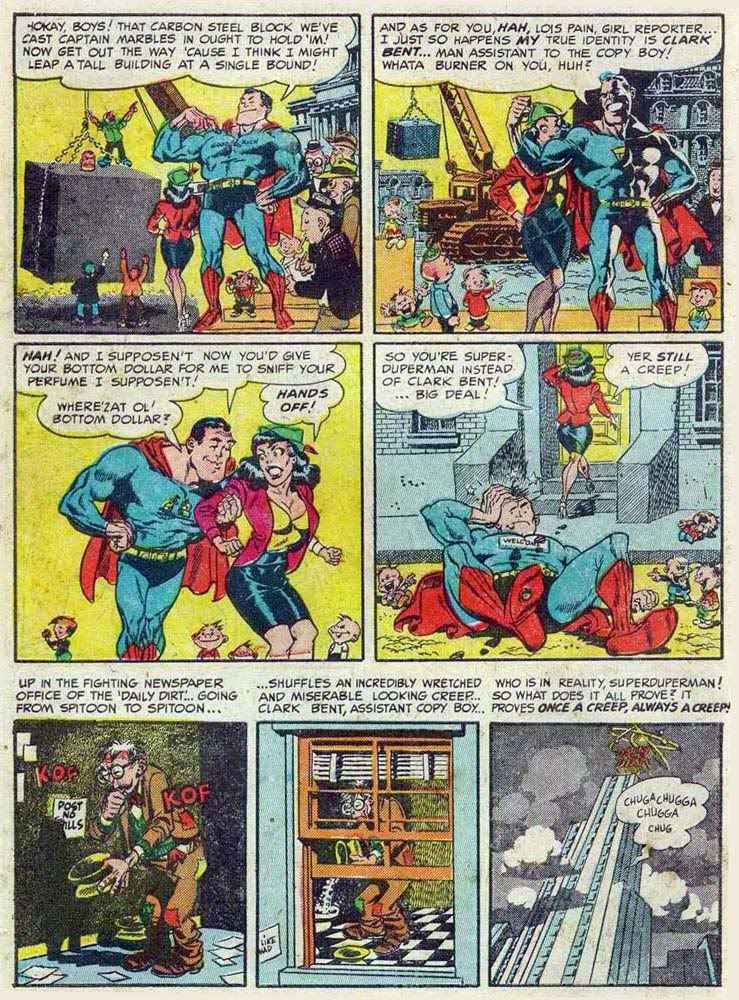
Link.
The Genius Of Beloved Leader
Who says he's so stupid?
Bush admits to Engel that going to war was a decision based on his personal instinct and not on any long-range strategy for the Mideast:Link.
“I know people are saying we should have left things the way they were, but I changed after 9/11. I had to act. I don’t care if it created more enemies. I had to act.”
***
And he says that Israeli Prime Minister Ehud Olmert is an obstacle to peace in the region:
“The problem is Olmert. This is a man who came to power on a promise that he was going to unilaterally define a Palestinian state. You can’t pressure democracies.”
***
“We can have meetings. Talking is not the problem. We can talk to Iran. But Iran wants nuclear weapons and I’m not going to let that happen. Not on my watch. We tried to have dialogue with Syria, right after the war, didn’t get much. * * "
What This Nation Needs; Another Drop Down The Slippery Slope Towards The Inevitable Christofascist State
First, in answer to the unasked question: Yes, it will be no good and an insult to everything this country's about. Everything.
So. Carolina's House & Senate have unanimously passed a bill allowing the creation of the faith plate. The license will feature a cross against a stained glass window with the words "I Believe" at the bottom. The ACLU, among others, is threatening suit.
A Pol One Can Almost Be Proud Of
And permit me to say, I would honestly be shocked to find this kind of honesty and lucidity amongst the GOP. Link.
Hey, wait a second! Here's the GOP's latest superstar/exemplar.
Hey, wait a second! Here's the GOP's latest superstar/exemplar.
Sad, Sad, Sad; Another Failure Of Big Media
By lying to us or failing to properly address what needs to be addressed, they alienate us and then cry about losing audience to the web, etc. Well, make yourself irrelevant....
This is kind of pathetic.
And, really, inexcusable.
As she points out, the truth was out there to be seen by anybody with open eyes.
Yet the professionals were blind or unwilling to see and acknowledge reality. And of what value are journalists like that?
None.
This is kind of pathetic.
And, really, inexcusable.
As she points out, the truth was out there to be seen by anybody with open eyes.
Yet the professionals were blind or unwilling to see and acknowledge reality. And of what value are journalists like that?
None.
When I first heard about Scott McClellan's charges that the Bush administration had lied and deceived Americans during the months and years leading up to the war, I burst into tears of happiness. No, nothing he wrote was new. And even if he still seems like a sleazy public relations expert in obfuscation, an insider was finally telling the truth, in one book.Link.
My story is different from those who felt seriously constrained about raising questions about the administration's obvious lies. I worked as an editorial writer at The San Francisco Chronicle, where a liberal editorial board raised serious objections to the war. And yet, in the years following 9/11, I felt editorial restraints that never allowed us to tell the whole truth about the lies and deception that led to America's most catastrophic foreign policy disaster.
Others in the mainstream media felt far greater restraints. Jessica Yellin, a CNN journalist, for example, says she felt pressured by corporate executives at her previous network to support the Iraq War. To Anderson Cooper, she described how she and others were "under enormous pressure from corporate executives, frankly, to make sure that this was a war presented in a way that was consistent with the patriotic fever in the nation and the president's high approval ratings." On the Today Show, Katie Couric, Brian Williams, and Charles Gibson also admitted feeling pressure from the Bush administration to support the war, MSNBC reported. Couric even recounted a threat from the White House Press Secretary to "block access to [the network] during the war" if she did not change the tone of her interviewing style."
So what did I experience? An editor and an editorial board who felt that, in the absence of inside sources, we could not counter the administration's lies.
Let me give you some examples. I was raised in a Republican family, but schooled by the great iconoclastic journalist I.F. Stone, who taught me that you can find the truth without inside sources, if only you're willing to see beyond patriotic fervor and examine voices in the public domain that are marginalized, So, I would read national security experts who countered Donald Rumfeld's ridiculous predictions; I would read the British, Canadian, Italian and French press; I would read the writings of experts in resource wars and weapons of mass destruction.
No, I didn't know I was right. But I was sure that the administration was lying. And, I knew that at the very least that our editorials should be asking why Bush, Cheney, Rumsfeld et al should be believed when I had found strong evidence that they were cherry picking intelligence, and setting up their own office in the Pentagon, and acting in complete secrecy.
The rush to war drove me crazy. In the days that led up to the war, I went to my editor and told him I needed a few days unpaid leave to accept the fact that we were, in fact, going to war. In my mind's eye, I saw a baby tied to the railroad tracks and saw the train rapidly moving toward the helpless child. I saw years of quagmire, bloodshed, and tens of thousands of deaths. I needed a few days to accept that reality before I could return to writing. He understood and allowed me to regain my professional composure.
To its credit, the editorial board raised some of the toughest questions in the mainstream media. And yet....I was the only one who didn't believe Colin Powell's shameful presentation at the United Nations. Why? Not because I had special insider knowledge, but like I.F. Stone, I had found credible people who could dissect his speech and found it unconvincing and unpersuasive.
When I heard Bush's inaugural address, I heard two major lies embedded within his speech. But somehow that still wasn't enough to accuse him of plagiarism and deception.
The truth is, even a liberal newspaper, blessed with a liberal editorial board, did not engage in truth telling. We raised some good questions, wrote about supporting the troops, but failed to describe the deception that led to the catastrophe that was unfolding right before our eyes.
While I was writing editorials, I was also publishing two weekly political columns on the op-ed page. I also felt constrained as a columnist. If I wanted to discuss this country's desire to gain control and access over oil, I had to bump up against the accusation that I was a vulgar Marxist, rather than conversant with the reality of resource wars.
Finally, I am an historian, and I knew Iraq's history. I also knew that the war would end in a disastrous occupation, not a liberation, and that no country, including our own, will ever tolerate occupation by a foreign nation.
This week, I sat with a former colleague from the editorial board in a café, rather than in the room where we used to make our editorial decisions. He admitted that I had been right, but even more, that even in a liberal paper, the editor and most of the board, had felt restrained, afraid of seeming unpatriotic, afraid of saying the emperor wore no clothes, afraid of not giving the President the benefit of the doubt, afraid of truth telling without access to inside sources.
You may say, "Ho Hum, even the Senate has now, after five years, come out with a report that describes (oh, so tepidly) the years of deception.
But for me, the tears flowed because I remembered all those years when I felt passionate about telling the public the truth, but was unable to do so in a mainstream, liberal, newspaper.

The Moral Corruption Of Our Leaders And Their Enablers
Maybe it has to do with amoral greed or something... the mise en scene seems to be the loss of a moral balance or something.
Anyway.
A practically current case study, as it were.
Apologies: a major moral failing that Joe Lieberman has failed to bring to light. So if Joe hasn'r ragged on it, I guess I must be wrong.
Anyway.
A practically current case study, as it were.
Apologies: a major moral failing that Joe Lieberman has failed to bring to light. So if Joe hasn'r ragged on it, I guess I must be wrong.
The World's Greatest Leaders
Chapter MDCXLIII of "Our Leaders' Belief In Government As A Source Of Funds To Re-Distribute For Their Benefit And The Benefit Of Their Big Wealth Supporters":
Federal prosecutors are aiming to block the sale of the home of Christopher J. Ward, former treasurer of the National Republican Congressional Committee, over allegations that he shifted over $500,000 from Senate Republicans into his personal accounts over a four-year period to make mortgage payments and fund remodeling jobs.Link.
According to the Department of Justice and an internal NRCC audit stemming from its accusations against Ward in March, he began embezzling in 2003. $198,841 in particular has been isolated by investigators, $95,000 of which is said to be from the 2006 President's Dinner, to pay for work done on Ward's house. Also diverted, say court documents, was $72,000 to make mortgage payments.
Ward, under investigation by the FBI, has been relieved of his duties with the NRCC but has yet to be charged criminally. Five GOP-connected organizations so far have implicated Ward in the misappropriation of at least $47,000, a far cry from what could have gone missing from the NRCC; an internal audit there suggests a figure of up to $600,000, but that audit is still in progress, said Karen Hanretty, NRCC's communications director.
Ward worked for the NRCC starting in November of 1995, taking on the role of treasurer in 2003. He stepped down in July of 2007 but stayed on as a consultant until January 28, 2008, when it was discovered that he was not auditing NRCC's 2006 finances as previously believed. An internal investigation by Chairman Tom Cole revealed that the last calendar year successfully audited was 2001, with Ward fabricating reports for 2002 through 2006.
How President McCain Will Get Elected: Lies, Lies, Lies
If truth be told, however, Obama earned his Ivy League degrees the hard way, while the child of privilege in this year’s presidential contest is John McCain. McCain obtained his appointment to the U.S. Navy Academy because his father and grandfather had been there, and McCain’s path to the Senate was made easy because his predecessor, Barry Goldwater, liked his father, Admiral Jack McCain.Link.
Yet McCain always passes over his privileged history, while making much of the fact that he finished at the bottom of his class at Annapolis to establish his bona fides as a regular guy. In addition, McCain invokes his laudable Vietnam POW experience as evidence of his physical toughness and stamina, qualities to which regular guys can easily aspire.
***
Overall, the Times’ report suggests that to get elected president today the candidate must “make an emotional connection [with average American voters]” which helps to win their “trust and confidence” – which are essential. Trust and confidence are not won by academic pedigree or prestigious educational success. To the contrary, for (too) many voters, it is necessary to shed such accomplishments to win this kind of loyalty. Ivy League degrees are considered by many as indicia of arrogance and privilege (whether such qualities belong to the degreeholder or not).
***
Dr. Westen also addressed the emotionally-loaded question of race in passing in The Political Brain. He explains that Obama, like every African-American candidate for Senate or President in the near future, needs to study the effectively-orchestrated Republican campaign run against Congressman Harold Ford (also an African-American), when he sought to win a Senate seat in Tennessee in 2006. It was a “psychologically sophisticated” undertaking built on racism. It worked. And Republicans got away with it, paying no price for their underhanded tactics, but rather winning a Senate seat.
The Democrats were fearful of talking about race in the Ford campaign, Westen observes. This was a mistake. They failed to call attention to the racist campaign being waged against them, and they did not call the GOP on its morally reprehensive decision to play to people’s prejudice. The same kid of racist campaign has already started with Obama, and if the Obama campaign and his supporters do not call attention to it, John McCain will gain an easy victory, only to bring us the third term of the Bush/Cheney Administration.
Subscribe to:
Posts (Atom)

