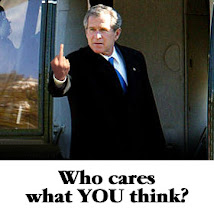
1. The disappearing drawdown: As we noted Friday, the size of the Bush-Petraeus troop withdrawal is shrinking even before it begins. Need proof? Last Tuesday, the Washington Post talked of a "conditions based" drawdown of "35,0000 to 50,000 troops." By Sunday, the Post was saying that Petraeus had proposed "withdrawing more than 20,000 troops from Iraq."
2. The backtracking defense secretary: At a press conference Friday, Robert Gates said it would be his "hope" that the troop drawdown to be made in the first half of 2008 would continue at the same pace through the second half of 2008. When a reporter asked Gates if the result of the drawdowns for which he hoped would be 100,000 U.S. troops in Iraq by the end of 2008, Gates said: "That would be the math." But when Fox's Chris Wallace asked Gates about those comments Sunday, the defense secretary got a little wobbly. He stressed that he never uttered the number "100,000" himself, and he suggested that there's doubt about even the initial drawdowns Petreaus has proposed and Bush has endorsed. "What I said was that I hoped the conditions would improve in Iraq to the extent that not only could we complete the drawdowns that Gen. Petraeus has said he would like to make between now and July, but also that they could continue thereafter," Gates explained.
3. The wary defense secretary: Although there may be bipartisan support in Congress for a bill that would guarantee troops more time between deployments to Iraq, Gates said Sunday that he would urge the president to veto any such measure if one gets to his desk. "If it were enacted," Gates said, "we would have force management problems that would be extremely difficult and, in fact, affect combat effectiveness and perhaps pose greater risk to our troops." If that sounds familiar, maybe it's because Petraeus said last week that he'd be "uncomfortable" with the idea of Congress' writing his proposed troop drawdown into law.
4. The undercutting advertisement: If we're having so much "success" in Iraq, the Post's Walter Pincus wonders why Petraeus' commanders have begun advertising for private contractors to take over supply operations that soldiers are too busy to handle. In a request for bids sent out earlier this month, Petraeus' commanders say "increased insurgent activity" -- hello? -- means that the soldiers who would otherwise be staffing combat-supply warehouses in Iraq "must continue to pull force protection along with convoy escort and patrol duties."
Tuesday, September 18, 2007
Our Leaders' Flip Flops for the Day
Well, likely there were more, but these will have to do....


Flippy-Floppy Straight Talk from St. John McCain
The Wall Street Journal says John McCain's presidential campaign is making a comeback as it tries to ride "what it perceives to be a sentiment among Republicans that the war in Iraq is turning around."Link.
The Journal acknowledges that McCain's "war pitch is a complex one." "He hammers on how he was among the first Republicans to blast what he calls 'the Rumsfeld strategy' of trying to subdue Iraq with limited means," the Journal explains. "As far back as 2003, Mr. McCain argued that the U.S. needed far more troops in Iraq -- a message, he argues, that the Bush administration didn't hear until the start of this year, pursuing until then a strategy he says was 'doomed to failure.'"
Truth be told, it's all a little more "complex" than that. While McCain may have argued for more troops at the beginning of the war, he seemed pretty solidly in line behind the Rumsfeld strategy as things progressed. Here's McCain on Iraq in 2004: "I'm confident we're on the right course." And here's McCain on Iraq in 2005: "Overall, I think a year from now, we will have made a fair amount of progress if we stay the course."
The Journal doesn't mention McCain's flip-flopping on Iraq. But that's OK, neither does he. In an interview with MSNBC's Joe Scarborough this morning, the senator declared that he broke with Bush and Rumsfeld on Iraq "from the beginning, after traveling over there in 2003. And I said that the strategy would fail."
Defeatist of the Day; The Paper Tiger Makes a Crumply Noise....
Every effort should be made to stop Iran from obtaining nuclear weapons, but failing that, the world could live with a nuclear-armed regime in Tehran, a recently retired commander of U.S. forces in the Middle East said Monday.[more]
John Abizaid, the retired Army general who headed Central Command for nearly four years, said he was confident that if Iran gained nuclear arms, the United States could deter it from using them.
"Iran is not a suicide nation," he said. "I mean, they may have some people in charge that don't appear to be rational, but I doubt that the Iranians intend to attack us with a nuclear weapon."
The Iranians are aware, he said, that the United States has a far superior military capability.
"I believe that we have the power to deter Iran, should it become nuclear," he said, referring to the theory that Iran would not risk a catastrophic retaliatory strike by using a nuclear weapon against the United States.
"There are ways to live with a nuclear Iran," Abizaid said in remarks at the Center for Strategic and International Studies, a think tank. "Let's face it, we lived with a nuclear Soviet Union, we've lived with a nuclear China, and we're living with (other) nuclear powers as well."
Monday, September 17, 2007
Greenie: How He Dissembles; We Report, You Decide
He whines:
After nearly two decades as chairman of the Federal Reserve, Alan Greenspan wants to solidify his standing in history.He's nailed by Prof. Krugman:
In an interview timed with the release of his memoir Monday, Mr. Greenspan sought to distance himself from the economic policies of President Bush and refute critics who say his policies at the Fed contributed to the housing bubble and bust that is now roiling the economy.
Mr. Greenspan unleashed bottled-up frustration about President Bush, Vice President Dick Cheney and Republican leaders in Congress who, he contends, put politics ahead of Republican goals like fiscal discipline and lower government spending.
“I’m just very disappointed,” he said glumly, as he sat in his living room. “Smaller government, lower spending, lower taxes, less regulation — they had the resources to do it, they had the knowledge to do it, they had the political majorities to do it. And they didn’t.”
In the end, he said, “political control trumped policy, and they achieved neither political control nor policy.”
Mr. Greenspan, a lifelong Republican who presided over the longest sustained economic expansion in American history, sounded frustrated that neither a Republican White House nor Republican leaders in Congress were heeding his quiet pleas for greater fiscal discipline.
Mr. Greenspan said he met frequently at the White House with President Bush and Vice President Cheney, but his enthusiasm for the new administration cooled as he discovered that Mr. Bush ignored much of his advice.
In his first term, Mr. Bush would rarely let a week go by without visiting a small business or a camera-friendly factory to extol entrepreneurship or the importance of tax cuts. But back at the White House, Mr. Greenspan got virtually no response to his advice that the president veto spending bills. Mr. Greenspan said he was told his recommendations would be “taken under advisement.”
His observations are in line with those of others who engaged Mr. Bush frequently, including the former Treasury secretary, Paul H. O’Neill, who was fired in December 2002. After the Sept. 11 attacks, they said, Mr. Bush would become animated and even passionate about counterterrorism or the war in Iraq. But they said that broader economic discussions bored him, unless he could take them to the factory floor.
Mr. Greenspan has always been acutely aware of the explosive impact that his public comments could have in both political and economic circles. He never criticized specific Republican or Democratic politicians while he was at the Federal Reserve, even when he was under attack from one side or the other.
But in the interview, Mr. Greenspan seemed dismayed that leaders in his own party paid little heed to his pleas for spending restraint and for “pay-as-you-go” rules that would require Congress to offset the cost of new tax cuts with savings elsewhere. He repeated the conclusion about the Republicans’ loss of Congressional control in the 2006 elections: “They deserved to lose.”
Mr. Greenspan also spelled out his own views about the war in Iraq: he supported the invasion, he says, not because Saddam Hussein might have had weapons of mass destruction, but because Saddam had shown a clear desire to capture the Middle East’s oil fields.
“I supported taking out Saddam, because he was moving inexorably toward taking the world’s oil resources,” he said. “Iraq was a far greater threat than Iran to the world scene.”
But Mr. Greenspan also seemed intent on protecting his reputation in history about a debacle that is a focus of his successors at the Federal Reserve: the housing bubble that peaked while he was chairman of the Fed and the bust that now threatens to tip the overall economy into a recession.
Though he says little about the issue in his book, “The Age of Turbulence: Adventures in a New World,” (Penguin Press, $35) Mr. Greenspan sought to staunchly refute charges that he contributed to the housing bubble by cutting interest rates from 2001 until 2004 and by making little effort to regulate the explosion of risky new mortgages.
On Tuesday, after a month of almost unremitting turmoil in financial markets, Ben S. Bernanke, Mr. Greenspan’s successor as Fed chairman, will preside over a crucial Fed policy meeting to decide whether and how much to lower interest rates in order to prevent a broader economic downturn.
Mr. Greenspan, 81, acknowledged that the housing frenzy had been pumped up in part because of very low interest rates and in part because of the growing willingness of mortgage lenders to underwrite dubious and often fraudulent loans that were much bigger than many borrowers could realistically afford.
But he said it was a mistake to blame the Fed, which needed to reduce interest rates in order to fend off the recession of 2001 and what many economists thought was a real risk of the kind of “deflation,” an across-the-board drop in consumer prices, that had plagued Japan.
John B. Taylor, a professor of economics at Stanford University and a former under secretary of the Treasury under President Bush, recently argued that the Fed’s rate cuts after 2001 appeared to have exaggerated both the housing boom and bust.
“There has been a bit of historical revisionism going on,” Mr. Greenspan grumbled. The real force behind soaring real estate prices, he said, was a global one: a drop in worldwide inflation and interest rates, in part because of the end of the Cold War and the rise of China as a manufacturing colossus.
“The housing boom is not an American phenomenon — it’s a worldwide phenomenon,” Mr. Greenspan said. “The evidence is quite overwhelming that what we are going through is a consequence of the fall of the Soviet Union and the shift of a billion workers from central planning in to the labor market.”
The United States was only one of 40 countries that experience a housing boom after 2000, he said, and all of the booms were driven in part by low interest rates.
“If you line up all the major developed countries and all the developing countries, leaving out the Zimbabwes, inflation rates were all in single digits. This is utterly unprecedented, there is no history like this. And the consequence was a fairly dramatic decline in real interest rates, which created dramatic housing price increases around the world.”
When President Bush first took office, it seemed unlikely that he would succeed in getting his proposed tax cuts enacted. The questionable nature of his installation in the White House seemed to leave him in a weak political position, while the Senate was evenly balanced between the parties. It was hard to see how a huge, controversial tax cut, which delivered most of its benefits to a wealthy elite, could get through Congress.
Then Alan Greenspan, the chairman of the Federal Reserve, testified before the Senate Budget Committee.
Until then Mr. Greenspan had presented himself as the voice of fiscal responsibility, warning the Clinton administration not to endanger its hard-won budget surpluses. But now Republicans held the White House, and the Greenspan who appeared before the Budget Committee was a very different man.
Suddenly, his greatest concern — the “emerging key fiscal policy need,” he told Congress — was to avert the threat that the federal government might actually pay off all its debt. To avoid this awful outcome, he advocated tax cuts. And the floodgates were opened.
As it turns out, Mr. Greenspan’s fears that the federal government would quickly pay off its debt were, shall we say, exaggerated. And Mr. Greenspan has just published a book in which he castigates the Bush administration for its fiscal irresponsibility.
Well, I’m sorry, but that criticism comes six years late and a trillion dollars short.
Mr. Greenspan now says that he didn’t mean to give the Bush tax cuts a green light, and that he was surprised at the political reaction to his remarks. There were, indeed, rumors at the time — which Mr. Greenspan now says were true — that the Fed chairman was upset about the response to his initial statement.
But the fact is that if Mr. Greenspan wasn’t intending to lend crucial support to the Bush tax cuts, he had ample opportunity to set the record straight when it could have made a difference.
His first big chance to clarify himself came a few weeks after that initial testimony, when he appeared before the Senate Committee on Banking, Housing and Urban Affairs.
Here’s what I wrote following that appearance: “Mr. Greenspan’s performance yesterday, in his first official testimony since he let the genie out of the bottle, was a profile in cowardice. Again and again he was offered the opportunity to say something that would help rein in runaway tax-cutting; each time he evaded the question, often replying by reading from his own previous testimony. He declared once again that he was speaking only for himself, thus granting himself leeway to pronounce on subjects far afield of his role as Federal Reserve chairman. But when pressed on the crucial question of whether the huge tax cuts that now seem inevitable are too large, he said it was inappropriate for him to comment on particular proposals.
“In short, Mr. Greenspan defined the rules of the game in a way that allows him to intervene as he likes in the political debate, but to retreat behind the veil of his office whenever anyone tries to hold him accountable for the results of those interventions.”
I received an irate phone call from Mr. Greenspan after that article, in which he demanded to know what he had said that was wrong. In his book, he claims that Robert Rubin, the former Treasury secretary, was stumped by that question. That’s hard to believe, because I certainly wasn’t: Mr. Greenspan’s argument for tax cuts was contorted and in places self-contradictory, not to mention based on budget projections that everyone knew, even then, were wildly overoptimistic.
If anyone had doubts about Mr. Greenspan’s determination not to inconvenience the Bush administration, those doubts were resolved two years later, when the administration proposed another round of tax cuts, even though the budget was now deep in deficit. And guess what? The former high priest of fiscal responsibility did not object.
And in 2004 he expressed support for making the Bush tax cuts permanent — remember, these are the tax cuts he now says he didn’t endorse — and argued that the budget should be balanced with cuts in entitlement spending, including Social Security benefits, instead. Of course, back in 2001 he specifically assured Congress that cutting taxes would not threaten Social Security.
In retrospect, Mr. Greenspan’s moral collapse in 2001 was a portent. It foreshadowed the way many people in the foreign policy community would put their critical faculties on hold and support the invasion of Iraq, despite ample evidence that it was a really bad idea.
And like enthusiastic war supporters who have started describing themselves as war critics now that the Iraq venture has gone wrong, Mr. Greenspan has started portraying himself as a critic of administration fiscal irresponsibility now that President Bush has become deeply unpopular and Democrats control Congress.
Something to be Proud About
Chafee reaalizes GOP not conservative organization anymore, quits party -- quietly....
Indian Innovation
Indians do innovate. It's not just call centers and writing tedious code....
"Five nine, five ten," said the research student, pushing down a laptop button to seal the measurement. "That's your height."Link.
"Spot on," I said.
"OK, we're freezing you now," interjected another student, studying his computer screen. "So we have height and tracking and your gait DNA".
"Gait DNA?" I interrupted, raising my head, so inadvertently my full face was caught on a video camera.
"Have we got that?" asked their teacher Professor Rama Challapa. "We rely on just 30 frames - about one second - to get a picture we can work with," he explained.
Tracking individuals
I was at Maryland University just outside Washington DC, where Professor Challapa and his team are inventing the next generation of citizen surveillance.
They had pushed back furniture in the conference room for me to walk back and forth and set up cameras to feed my individual data back to their laptops.
Gait DNA, for example, is creating an individual code for the way I walk. Their goal is to invent a system whereby a facial image can be matched to your gait, your height, your weight and other elements, so a computer will be able to identify instantly who you are.
"As you walk through a crowd, we'll be able to track you," said Professor Challapa. "These are all things that don't need the cooperation of the individual."
Since 9/11, some of the best scientific minds in the defence industry have switched their concentration from tracking nuclear missiles to tracking individuals such as suicide bombers.
Surveillance society
My next stop was a Pentagon agency whose headquarters is a drab suburban building in Virginia. The Defence Advanced Research Projects Agency (Darpa) had one specific mission - to ensure that when it comes to technology America is always ahead of the game.
Its track record is impressive. Back in the 70s, while we were working with typewriters and carbon paper, Darpa was developing the internet. In the 90s, while we pored over maps, Darpa invented satellite navigation that many of us now have in our cars.
"We ask the top people what keeps them awake at night," said its enthusiastic and forthright director Dr Tony Tether, "what problems they see long after they have left their posts."
"And what are they?" I asked.
He paused, hand on chin. "I'd prefer not to say. It's classified."
"All right then, can you say what you're actually working on now."
"Oh, language," he answered enthusiastically, clasping his fingers together. "Unless we're going to train every American citizen and soldier in 16 different languages we have to develop a technology that allows them to understand - whatever country they are in - what's going on around them.
"I hope in the future we'll be able to have conversations, if say you're speaking in French and I'm speaking in English, and it will be natural."
"And the computer will do the translation?"
"Yep. All by computer," he said.
"And this idea about a total surveillance society," I asked. "Is that science fiction?"
"No, that's not science fiction. We're developing an unmanned airplane - a UAV - which may be able to stay up five years with cameras on it, constantly being cued to look here and there. This is done today to a limited amount in Baghdad. But it's the way to go."
Smarter technology
Interestingly, we, the public, don't seem to mind. Opinion polls, both in the US and Britain, say that about 75% of us want more, not less, surveillance. Some American cities like New York and Chicago are thinking of taking a lead from Britain where our movements are monitored round the clock by four million CCTV cameras.
So far there is no gadget that can actually see inside our houses, but even that's about to change.
Ian Kitajima flew to Washington from his laboratories in Hawaii to show me sense-through-the-wall technology.
"Each individual has a characteristic profile," explained Ian, holding a green rectangular box that looked like a TV remote control.
Using radio waves, you point it a wall and it tells you if anyone is on the other side. His company, Oceanit, is due to test it with the Hawaiian National Guard in Iraq next year, and it turns out that the human body gives off such sensitive radio signals, that it can even pick up breathing and heart rates.
"First, you can tell whether someone is dead or alive on the battlefield," said Ian.
"But it will also show whether someone inside a house is looking to harm you, because if they are, their heart rate will be raised. And 10 years from now, the technology will be much smarter. We'll scan a person with one of these things and tell what they're actually thinking."
He glanced at me quizzically, noticing my apprehension.
"Yeah, I know," he said. "It sounds very Star Trekkish, but that's what's ahead."
What a Surprise! Walter Reed is Still a Mess!!
Almost Home, But Facing More Delays at Walter Reed
By Dana Priest and Anne Hull
The Washington Post
Saturday 15 September 2007
Soldier is told paperwork errors will slow retirement.
After nearly three years as an outpatient at Walter Reed Army Medical Center, Staff Sgt. John Daniel Shannon had begun the wrenching process of turning himself into a civilian.
He no longer wore the uniform he loved so much. He sported a short beard and traded his black beret for a baseball cap. Granted a 30-day leave to prepare for retirement as his disability case finally made it through the system, he moved his family to Suffolk, Va., and began to babysit his two kids, clean the house and grow vegetables. Given what had happened to him in Iraq - the traumatic brain injury from an AK-47 round that shattered one eye and half his skull - and the chronic post-traumatic stress disorder that followed, that was about all he could handle.
Last week, Shannon, 43, was back at Walter Reed, but not to say goodbye. The doctors' signatures on two time-sensitive forms in his disability file had expired. He would have to be reexamined by his doctors, he was told, and his medical summaries would have to be written all over again. Unfortunately, the sergeant in charge of his disability paperwork had not stayed on top of his case.
"There was a failure of paying attention to the currency of his paperwork," a Walter Reed spokesman, Charles Dasey, said last night.
The bottom line: No one could tell Shannon when he might go back to his family, transfer into the Veterans Affairs medical system and move on with his life.
After a Washington Post story in February described the conditions that Shannon and other wounded soldiers at Walter Reed endured after returning from Iraq, Shannon became something of a spokesman for his fellow patients.
He testified before a congressional hearing about the Army's obligation to care for its wounded. Members of Congress and generals shook Shannon's hand and thanked him for his courage, while President Bush and Defense Secretary Robert M. Gates promised swift changes. Three panels were set up to study not only Walter Reed's failures, but the entire overburdened military medical-care system for returning soldiers and Marines five years into war.
But none of that kept Shannon from getting caught up again in military bureaucracy.
"It's like being kicked in the teeth by a horse," Shannon said this week in a phone interview, alone in his room at Walter Reed. "I've been sitting here for three years. I don't even know what 'going on with my life' means. I want to scream at the top of my lungs. I'm at the end of my rope."
While Shannon, a senior sniper in Iraq, began speaking at public events and counseling other soldiers about the cumbersome Army disability process, he was quietly fighting his own battles.
The case manager assigned to shepherd him through the system was hard to reach. He couldn't get straight answers about his future. Appointments were still difficult to make. Finally, as his discharge seemed imminent, a cascading set of errors and inattention ensured the delay of his release. "It's been 33 months," he said. "What kind of beer are they drinking?"
After The Post's stories in February, the Army moved swiftly to fix the outpatient system. It created a new brigade structure to oversee the wounded and brought in combat infantry officers to run it. More platoon sergeants and case managers were added to give more individual service. Building 18, the moldy and mouse-ridden barracks for wounded outpatients, was closed, and soldiers moved into new living quarters with flat-panel TVs and computers.
But some soldiers still complain of lost paperwork and delays in appointments. In June, one dorm was without air conditioning. Up and down a sweltering hallway, soldiers used fans and kept their doorways open to ease the summer heat.
At a town hall meeting in July, soldiers vented their frustration over a variety of issues to Maj. Gen. Eric B. Schoomaker, Walter Reed's commander. One mother said that her son had been given discharge papers to sign with no explanation of his options. Other soldiers complained about an orthopedic surgeon, saying the doctor had been repeatedly "abusive and demeaning to patients" during the medical disability process and should be fired.
This week Shannon praised the new brigade; his company commander, Capt. Steven Gventer; and the medical and psychological care he has received. For Shannon and others, including some commanders, the disability process remains the largest source of anger. A presidential commission suggested doing away with the Army's long evaluation process - which must essentially be redone by the Department of Veterans Affairs before any VA benefits can be calculated. But that has not happened.
In his time at Walter Reed, Shannon has had six different disability case managers assigned to him.
His latest round of bad news involved his current disability case manager. In August, the manager called Shannon in Suffolk to say that one important document was missing Shannon's signature. This would delay his retirement date.
Shannon was livid. It had been two months since his final surgery, and the process should have been close to completion.
"The files just sat there," he said. "When it got ready to go to the [evaluation] board, he noticed they weren't signed. Why was it so hard for him to do this job?"
The case manager informed Shannon that he himself was in the process of retiring and would be hard to reach, but he said he would fax Shannon the Army Form 3947 for his signature. The fax never arrived. Shannon said he could not reach the counselor, Sgt. 1st Class Allen Domingo, the next dozen times he tried.
Shannon and his wife were plunged into despair. Torry Shannon, who had spent two years caring for her husband and children at Walter Reed, had just started a house-cleaning business in Suffolk.
The delay and sense of neglect seemed an echo of their early days at Walter Reed, when Shannon, with a bandaged head from surgery and on heavy pain medications, was released from the hospital with nothing more than a map and told to find his room across post by himself. He had sat for weeks without appointments and without anyone to check on him. The family had almost gone broke. At one point they lived five to a tiny room.
Shannon, struggling with post-traumatic stress, was so angry that he broke things around the house, including his new Bluetooth earphone, which he smashed just thinking about all the new obstacles. His PTSD had been triggered, as it had been before, by the thought of soldiers treated disrespectfully. "It's about whether we're important enough," he said.
Last Friday, Domingo phoned Shannon with even worse news. Some of the doctors' signatures on some key paperwork - narrative medical evaluations of his disabilities - had expired. Shannon would have to make new appointments, get new signatures and be reevaluated.
Shannon checked back into a room at Walter Reed.
"I'm going to lose it. He's going to lose it," Torry Shannon said Tuesday morning. "He's cycling up again, and I've become a single parent in a 24-hour period. I just opened up a business. There's no one to watch the kids. . . . I want my husband home."
When Shannon tried to reach Domingo again for some explanation, the voice mail message told him what Domingo had not: "I will be out of the office from 10 to 14 September. I will be involved in transitional, retirement . . . training . . . please leave number and message. . . . Have a fine Army day."
Dasey, the Walter Reed spokesman, said Domingo was kept on the case for the sake of continuity. "Sergeant Domingo already has established a relationship with Sergeant Shannon," he said.
Domingo could not be reached for comment.
Dasey said Army officials determined last night that Shannon's paperwork is still valid and they would send his case on to the medical evaluation board, the last step in determining Army disability pay and benefits, on Monday. He said additional appointments with doctors would not be necessary. He could not explain how Domingo had made such a mistake.
Shannon said he would like to take over his case manager's job. He wants to make sure that other soldiers at Walter Reed, all younger and less outspoken, get the treatment they deserve. "I wish I could take his job so I could kick some doors in and say, 'Hey! What's going on here!' "
Link.
And Something Greenie Got Right, Sort of....
Greenspan's true genius is that he was often kind of right, just not as infallible and omniscient as the pigs on Wall Street wanted to believe. His great accomplishments were to fuel bubbles, which is to say he was too good at pumping the economy (which, at the right level, is of course a good thing).
So here's Greenie -- five years too late -- on Iraq:
And more on Greenie's foreign policy acuity:
So here's Greenie -- five years too late -- on Iraq:
AMERICA’s elder statesman of finance, Alan Greenspan, has shaken the White House by declaring that the prime motive for the war in Iraq was oil.Of course, we shouldn't forget the desire for bases -- maybe even as back-up for when Saudi Arabia goes all Iran....
In his long-awaited memoir, to be published tomorrow, Greenspan, a Republican whose 18-year tenure as head of the US Federal Reserve was widely admired, will also deliver a stinging critique of President George W Bush’s economic policies.
However, it is his view on the motive for the 2003 Iraq invasion that is likely to provoke the most controversy. “I am saddened that it is politically inconvenient to acknowledge what everyone knows: the Iraq war is largely about oil,” he says.
Greenspan, 81, is understood to believe that Saddam Hussein posed a threat to the security of oil supplies in the Middle East.
Britain and America have always insisted the war had nothing to do with oil. Bush said the aim was to disarm Iraq of weapons of mass destruction and end Saddam’s support for terrorism.
And more on Greenie's foreign policy acuity:
Greenspan Spills the Beans on Oil
By Ray McGovern
September 16, 2007
For those still wondering why President George W. Bush and Vice President Dick Cheney sent our young men and women into Iraq, the secret is now “largely” out.
No, not from the lips of former Secretary of State Colin Powell. It appears we shall have to wait until the disgraced general/diplomat draws nearer to meeting his maker before he gets concerned over anything more than the “blot” that Iraq has put on his reputation.
Rather, the uncommon candor comes from a highly respected Republican doyen, economist Alan Greenspan, chairman of the Federal Reserve from 1987 to 2006, whom the president has praised for his “wise policies and prudent judgment.”
Sadly for Bush and Cheney, Greenspan decided to put prudence aside in his new book, The Age of Turbulence, and answer the most neuralgic issue of our times—why the United States invaded Iraq.
Greenspan writes:
“I am saddened that it is politically inconvenient to acknowledge what everyone knows: the Iraq war is largely about oil.”
Everyone knows? Would that it were so. But it’s hardly everyone.
There are so many, still, who “can’t handle the truth,” and that is understandable. I have found it a wrenching experience to conclude that the America I love would deliberately launch what the Nuremburg Tribunal called the “supreme international crime”—a war of aggression—largely for oil.
For those who are able to overcome the very common, instinctive denial, for those who can handle the truth, it really helps to turn off the Sunday football games early enough to catch up on what’s going on.
There they could have seen another of Bush’s senior economic advisers, former Treasury Secretary Paul O’Neill on Jan. 11, 2004, discussing The Price of Loyalty, his memoir about his two years inside the Bush administration.
O’Neill, a plain speaker, likened the president’s behavior at cabinet meetings to that of “a blind man in a roomful of deaf people.” Cheney and “a praetorian guard that encircled the president” would help Bush make decisions off-line, blocking contrary views.
Cheney has a Rumsfeldian knack for aphorisms that don’t parse in the real world— like “deficits don’t matter.” To his credit, O’Neill picked a fight with that and ended up being fired personally by Cheney. In his book, Greenspan heaps scorn on the same Cheneyesque insight.
O’Neill made no bones about his befuddlement over the president’s diffident disengagement from discussions on policy, except, that is, for Bush’s remarks betraying a pep-rally-cheerleader fixation with removing Saddam Hussein and occupying Iraq.
Why Iraq? 'Largely Oil'
O’Neill began to understand right after Bush’s inauguration when the discussion among his top advisers abruptly moved to how to divvy up Iraq’s oil wealth.
Just days into the job, President Bush created the Cheney energy task force with the stated aim of developing “a national energy policy designed to help the private sector.” Typically, Cheney has been able to keep secret its deliberations and even the names of its members.
But a Freedom of Information Act lawsuit forced the Commerce Department to turn over task force documents, including a map of Iraqi oilfields, pipelines, refineries, terminals, and potential areas for exploration; a Pentagon chart “Foreign Suitors for Iraqi Oilfield Contracts”; and another chart detailing Iraqi oil and gas projects—all dated March 2001.
On the 60 Minutes program on Dec. 15, 2002, Steve Croft asked then-Defense Secretary Donald Rumsfeld, “What do you say to people who think this [the coming invasion of Iraq] is about oil?” Rumsfeld replied:
“Nonsense. It just isn’t. There—there—there are certain............. things like that, myths that are floating around. I’m glad you asked. I—it has nothing to do with oil, literally nothing to do with oil.”
Au Contraire
Greenspan’s indiscreet remark adds to the abundant evidence that Iraq oil, and not weapons of mass destruction, was the priority target long before the Bush administration invoked WMD as a pretext to invade Iraq.
In the heady days of “Mission Accomplished,” a week after the president landed on the aircraft carrier, then-Deputy Defense Secretary Paul Wolfowitz virtually bragged about the deceit during an interview.
On May 9, 2003, Wolfowitz told Vanity Fair:
“The truth is that for reasons that have a lot to do with the U.S. government bureaucracy, we settled on the one issue that everyone could agree on, which was weapons of mass destruction as the core reason...”
During a relaxed moment in Singapore later that same month, Wolfowitz reminded the press that Iraq “floats on a sea of oil,” and thus added to the migraine he had already given folks in the White House PR shop.
But wait. For those of us absorbing more than Fox channel news, the primacy of the oil factor was a no-brainer.
The limited number of invading troops were ordered to give priority to securing the oil wells and oil industry infrastructure immediately and let looters have their way with just about everything else (including the ammunition storage depots!).
Barely three weeks into the war, Rumsfeld famously answered criticism for not stopping the looting: “Stuff happens.” No stuff happened to the Oil Ministry.
Small wonder that, according to O’Neill, Rumsfeld tried hard to dissuade him from writing his book and has avoided all comment on it. As for Greenspan’s book, Rumsfeld will find it easier to dodge questions from the Washington press corps from his sinecure at the Hoover Institute at Stanford.
Eminence Grise...or Oily
But the other half of what Col. Larry Wilkerson, Colin Powell’s former chief of staff at the State Department, calls the “Cheney-Rumsfeld cabal” is still lurking in the shadows.
What changed Cheney’s attitude toward Iraq from his sensible remark in 1992 when then-Defense Secretary Cheney defended President George H.W. Bush's decision in 1991 not to follow up the expulsion of Iraqi troops from Kuwait with the ouster of Saddam Hussein and the conquest of Iraq.
“How many additional American casualties is Saddam worth?” Cheney asked in August 1992. “Not that damned many. So I think we got it right...when the president made the decision that we were not going to go get bogged down in the problems of trying to take over and govern Iraq.”
Then, there were Cheney’s revealing, damning remarks as Halliburton's CEO?
“Oil companies are expected to keep developing enough oil to offset oil depletion and also to meet new demand,” Cheney said in autumn 1999. “So where is the oil going to come from? Governments and the national oil companies are obviously in control of 90 percent of the assets. Oil remains fundamentally a government business. The Middle East with two-thirds of the world’s oil and the lowest cost is still where the prize ultimately lies.”
Not only Cheney, but also many of the captains of the oil industry were looking on Iraq with covetous eyes before the war.
Most forget that the Bush/Cheney administration came in on the heels of severe shortages of oil and natural gas in the U.S., and the passing of a milestone at which the United States had just begun importing more than half of the oil it consumes.
One oil executive confided to a New York Times reporter a month before the war: “For any oil company, being in Iraq is like being a kid in F.A.O. Schwarz.”
There were, to be sure, other factors behind the ill-starred attack on Iraq—the determination to acquire permanent military bases in the area, for one. But that factor can be viewed as a subset of the energy motivation.
In other words, the felt need for what the Pentagon prefers to call “enduring” military bases in the Middle East is a function of its strategic importance which is a function—you guessed it, a function of its natural resources. Not only oil, but natural gas and water as well.
In my opinion, the other major factor in the Bush/Cheney decision to make war on Iraq was the misguided notion that this would make that part of the world safer for Israel.
Indeed, the so-called “neo-conservatives” still running U.S. policy toward the Middle East continue to have great difficulty distinguishing between what they perceive to be the strategic interests of Israel and those of the United States.
Why Are Americans Silent?
Could it be that many Americans remain silent because we are unwilling to recognize the Iraq war as the first of the resource wars of the 21st century; because we continue to be comfortable hogging far more than our share of the world’s resources and will look the other way if our leaders tell us that aggressive war is necessary to protect that siren-call, “our way of life,” from attack by those who are just plain jealous?
Perhaps a clue can be found in the remarkable reaction I received after a lecture I gave two and a half years ago in a very affluent suburb of Milwaukee. I had devoted much of my talk to what I consider the most important factoid of this century: the world is running out of oil.
Afterwards some 20 folks lingered in a small circle to ask follow-up questions. A persistent, handsomely dressed man, who just would not let go, dominated the questioning:
"Surely you agree that we need the oil. Then what's your problem? Some 1,450 killed thus far are far fewer than the toll in Vietnam where we lost 58,000; it's a small price to pay... a sustainable rate to bear. What IS your problem?"
I asked the man if he would feel differently if one of those (then) 1,450 killed were his own son. Judging from his abrupt, incredulous reaction, the suggestion struck him as so farfetched as to be beyond his ken. “It wouldn’t be my son,” he said.
And that, I believe, is a HUGE part of the problem.
The God, Greenspan, is Another Liar; Who'd Have Guessed??
Alan Greenspan’s new book draws on extensive public records, transcripts, data, others’ books and accounts, interviews (many on background) he has previously given, interviews he has conducted with his contemporaries, and his personal notes and recollections. The resulting story is sweeping and fact-filled. Still, there are a few points where his assertions differ from the historical record or with his public statements at the time, though they do not change the overall story. (See related article.)Link.
For example, the former Fed chairman writes that he told President Gerald Ford that “recessions are like hurricanes — they range from ordinary to catastrophic.” He was relieved when the recession of 1974-75 turned out to be “the milder kind of storm.” But in fact, it was the most severe recession of the post-World War II period, according to the National Bureau of Economic Research, the official scorekeeper.
He recalls writing in a campaign speech for President Ronald Reagan that the 1980 recession had been “one of the major economic contractions in the last fifty years.” In fact, the NBER later determined it was the mildest. Mr. Greenspan points out in a subsequent interview that the point of his story is to show how Reagan went on to exaggerate what his speechwriters had said by referring to the “Carter depression,” despite their efforts to correct him.
Mr. Greenspan also describes the risks he was taking by moving to raise rates shortly after taking office in August, 1987 because the Fed “hadn’t raised interest rates for three years… The risk in clamping down during a stock-market surge is especially acute- it can pop the bubble of investor confidence.” In fact, Mr. Greenspan’s predecessor, Paul Volcker, had begun tightening monetary policy the prior fall, raising the federal funds rate a full percentage point, which in turn drove Treasury bond yields up over a point. The combined Volcker-Greenspan tightening undermined stock valuations, precipitating that fall’s crash.
It is true that the largely symbolic discount rate hadn’t risen in more than three years; Mr. Greenspan boosted it on Sept. 4. Mr. Greenspan, in the interview, notes at the time the discount rate mattered more than today because changes in the federal funds rate weren’t announced.
Mr. Greenspan, often criticized for not preventing the 1990 bull market from becoming a bubble, says he attempted to do just that in early 1997. He writes that he told the Federal Open Market Committee in February that “some sort of preemptive move” was needed to rein in the stock market. But an official transcript of that meeting clearly shows Mr. Greenspan was recommending a preemptive move against inflation, not stocks. In his book he quotes himself as saying, “What we are trying to avoid is bubbles that break,” but in fact he said that at the next meeting, in March, and the context suggests he was arguing against, rather than for, raising rates to damp stocks.
In the interview, Mr. Greenspan says regardless of the motivation for the Fed’s rate increase then, the fact that stocks soared even higher afterwards only proves his larger point that incremental rate increases can’t defuse a bubble.
He writes that when the Fed cut rates to 1%, it knew a possible risk was “we might foster a bubble.” At least one former colleague confirmed hearing Mr. Greenspan express such concerns. But publicly Mr. Greenspan dismissed such a possibility. “My own sense is we don’t have to worry much about the emergence of bubbles for a while because it takes a number of years for the trauma of the collapse [of the last bubble] to wear off,” he told an academic conference in early 2004.
One less serious discrepancy involves CNBC’s whimsical exercise of filming Mr. Greenspan arriving at his office on the mornings of FOMC meetings, then informing viewers a fat briefcase meant a rate hike was coming and a thin one meant the opposite. Mr. Greenspan says in fact the thickness of his briefcase “was solely a function of whether I had packed my lunch.” But Greenspan’s wife Andrea Mitchell, in her own autobiography, gives a different explanation: “I had bought him two briefcases for Christmas, and if he was carrying a lot of books, he took one, and not the other.”
In the interview, Mr. Greenspan defers to his wife’s account.
At the end of his book Mr. Greenspan writes, “There are errors in this book. I do not know where they are. If I did, they wouldn’t be there. But with two hundred thousand words, my probabilistic mind tells me some are wrong. My apologies in advance.”
Sunday, September 16, 2007
The Good News for Today; What We Work for: To Pay Our Health Insurance Premiums
The cost of health insurance in the United States climbed nearly twice as fast as wages in the first half of 2007, with family coverage costing employers around 1,000 dollars (714 euros) a month, a poll showed Wednesday.[more]
Actually, here is more:
There was a great line at this morning's Business and Health Care forum, attributed to Newt Gingrich, which went something like, "one man's $200 billion in waste is another man's $200 billion profit stream." That's about the most essential fact in health care politics there is.
Some other thought-provoking comments:
• "In this country, our biggest source of health costs are preventable, chronic diseases. 25 years ago, they were acute conditions." In other words, the bulk of our spending isn't in cardiac arrest, but in managing cardiac disease. That suggests a prevention and wellness directed approach to cost control, not to mention significantly more research into how to cost effectively manage chronic conditions.
• "We need plan designs that incentivize the right patient behaviors and disincentivize wrong behaviors. At Pitney-Bowes, we eliminated the costs of 'tier one' drugs for chronic conditions. The result was reductions in the rate of cost increase for diabetes, cardiovascular health, etc -- all because we made those drugs free!" This goes to my progressive cost-sharing argument, but there are quite a few treatments we know to be effective and cheap if followed. If we made it effective and cheap to follow them, it would lower costs and improve health.
• "Commodities that are very bad for you are heavily subsidized. Poor people thinking very rationally about how to maximize their food purchasing are purchasing foods that contribute to chronic conditions." Our subsidies go into corn, not organic fruit. So those most likely to take advantage of subsidized foods load up on corn. And then they get sick. And then we pay. On the bright side, this is very good for a very small number of very politically powerful corn farmers.
• "In the past, folks have asked if we really should have wellness plans, because well be spending money on employees who leave for other companies. The hope, now, is that enough other companies will do this that we'll benefit from their programs and they'll benefit from ours." This is what you'd call a collective action problem: If every company will invest in wellness, they'll all save money. But on your own, it doesn't make sense to pump money ensuring a healthy middle age for young workers who will leave your firm.
Big Journalism Keeps Shooting Itself in Its Foot
What breathtaking bullshit:
During the September 12 edition of CNN Headline News' Glenn Beck, Washington Post media critic and CNN Reliable Sources host Howard Kurtz said that MSNBC host Keith Olbermann has described Fox News as a channel that "poses as a news organization and puts out dangerous misinformation [and] is a cheerleader for the Bush administration, that it is misinforming our society." Kurtz added: "But you know what? They're entitled to do that."Link.
Essential Reading
Jane Smiley tells us how Naomi Klein spells it all out for us and how it all went bad and stuff:
You might have read the piece in Salon the other day where John Dean laments the passing of the Republican Party as a positive, or, even, a non-damaging force in American life. The party he has known for forty years, and the party he says that his friends now know, is a hateful, entirely corrupt, and self-interested body composed of those who take revenge and those who fear having revenge taken upon them. Every current candidate for the presidency is "authoritarian" in an extreme and unAmerican way that Dean thinks would have in earlier decades been "corrected" by the political system, but the Republicans, according to Dean, have broken the political system precisely so that it won't correct them. Sounds like the financial markets, doesn't it?
Personally, I would have put things slightly differently. The Republican Party now seems to work like a gang, in which the most valued qualities in members are loyalty to the gang and the leader, obedience to authority, and violence toward outsiders. The gang is constantly having to prove its dominance, and so candidates for leadership vie with one another for the most tyrannical or violent rhetoric, rhetoric which simultaneously demonizes those who don't accept the authority of the gang and the leader and removes all rules and laws for the gang and the leader. No one is exempt from the wrath of the gang. In this case, the Republican party has now separated itself fairly clearly from the general American population, and as Americans support it less, they come to seem to the Republicans to be more and more the enemy. The far away enemy is one thing, in terms of threat (think Al Qaeda, Shiites, Sunnis) but the enemy close at hand is more threatening because their enmity is seen as a "betrayal."
I don't doubt Dean. I always thought that for a Republican, he had something of a conscience. What amazes me is that Republicans who are now exclaiming at what has happened to the Republican Party (and yes, I talked to my mother this morning) didn't see this coming. Everything, every value, that the Republicans have held up for my lifetime as desirable has been pointing us in this direction. As I've said before on the HuffPost, all of this is the necessary consequence of traditional Republican values, not an accidental byproduct. Or maybe I'll put it this way -- when you reject common humanity, value profits above people, practice sectarian religion, feel contempt for the choices of others, exalt wealth, conflate consumersim with citizenship, join exclusive clubs, daily practice unkindness rather than kindness, and develop theories, such as those of free market capitalism, that allow you to congratulate yourself morally for selfishness and short-sightedness, then being a gang member is in your future.
Speaking of Free Market Capitalism, John Dean should start reading Naomi Klein's new book, The Shock Doctrine, which is being published next week, simultaneously in the US and in Britain. As Karl Marx pointed out, history and politics are not only psychological, they are also material. This week, the Guardian is running not only four excerpts from Klein's book, but also several commentaries both disagreeing and agreeing with her thesis. Her thesis is this (and if I am slightly inaccurate, blame me, not Naomi): In the fifties and sixties in the US, at least two lines of thought converged. One was about how to change people's minds without leaving marks and the other was about what was the best way of organizing a given economy. The first grew out of experiments in psychological torture (whoops, I mean electrocshock therapy) run by Ewen Cameron in the late 1940s. The theory was that patients could be rid of mental illnesses by "regressing" them to an infantile state, attaining a "clean slate" upon which new patterns of behavior and thought would be etched. Cameron used both electroshock and powerful drugs to attain his clean slate, having no actual knowledge of the chemistry of the brain or how it works -- in other words, he was operating in accordance with a metaphor. The result of Cameron's experiments, for the patients, was often considerable loss of short term and even long term memory and a subsequent lifelong feeling of "blankness" on the part of the patients (apparently, later refinements of electroshock techniques have mitigated these effects). In the 1950s, the CIA redirected these techniques toward torture of political opponents, allegedly to find out information, but really to test the techniques themselves (hello, Jose Padilla!).
At the same time, Milton Friedman was coming up with the idea that if only an economy could be purified of any kind of restraints on the free market (for example labor unions or socialized medicine or history), then the free market would be able to perfectly gauge the value of any type of good or service, and therefore an economy would balance itself, and, most importantly, inflation would be controlled (also, as you can see, a metaphor, or, perhaps, an extended analogy).
According to Klein, it soon became apparent that all powerful shocks to a system had a similar effect, whether the system was a human body or a national body, and this was to temporarily disable the system's defenses. The US government, the CIA, and the free market economists began to act on this insight, to collude in larger experiments. The first of these was the right wing coup, in Chile, led by Augusto Pinochet, in 1973. At the time, Chile had a functioning leftish government and economy, and the voters had already rejected Friedman's pure free market troika: privatization of government functions, an end to social spending, and deregulation.The new economy was dependent upon outside investors and highly profitable to them -- let's call that the allure of globalization. Pinochet set about instilling terror in the population (that's the shock therapy) using death squads, exemplary killings, and torture. Taking advantage of this, the economists installed the new free market way of doing things within days of the coup. But Friedman's ideas did not work -- inflation rose. In the eighties, the Chilean government tried again, this time by inducing a profound economic crash -- essentially impoverishing the populace in order to bring them to heel. Ultimately, the Chilean "miracle" (Friedman's term) did nothing for the population, but it did enrich the top ten per cent and put 45% below the poverty line. It turns out that as far as the economists were concerned, this was a good thing.
The Shock Doctrine traces what the US, the CIA, the economists, the Neocons, and the multinational corporations learned from the Chilean experiment and subsequent ones (Argentina, Uruguay, Brazil, Poland, Russia, China, England) and finally makes its way to Iraq (this is a 590 page book, and the print is small). Essentially, they learned that a small economy is easier to "regress" than a large one, that the shock has to be brutal, and that the free market doesn't work as Friedman said it would (automatically assigning appropriate value), but that it sure does make a few people rich beyond their wildest dreams, and that these people were Friedman's (and his students') benefactors and paymasters. They also learned to lie lie lie in order to sell what amounts to a program of inhuman greed to voters who have other needs, wishes, and ideas.
For our purposes, the more interesting section of Klein's book is about Iraq, where she traveled in the first year after the invasion, and this section forms part of her series of posts at the Guardian. She believes that the Iraq War was intended to not only steal Iraqi oil, but also to impose a radical free market on an unwilling populace, and that that was what was behind the installation of Bremer as the capo of Iraqi reconstruction. She believes that, thanks to the resistance of the Iraqis and their deep resentment at being used and exploited by the Americans, this effort has failed. However, a parallel effort, to shock the US economy into absolute deregulation, privatization, and an end to social spending, has been and is succeeding. What this amounts to is the fleecing of the American taxpayer in order to enrich the war making industries. The byproduct, as in Chile, is the gutting of the rule of law and the American political system as we have known it. Why did Bush and Cheney go to war? Well, where do they get their fortunes? The Shock Doctrine works perfectly for them. As for that 45% below the poverty line, well, once the globalizing manufacturers exported the well-paying US jobs, then the globalizing financiers moved in and sold the newly impoverished working class a few sub-prime mortgages guaranteed to take whatever else they had. Then the financiers screamed for a bailout, and Bernanke gave it to them. The free market, you might say, is working perfectly now, at least according to its shock principles.
So, John Dean, stop wondering what happened to your fellow Republicans. They embarked, knowingly in many cases, unknowingly in some cases, with utter indifference in still other cases, upon the destruction of the common good. They began doing this in the Cold War and kept up with it when it turned out to benefit them economically. Some of them did this because they were fearful and aggressive by nature, and hurting those outside their own families and clubs felt good, or reassuring. Some did it for money. Some did it for "patriotism." Some did it for religion and some did it out of pure cussedness, but they did it, and they did it over time.
Klein ends her book on a hopeful note -- in many places such as Chile and Lebanon, the people have learned from their experiences -- they are cannier and more resistant to the shocks administered to them by Bushco and their own ruling classes. Having endured "Disaster Capitalism" for several decades, they understand their own self-interests better and aren't as easy to fool. I would like to be as hopeful. The question, as always, with Bush and Cheney, is how far are they willing to go? And, is anyone willing to stop them? From John Dean's article, it doesn't sound as though it is going to be the Republicans.
Another Winner; Fred Thompson, Agent of Libya
Here.
Of course, once being BFF with Saddam didn't stop the Rummy-Cheney team from invading Iraq for no good reason and kicking his ass big time.
Of course, once being BFF with Saddam didn't stop the Rummy-Cheney team from invading Iraq for no good reason and kicking his ass big time.
How Bad is it for the Iraqis?

In part, this bad:
Iraqis found themselves in a difficult position on Tuesday as they reflected on the report to Congress by Gen. David H. Petraeus and Ambassador Ryan C. Crocker. Although they say there is nothing they want more than to have American soldiers leave Iraq, they also say there is nothing they can afford less.Link.
More than 20 Iraqis of different sects and ethnicities said in interviews across the country that they viewed the report favorably because it — or, at least the parts shown on television in Iraq — portrayed the situation accurately. They also said it signaled that there would be little change in the status quo.
Most of those who wanted a quicker pullback were politically close to the anti-American cleric Moktada al-Sadr, who has advocated immediate withdrawal. But even Mr. Sadr’s supporters left room for negotiation when it came to suggesting dates for withdrawal.
“We prefer the occupation forces get out today,” said Salah al-Ubaidi, the spokesman for Mr. Sadr’s office in Najaf. But he added: “The exact timetable of the withdrawal, in my opinion, is up to these forces to decide. It is up to the professionals in the security field.”
Mostly, Iraqis appeared rueful about their vulnerability and the need to allow foreign troops to help keep order for some time to come. Politicians were more measured in their views, and most stuck to the line that any withdrawal should be pegged to the readiness of Iraqi troops.
A city employee in Baquba, the capital of Diyala Province, vividly described his ambivalence.
“The withdrawal of the occupation forces is a must because they have caused the destruction of Iraq, they committed massacres against the innocents, they have double-crossed the Iraqis with dreams,” said the worker, Ahmad Umar al Esawi, a Sunni. “I want them to withdraw all their troops in one day.”
Dropping his voice, he continued: “There is something that I want to say although I hate to say it. The American forces, which are an ugly occupation force, have become something important to us, the Sunnis. We are a minority and we do not have a force to face the militias. If the Americans leave, it will mean a total elimination of the Sunnis in Iraq.”
Mr. Esawi added, “I know I said I want them to leave, but if we think about it, then I have to say I want them to stay for a while until we end all the suspicions we have of each other and have a strong national government.”
Several people said they were certain that the trend of decreasing violence cited by General Petraeus would reverse itself as soon as the Americans left.
“Violence could erupt at any moment if the Americans leave,” said Sara al-Zubaidi, 30, a Baghdad resident whose father is Sunni and whose mother is Shiite. “The ones who do these terrible things are asleep, not gone. They are waiting for the opportunity, just waiting for the opportunity to eat one another,” said Ms. Zubaidi, a graduate of the city’s College of Arts.
In interviews four months ago, many Iraqis refused to say how long American troops should stay. Now, however, some say they want them here for a minimum of three years, and maybe even five years. Ms. Zubaidi said she thought five years would be the minimum, adding that the police and army needed to be remade to root out sectarianism.
“They will need five years,” she said. “The first year they need to prepare themselves properly to work with the Iraqi people. Then they need a year or two years to start from the ground building the security services and then. ...” She lowered her voice and looked around as if she was afraid someone might be listening, then continued: “They need one year to prepare a government for Iraq that is built not on a sectarian foundation. It must be a secular government.
“Religion has nothing to do with government,” she said. “Religion is in my heart.”
Prime Minister Nuri Kamal al-Maliki in his speech to Parliament on Monday, acknowledged that the country was not ready for the American forces to withdraw. In subdued language, he voiced the views of many Iraqis.
“We quietly realize that we need more time before our security forces can take over the security dossier throughout Iraq from the multinational forces,” he said. “They have played an important role in helping and backing our armed forces in fighting terror and outlaws.”
Like many legislators, Mr. Maliki said he favored tying any withdrawal to the ability of Iraqi forces to protect civilians.
While most of the Iraqis interviewed blamed the Americans for the country’s deterioration, several echoed the sentiments of members of Congress who blamed the Iraqi government for failing to provide services and for allowing sectarianism to dominate.
However, several Iraqis noted that it was the Americans who created the government. And the corollary, they say, is that Americans bear the responsibility for fixing it. Some went further, saying the Americans should start all over again — even if it meant they would be here for years.
Way to go, Bushie!
Our Leaders' Lie of the Moment
So many lies, so little time for, you know, facts....
Them Al-Qaida insurgents fighting for Sunnis... you know, our reason (at the moment) for being in Iraq?
Damn few of them there.
Them Al-Qaida insurgents fighting for Sunnis... you know, our reason (at the moment) for being in Iraq?
Damn few of them there.
More on ABC News' Lying Sack of Crap
Serious Big Media journalism does not believe in corroborating reporters' bona fides. BMJ is not sloppy like us bloggers who aren't all professionals but maybe just, you know, people with opinions, but who nonetheless must be held up to the higher standards the pros lyingly claim they live by.
Assholes.
Oh look, more on ABC News' higher standards!
Assholes.
Oh look, more on ABC News' higher standards!
In the end, it was Pascal Riché, a Paris-based former Washington correspondent for France's Libération newspaper, who uncovered a scandal at a top US television news network. On September 7, Pascal reported that an ABC counterterrorism consultant, Alexis Debat, had faked an interview with Sen. Barack Obama that he published under his name in a French journal, Politique Internationale, and that he had published other alleged interviews in the same journal with Sen. Hillary Clinton, House Speaker Nancy Pelosi, New York City Mayor Michael Bloomberg, former Federal Reserve Chairman Alan Greenspan, former Microsoft chairman Bill Gates, and former UN Secretary General Kofi Annan. It turns out, ABC itself later reported, the interviews were apparently fabricated.
Riché also reported that Debat claimed to have a Ph.D. from the Sorbonne that he did not in fact complete, and that he had exaggerated his CV in other respects—claiming to be an advisor to the French Ministry of Defense on transatlantic issues, for instance, when in fact he had been a lowly desk clerk in the bowels of the ministry for less than a year; claiming to be a visiting professor at Middlebury College, when in fact he had been a visiting instructor for a short winter term at Middlebury, and other such exaggerations. Mother Jones has obtained an annotated CV the French Embassy prepared about Debat—whose claims to be a former government official have apparently long irritated the government in Paris—outlining these and other discrepancies. (ABC believed the annotated CV was prepared by the French embassy, but sources now say it may have been annotated by a Washington-based French academic.)
Though Debat, often described in the American media as "a former French defense official," insisted he would clear his name and sue Riché and his online magazine Rue89 for slander, the alleged fabricated interviews soon became a problem not just for Debat but for ABC. Since 2002, the network has employed Debat as a counterterrorism consultant and sometimes reporter, sending him to far-flung locations to report on Al Qaeda, Iraq, Iran, and Pakistan. (For the past year and a half, Debat has also served as the director of the terrorism and national security program at the Nixon Center; he resigned "for personal reasons" this week, an official with the Nixon Center said.)
Sources also say that Debat claimed in the spring to have received a "large chunk of money" from the Pentagon to conduct a study concerning radical Islam; when I inquired about the contract, a Defense Department official said he would check into it.
Following Riché's report, ABC publicly announced that it had demanded Debat's resignation in June, after obtaining the annotated CV and investigating his claims to have a doctorate. ABC said it had investigated his reports then, and was undertaking a more extensive investigation upon learning of the fabricated interviews at Politique Internationale, but that to date, it was confident that all of Debat's reports for ABC had been vetted and multiply sourced and were standing up to scrutiny.
Interviews with journalists, think tank associates, and a former government official indicate that there were warning signs about Debat for years—even within the network itself. Two journalists familiar with Debat's work point to ABC chief investigative correspondent Brian Ross not only as the victim of Debat's alleged deceptions, but as an enabler, who has promoted sensational stories—including some that Debat brought the network—at the expense at times of rigorous journalism standards. (Ross did not return Mother Jones' phone call by press time, although an ABC executive has been in touch by phone and email.) They also say that they do not believe ABC has properly investigated Debat's reporting at all.
The two key questions to ask ABC, one source familiar with Ross' unit who asked to speak on background, are: "How is ABC investigating the information: Is it only being investigated by the Ross unit, or are outside reporters doing it? And in vetting or second-sourcing information brought to the network [by Debat], were resources outside of the Ross unit used?" Sources, and the AP reported late Thursday that ABC was sending long time Ross producer Rhonda Schwartz to Pakistan to investigate some of Debat's stories.
Overall, the picture of Debat that emerges from these interviews is of a smart, ambitious and cunning operator who would claim to be getting text messages from Middle Eastern intelligence operatives while at meetings with Ross and others at ABC, with tips that seemed too good to be true (which some colleagues believe were bogus), yet were used as "exclusives."
Sources provided multiple examples of stories that Ross—often with Debat's contributions—reported, only to be forced to run a correction the next day. For instance, one source noted, on September 5 last year, Ross reported that a Pakistani general had said that Pakistan would leave Osama bin Laden alone as long as he didn't cause any trouble. The Pakistani government angrily denied it, and the next day the ABC investigative unit's blog, the Blotter ran a correction.
Another ABC news story largely sourced to Debat – claiming that the U.S. government was advising and encouraging an Iranian Baluchi separatist group Jundullah which was carrying out attacks against the Iranian regime – was followed by an ABC report the next day carrying a "sharply-worded" denunciation from the Pakistani government.
One ethical issue raised by ABC's handling of Debat concerns the investigative unit's use of paid sources/consultants, who are often put on monthly retainer. But in ABC's use of Debat as a paid "consultant" who also had for the past year and a half an appointment at the Nixon Center, ABC also frequently had him reporting on its blog, the Blotter, and appearing as a "source" inside others' stories, blurring the line between source (and a paid one at that, with outside -- also paid -- affiliations) and a journalist, not clearly identified in the report. ABC also sent Debat frequently abroad, to gather information which he would put on the air and on the investigative unit's website.
Network officials strongly deny that ABC has tried to sweep the Debat matter under the rug, and say they are taking the matter of investigating his stories very seriously. "We acted expeditiously to sever ties with Debat when we could not establish his credentials and we did immediately investigate his work," ABC senior vice president Jeffrey W. Schneider emailed me.
In fact, the French news service AFP reported as far back as 2002 that according to the French government, Debat had never been a defense ministry official. "Alexis Debat, presented by the American [TV] channel ABC as 'a former official at the French Defence Ministry' in the context of the case of [Zacarias] Moussaoui … 'has never belonged' to this ministry," the AFP reported September 6, 2002. According to the annotated Debat CV, he had at one time had a low-rank desk job at the Ministry for less than a year.
And overnight Friday, Riché had a new scoop: a whistleblower inside ABC had alerted the network to its Debat problem, first in complaints to editors, and later, with a memo. "The ABC news reporter tried to alert the management of her network that Alexis Debat was not reliable," Riché reported. "In an email she wrote last May to a researcher in a Washington think tank, she explained she had been 'quietly concerned' about Debat's work for ABC 'for some time.'"
Rudy: His Law, His Order
Respect for law is a beautiful thing. Rudy, of course, is above anything so silly:
Rudy's new political ad attacking Hillary Clinton features multiple pictures of General Petraeus in uniform -- but now the Pentagon says that the General "has not condoned" the use of his image in Rudy's ad or any other political ads, adding that it was done "without his consent."Link.
Rudy's Web ad -- launched yesterday -- features images of a uniformed Petraeus as a narrator's voice in the background accuses Clinton of slandering the General. In the ad, the Giulilani campaign also faults Clinton for not forcefully condemning a MoveOn ad in The Times that also features a picture of Petraeus.
Giuliani's ad, in addition to featuring multiple pictures of Petraeus in uniform, also features photos of uniformed American soldiers in Iraq that are "shown as Mrs. Clinton is accused of turning her back on them," as today's New York Times piece on the ad puts it. You can view the ad here, on Giuliani's campaign Web site.
Defense Department regulations prohibit uniformed personnel from appearing in political ads. And while these are stock photos, meaning that neither Petraeus nor the other military personnel actively moved to appear in Giuliani's ad, their use in this ad makes the question of whether Petraeus or the Defense Department condone the use of images of him or other military uniformed personnel a fair one.
It also raises the question of whether the Giuliani campaign perhaps should have asked Petraeus' permission to use his image in the ad -- particularly since the ad is designed to portray him as respectful of the General while painting Clinton as disrespectful, even disdainful, towards the top commander in Iraq.
Triumph of the Christofascists
Freedom and tolerance are great. Not that we were perfect at it, we must try again... if we can.
The banned video is here. Remember, these people are really evil. They hate you.
Meanwhile, a somewhat deeper, fuller analysis is here.
"Someone" (the lawyers will have to figure it out) flagged our video exposing the criminal actions of the Creation Science Evangelism Ministry, and had our account pulled. Unlike false copyright complaints, we're unsure currently how we can have this rectified at the youtube level. We may in fact decide to stay off youtube and do as Gisburne has done, having you repost thousands of our videos over and over.Link.
Our suggestion for right this minute is to upload as many videos as you can all over the internet exposing the illegal activity that the CSE Ministry has currently been engaging in. They want to silence critics, that is clear, to ensure that this doesn't happen you must become more critical of them than you ever have. DO SOMETHING!
If you don't have a video serving that purpose merely uploading a video critiquing Kent Hovind would be good enough. If you feel like acting as childish as "they"do, feel free to flag their videos like it's your business all day long. We don't condone restricting free speech, but since nobody at youtube seems to care about these egregious and vile actions it's up to us to do anything we can to get youtubes attention. (this account is the main account causing the problems - users are reporting that they are flagging these videos left and right). That they would allow such activity after dozens of warnings from youtube members is extremely horrible mismanagement at best. There are dozens of videos and thousands of comments from angry youtube members who are pissed off that it takes 1 minute for someone to pull down a video if they're willing to claim ownership but it takes 14 days, tons of paperwork, and lawyers to reinstate what is rightfully ours. We are pissed. The Creation Science Ministries picked the wrong people to fuck with.
You have just as much right to CSE material as they do, as they've made their videos public domain. They changed their website recently to reflect a change that will never hold up in a court of law. You can't make videos public domain, and then rescind the copyright. Not only have there been countless fraudulent DMCA take down notices, but tracks have been covered with more illegal activity (by attempting to rescind free copyright usage).
Please keep in mind, Sapient wrote the above after being awake for 46 hours spending almost all of that time trying to defend all youtube atheists, only to have his own account removed. Please consider a paypal donation to help offset what will be lost.
Creation Science Evangelism has submitted many copyright violations on youtube in the past few days. The owner of the ministries is Kent Hovind who over the last 20 years has been seen as a public liar. He has held many lectures where he spends hours making people more ignorant as to how evolution works. He now sits in a jail cell for having refused to pay $840,000 in taxes. His defense the whole time was that his money belonged to God and nobody else.
He has stated that none of his material is copyrighted, and so far all of the instances of videos that have been pulled would have fallen within the boundaries of fair use.
Here is why this is important
Earlier this year the famous "psychic" Uri Geller submitted a false DMCA request takedown notice to have a video of mine removed which included about 8 seconds of material (that ironically painted URI in a positive light). When he submitted this notice, he had to sign off stating that he did in fact own the rights to the video, which he did not. What did I do? The same thing I am going to help many others do.
If you had a video pulled from youtube because of Creation Science Evangelism Ministries please make sure to post information about what happened IN THIS THREAD ON OUR SITE. I will try to help you obtain a lawyer.
Kent Hovinds people didn't learn enough from his jail sentence. Is Eric Hovind the next to spend time behind bars? Here is some more background information, behind the scenes footage and tapes.
Kents in jail, so Eric takes over.
The banned video is here. Remember, these people are really evil. They hate you.
Meanwhile, a somewhat deeper, fuller analysis is here.
Betray-Us for Dummies
He's already declaring victory for... Iraq?? Himself??? Our Beloved Leader??

And there's this:

The Ambitious Delusions of George Bush and David PetraeusLink.
We now learn that General David Petraeus fancies himself a Dwight Eisenhower for the 21st century.
According to a report in London's Independent newspaper by the reliable Middle East observer Patrick Cockburn, the U.S. military viceroy in Iraq would like very much to return from his mission and -- like the Supreme Commander of Allied forces in Europe during World War II and of North Atlantic Treaty Organization in its aftermath -- mount a bid for the White House.
Petraeus has apparently been so open in expressing his "long-term interest in running for the US presidency" that Sabah Khadim, a former senior adviser at Iraq's Interior Ministry who worked closely with the general in Baghdad, recalls, "I asked him if he was planning to run in 2008 and he said, 'No, that would be too soon'."
Such are the political calculations of the man whose embrace of President Bush's war has become so complete that he and his aides have radically altered the manner in which statistics are gathered on violence in Iraq in order to foster the fantasy that the fight has taken a turn for the better.
"General Petraeus has a reputation in the US Army for being a man of great ambition. If he succeeds in reversing America's apparent failure in Iraq, he would be a natural candidate for the White House in the presidential election in 2012," explains Cockburn. "His able defense of the 'surge' in US troop numbers in Iraq as a success before Congress this week has made him the best-known soldier in America. An articulate, intelligent and energetic man, he has always shown skill in managing the media."
The problem, of course, is that Petraeus's "open interest in the presidency" might, Cockburn suggests, "lead critics to suggest that his own political ambitions have influenced him in putting an optimistic gloss on the US military position in Iraq "
It is Petraeus's willingness to apply the optimistic gloss that marks him as a worthy successor to George Bush, who in Thursday night speech to the nation pronounced himself well and truly pleased with his general's recitation of the administration's talking points. Based on general's testimony, Bush is claiming "success in meeting (our) objectives."
The president's "return on success" is an empty promise that a small number of troops already scheduled for withdrawal from Iraq may, in fact, be withdrawn. At the same time, however, Bush acknowledges that this "success will require U.S. political, economic, and security engagement that extends beyond my Presidency."
Translation: For all the window-dressing talk about drawing down troop levels, Bush continues to peddle the " stay-the-course" message that has been his theme since the occupation of oil-rich Iraq went awry more than four years ago. And, once more, the president is asking Congress to provide him with more money for more war.
All that has changed is that the president now has a medal-bejeweled general who is willing to gloss over the failure the naked emperor so desperately seeks to define as "success."
Bush and Petraeus have joined their ambitions -- one for a presidency that is not summed up by the word "failed," one for a presidency of his own.
Ambition is, unfortunately, the wet nurse of delusion -- a delusion so severe that Bush has seldom hesitated to compare his meandering "war on terror" with the fight against fascism.
For their own reasons, the president and Petraeus feel they can afford to maintain the war until they figure out how to rearrange the letters of the word "quagmire" to spell "victory."
That will not happen. Bush's will be a failed presidency. And Petraeus's will be not be a presidency at all.
Unfortunately, on the way to their shared fate, the commander-in-chief and his general will preside over thousands of additional American deaths, tens of thousands of additional Iraqi deaths, the continued collapse of this country's global reputation and the emptying from our treasury of the resources that might have made America and the world more secure, more functional and more humane.
Petraeus may fancy himself a latter-day Eisenhower. But he has shown none of the wisdom of the man who, recognizing the folly of turning the Cold War into a hot fight, campaigned for the presidency in 1952 on a promise to end the bloodshed on the Korean Peninsula -- and, when elected, did so quickly and honorably.
To those who suggested in 1953 that it was necessary to wage an endless ground and air war against Chinese communists who were portrayed as being every bit as diabolical as the targets of the "war on terror," Eisenhower responded, "Every gun that is made, every warship launched, every rocket fired signifies in the final sense, a theft from those who hunger and are not fed, those who are cold and are not clothed. This world in arms is not spending money alone. It is spending the sweat of its laborers, the genius of its scientists, the hopes of its children. [...] This is not a way of life at all in any true sense. Under the clouds of war, it is humanity hanging on a cross of iron."
Six years later, as he was finishing a presidency that had, for the most part, maintained the peace, Eisenhower counseled against paying too much heed to the pleading of generals and politicians for new fights.
"I like to believe that people in the long run are going to do more to promote peace than our governments," Ike told British Prime Minister Harold Macmillan. "Indeed, I think that people want peace so much that one of these days governments had better get out of the way and let them have it."
And where do the people stand after weeks of propagandizing by the president and his Petraeus with regard to the war to which they have attached their ambitions?
A new poll of Iraqis, conducted by ABC News, Britain's BBC, and Japan's public broadcaster NHK, finds that 70 percent of those surveyed say they believe security has worsened in regions where the Bush/Petraeus surge has been focused. Another 11 percent of the people in whose name Bush claims the occupation must continue say the buildup has had no effect.
A new poll of Americans, conducted by the Gallup organization just prior to Petraeus's testimony, 58 percent rated the surge a failure. Perhaps more significantly, at least for the general's ambitions, 59 percent predicted that history would judge the whole of Bush's preemptive war with Iraq to have been a failure.
That is a seven percent increase from a year ago, when voters were preparing to reject the war and the war president's party at the polls. And while the testimony of a general and the preaching of a president may move some poll numbers temporarily, their empty words cannot change the reality that Eisenhower was right about such endeavors. "All of us have heard this term 'preventative war' since the earliest days of Hitler. I recall that is about the first time I heard it," the 34th president told a press conference in 1953. "In this day and time... I don't believe there is such a thing; and, frankly, I wouldn't even listen to anyone seriously that came in and talked about such a thing."
Those are the words of a general who had the wisdom required to assume the presidency, and of a president who had the wisdom to serve as commander-in-chief. It is a deficit of such wisdom that disqualifies both David Petraeus and George Bush, and that ill serves both Iraq and America.
And there's this:
The Fakery of General Petraeus: What Iraqis Think About the SurgeAnd here's another guy's opinion -- Betray-Us' superior:
By PATRICK COCKBURN
At first sight the Petraeus report looks as if it is going to be one of those spurious milestones in the war in Iraq, (like the Iraq Study Group’s report last December), heavily publicized at the time, but not affecting the political and military stalemate in the country.
Unfortunately, the propaganda effort by the White House now underway may have a more malign impact than most propaganda exercises. It claims that victory is possible where failure has already occurred. It manipulates figures and facts to produce a picture of Iraq that is not merely distorted but substantively false.
The ‘surge’, the dispatch of 30,000 American reinforcements, was announced by President Bush on January 10 as a bid to regain control of Baghdad and reduce the level of violence. But the achievements are more apparent than real. The Interior Ministry in Baghdad says that 1,011 people died violently in Iraq in August, but an official at the ministry revealed to the US news agency McClatchy that the true figure for the month is 2,890 killed.
The truest indicator of the level of violence in Iraq is the number of people fleeing their homes because they are terrified that they will be murdered. According to the UN High Commission for Refugees the number of refugees has risen from 50,000 to 60,000 a month and none are returning.
Iraqi society is breaking down. It is no longer possible to get medical treatment for many ailments because 75 per cent of doctors, pharmacists have left their jobs in the hospitals, clinics and universities. The majority of these have fled abroad to join the 2.2 million Iraqis outside the country.
The food rationing system on which five million Iraqis rely to stay alive is also breaking down with two million people no longer being fed because food cannot be distributed in dangerous areas. Rice and beans are of poor quality and flour, tea and baby formula are short. Unemployment is 68 per cent of the workforce, so without a state ration and no jobs, more and more Iraqis are living on the edge of starvation.
No wonder then that what Iraqis believe is happening to them and their country is wholly contrary to the myths pumped out by the White House and the Pentagon. The opinion poll commissioned by ABC news, the BBC and Japanese Television NHK and published yesterday shows that 70 per cent of Iraqis say that their security has got worse during the last six months when the US increased the number of its US troops in Baghdad and surrounding provinces. A solid 57 per cent believe that attacks on coalition forces are acceptable. Some 93 per cent of Sunni approve such attacks and 50 per cent of Shia also back them.
Interestingly, 46 per cent of Iraqis believe that full-scale civil war would be less likely if the US withdrew before civil order is restored. Some 35 per cent say it would be more likely to occur.
There are some other telling statistics showing the differences between the Shia and Sunni communities. Some 30 per cent of Shia Arabs say the security situation in their neighborhood has become better in the last six months and 21 per cent say it is getting worse. But more than half the Sunni -- 56 per cent -- say their security is worse and only 7 per cent say it is better. These figures confirm the belief that the Sunni are being pushed out of Baghdad or into small enclaves within the city.
Ever since the summer of 2003 the US has never admitted the political and military consequences of the lack of support for the occupation outside Kurdistan. The latest poll shows that 79 per cent of Sunni and 59 per cent of Shia have no confidence at all in the US and UK forces.
This basic lack of support for the occupation undermines the elaborate tactics which Gen David Petraeus is supposedly carrying out in Baghdad and elsewhere in Iraq. The US and Britain have been training Iraqi forces for four years now without producing Iraqi units willing to fight alongside them. The difficulty is not equipment or training but legitimacy and loyalty.
At the start of yesterday’s Congressional hearings congressmen asked how it was that Prime Minister Nouri al-Maliki was unable to produce a power sharing government. The answer is that he was not elected to do so. He was elected because the United Iraqi Alliance, the coalition of Shia parties, won the greatest number of seats in the December, 2005 general election and formed a government in alliance with Kurdish nationalist coalition. Some 54 per cent of Shia Arabs now support the government and 98 per cent of Sunni Arabs disapprove of it.
The Shia know they are 60 per cent of the population and are suspicious that the US is endlessly trying to find ways of robbing them of the power they were denied for centuries under the domination of Sunni Arabs who are only 20 per cent of Iraqis. They are deeply worried that the US is in effect creating a Sunni militia under US control by turning the Anbar Sunni tribes against al Qaida in Iraq.
The Shia leaders also notice that President Bush visited Anbar and not Baghdad earlier this month (though he may also have been seeking to to avoid the mortar bombs which rain down on the Green Zone these days to greet visiting foreign dignitaries).
Essentially there is a political and military stalemate in Iraq which the US ‘surge’ has not changed. The departure of Mr Maliki under pressure from the US would produce no more benefits than the sacking of his predecessor Ibrahim al-Jaafari last year. So-called moderate politicians like Iyad al-Allawi have limited local support though he has been heavily backed by the Sunni Arab states.
All the players in the Iraq tragedy who were present at the beginning of the surge in January are still there. Thanks to the US there are more militias than there used to be. General Petraeus might make a case for saying that the US position in Iraq is not much worse, but it is certainly no better.
In sharp contrast to the lionisation of Gen. David Petraeus by members of the U.S. Congress during his testimony this week, Petraeus's superior, Admiral William Fallon, chief of the Central Command (CENTCOM), derided Petraeus as a sycophant during their first meeting in Baghdad last March, according to Pentagon sources familiar with reports of the meeting.[Photo link.]
Fallon told Petraeus that he considered him to be "an ass-kissing little chickenshit" and added, "I hate people like that", the sources say. That remark reportedly came after Petraeus began the meeting by making remarks that Fallon interpreted as trying to ingratiate himself with a superior.
That extraordinarily contentious start of Fallon's mission to Baghdad led to more meetings marked by acute tension between the two commanders. Fallon went on develop his own alternative to Petraeus's recommendation for continued high levels of U.S. troops in Iraq during the summer.
The enmity between the two commanders became public knowledge when the Washington Post reported Sep. 9 on intense conflict within the administration over Iraq. The story quoted a senior official as saying that referring to "bad relations" between them is "the understatement of the century".
Subscribe to:
Posts (Atom)