Sunday, February 18, 2007

Our Rightist Leaders Leading; The Master Race in Action!

State Sen. Scott Brown, R-Wrentham, came under fire yesterday following a presentation to a group of King Philip High School students in which he directly quoted Internet postings about him containing foul language, and identified some of the students who authored them.

Brown on Thursday spoke to students in some of teacher Joseph Ferreira's history classes on the legislative process, and while talking about the divisiveness of some issues, discussed postings some students had put up about him and his family on facebook.com, a Web site popular with students.
[More.]

And here's a rightist blogger of great intellect and principal:
Pardon My French

But I can't resist - it seems the Dixie Clits were the focus of that music industry masturbatory fantasy they call the Grammy Awards. I would have watched, but my toenails were having a growth spurt and it was simply that much more fascinating to watch. That the Police were probably the best thing going tells you something about the state of the music industry today. Not that the Police weren't great in their day - and they're still excellent musicians - but why go on tour when you need another roadie just to carry the hair pieces and rejuvenation cream?
(Emphasis in witty original.)

Link
.

Read and weep: The modern Big Media water carriers compared to real journalists. (Short answer: it's not favorable.)

An old-time enabler of the leadership that's brought us our debased world apologizes:
Mea culpa to Bush on Presidents Day
Plain Talk by Al Neuharth, USA TODAY founder

Our great country has had 43 presidents. Many very good. A few pretty bad. On Presidents Day next Monday, it's appropriate to commemorate them all.

I remember every president since Herbert Hoover, when I was a grade school kid. He was one of the worst. I've personally met every president since Dwight Eisenhower. He was one of the best.

A year ago I criticized Hillary Clinton for saying "this (Bush) administration will go down in history as one of the worst."

"She's wrong," I wrote. Then I rated these five presidents, in this order, as the worst: Andrew Jackson, James Buchanan, Ulysses Grant, Hoover and Richard Nixon. "It's very unlikely Bush can crack that list," I added.

I was wrong. This is my mea culpa. Not only has Bush cracked that list, but he is planted firmly at the top.

The Iraq war, of course, has become Bush's albatross. He and his buddies are great at coining words or slogans. "Bushisms" that will haunt him historically:

"Shock and Awe," early 2003.

"Mission Accomplished," May 1, 2003.

"Stay the Course," June 2003, 2004, 2005, 2006.

"New Strategy," 2007.
Another term historians may weigh critically is "Decider."

Is he just a self-touted decider doing what he thinks right? Or is he an arrogant ruler who doesn't care or consider what the public or Congress believes best for the country?

Despite his play on words and slogans, Bush didn't learn the value or meaning of mea culpa (acknowledgement of an error) during his years at Yale.

Bush admitting his many mistakes on Iraq and ending that fiasco might make many of us forgive, even though we can never forget the terrible toll in lives and dollars.

Feedback: Other views on Bush presidency

"Just as we don't stop football games after three quarters, we shouldn't judge the historical place of presidents when they've still got nearly two years in office."

— John J. Miller, political reporter, National Review

"Unless there is some great reversal, Bush will be seen as one of the country's poorest presidents. Iraq will stand at the top of the list, but the administration's failed responses to Katrina and global warming will stand with its abuse of civil liberties to mark Bush out as a man with poor judgment and a failed leader."

— Robert Dallek, historian; his new book, Nixon and Kissinger: Powers in Power, will be published in April.
(And yes, this is too little, too late.)

And here's Our Leaders being caught in their own lies and Big Media water carriers letting them get away with it:
It seems almost inconceivable: The White House actually invites the press corps to hold it accountable -- but when the time comes, and a key benchmark is missed, the press is silent.

And yet that's exactly what has happened.

Back in January, when President Bush announced that in spite of the public opinion against the war in Iraq he was going to send in more troops, he repeatedly insisted that what was different this time was that the Iraqis were finally serious about stepping up.

Responding to reporters who were skeptical -- after all, they'd heard this many times before -- White House officials urged them to judge for themselves whether that would happen

"You're going to have to -- you're going to have some opportunities to judge very quickly," one senior administration official said at an official background briefing on January 10, a few hours before Bush's prime-time announcement.

"The Iraqis are going to have three brigades within Baghdad within a little more than a month. They have committed to trying to get one brigade in, I think, by the first of February, and two more by the 15th," the official said.

"So people are going to be able to see pretty quickly that the Iraqis are or are not stepping up. And that provides the ability to judge."

I'm no military expert, and as I indicated on the Nieman Watchdog Blog on Wednesday and in yesterday's column, it isn't entirely clear to me whether the Iraqis are living up to their word.

And President Bush yesterday insisted that everything's going according to plan: "Our new commander in Iraq, General David Petraeus, is now on the ground in Baghdad," Bush told the American Enterprise Institute. "He says the Iraqi government is following through on its commitment to deploy three additional army brigades in the capital."

But at a Pentagon press conference yesterday, Joint Chiefs of Staff chairman Peter Pace acknowledged that only two of those three Iraqi brigades are there: "You've got two of the Iraqi brigades in -- that were going to plussed up in Baghdad in Baghdad now. The third one is moving this month," Pace said.

Other press reports suggest that even those two brigades are not anywhere near full strength.

And action in Baghdad seems thus far to be almost entirely led by Americans, in stark contrast to what was promised.

David Lerman writes for the Hampton Roads (Va.) Daily Press: "The Democratic chairman and former Republican chairman of the Senate Armed Services Committee questioned the credibility of President Bush's new security plan for Baghdad Thursday, citing news reports of an overwhelmingly American-led operation despite administration promises to let Iraqi forces take the lead.

"Virginia Sen. John Warner, a senior Republican, used a committee hearing to call attention to a New York Times report that the first major sweep of the Iraqi capital under the new security plan used only 200 Iraqi police and soldiers, but 2,500 Americans.

"Warner, who has warned against sending more Americans to combat a low-grade civil war, expressed surprise that the first major security sweep of Baghdad under the new plan would be conducted by so few Iraqi forces. Defense officials had stressed in recent weeks that U.S. troops would be deployed in phases over coming months - with time allowed to measure the commitment of the Iraqi government to beef up its own security.

"Gen. Peter Schoomaker, chief of staff of the Army, and Gen. James T. Conway, the Marine Corps commandant, told Warner Thursday they were not familiar with the details of the described security sweep. But Conway added, 'It is counter to what I understand to be the plan as well.'"

As Lerman explains: Pace "described the new security plan as an Iraqi-led operation during an appearance before Levin's committee earlier this month.

"'We will not be out front by plan,' Pace said of U.S. forces. 'The Iraqis would be the ones going door-to-door, knocking on doors, doing the census work, doing the kinds of work that would put them out in front for the first part of the - if it develops - firefight. Our troops would be available to backstop them and to bring in the kind of fire support we bring in."

That was the plan.

Where's the accountability?

A Rogue Briefer? Hardly
The official Bush administration position on its earlier, unsubstantiated charges of direct Iranian government involvement in the shipping of explosive devices to Iraqi militants is that the anonymous military briefers in Baghdad on Sunday went too far.

But that's baloney.

Consider a few facts:

1) The briefing was being carefully monitored by the White House -- which had postponed it twice previously. National security adviser Stephen Hadley told reporters on February 2: "The truth is, quite frankly, we thought the briefing overstated. And we sent it back to get it narrowed and focused on the facts."

After that, it's quite obvious that neither the briefing -- nor its suspiciously secretive, entirely anonymous format -- would have gone forward without explicit White House approval.

2) And far from being a creature of this briefing, the allegation that Tehran is supplying the explosives was actually first made days earlier, by a slew of administration officials who spoke in what had all the appearances of a coordinated leak to New York Times reporter Michael R. Gordon.

Gordon's story, which came out the day before the briefing, credulously quoted "civilian and military officials from a broad range of government agencies provided specific details. . . .

"An American intelligence assessment described to The New York Times said that 'as part of its strategy in Iraq, Iran is implementing a deliberate, calibrated policy -- approved by Supreme Leader Khamenei and carried out by the Quds Force -- to provide explosives support and training to select Iraqi Shia militant groups to conduct attacks against coalition targets.'"

That assessment doesn't sound like the work of one rogue briefer, does it?

3) Until Bush officially backed off the specific charge of involvement by Tehran, what the briefer said was being espoused as the White House position by press secretary Tony Snow.

"Let me put it this way," Snow said on Monday. "There's not a whole lot of freelancing in the Iranian government, especially when it comes to something like that. So what you would have to do, if you're trying to do the -- to counter that position, you would have to assume that people were able of putting together sophisticated weaponry, moving it across a border into a theater of war and doing so unbeknownst and unbidden."

4) Furthermore, CNN Pentagon correspondent Barbara Starr was apparently being told by her sources as recently as Wednesday that the briefer actually understated things.

"[T]he US certainly does have intelligence tying these Iranian weapons shipments to Iran's supreme leader Ayatollah ali Khamenei," Starr said. "It's not something that the Bush White House wants to talk about in public too much because they really do not want to ratchet up tensions with Iran, the facts aside."

5) Bush's big backtrack, of course, wasn't really a backtrack. His basic argument: What's the difference? (See yesterday's column.)

So at a point where the Bush administration needs to be taking extraordinary steps to reestablish its credibility when citing intelligence against a potential enemy, the rollout of this specious claim simply adds to the belief that they can't be trusted.

What Can You Believe?
Can any part of what the administration says about Iran's involvement in Iraq be taken at face value? Given recent history, certainly not without independent verification.

Michael Hirsh, Babak Dehghanpisheh and Mark Hosenball of Newsweek weigh in with the first of what I hope will be many substantial examinations of the charges. They find lots and lots of holes.

"President Bush officially anointed a new enemy of the United States on Wednesday: the 'Quds Force.' After a week in which his administration contradicted itself repeatedly over the threat from Iran, Bush settled on what he said were the known facts. The sophisticated weapons being used against U.S. troops in Iraq 'were provided by the Quds Force,' a paramilitary arm of the Iranian Revolutionary Guard Corps (IRGC), the president said at a news conference in the East Room. 'We know that. And we also know that the Quds Force is a part of the Iranian government. That's a known. What we don't know is whether or not head leaders of Iran ordered the Quds Force to do what they did.'

"Just who are the Quds Force? And how good is the intelligence on them, really? A Newsweek investigation shows that the evidence against the Quds Force is still questionable, and that some of the key Iraqi politicians Washington is relying on most, such as Kurdish leader Jalal Talabani, have had close relations with the Iranian group. . . .

"The upshot is that while the American military is blaming the Quds Force and [the Iranian Revolutionary Guard Corps] for all sorts of misdeeds, the highest officials in the U.S.-backed Iraqi government appear to be buying weapons from them and asking for their help on security issues.

"Yet even if elements of the Quds Force are involved in weapons trafficking, it is unclear if they are being directed by Tehran or if they are freelancing. After the war in Bosnia in the '90s, some former Quds Force members were known to engage in smuggling, apparently without the knowledge of their central command. . . .

"[C]onsiderable doubts continue to surface about the intelligence presented at the Baghdad slide show, including the fact that the writing on the conventional weapons displayed was in English, not Farsi. U.N. Ambassador Zarif also says that the date markings are American-style--that is, the month comes first. 'There is every reason to believe that this evidence is fabricated,' he said. U.S. officials say the weapons were apparently built for the international market. Asked why the writing on the weapons allegedly made in Iran was in English, one U.S. intelligence official responded: 'That's a very good question.' It is one of many questions about the Quds Force that has yet to be answered."
(Note that the WaPo only has enough balls to publish him on the website, not in the paper itself.)

And looky: You can be religious and hate the war and disagree with Our Leaders! And believers can also support Dems! Will Miracles never cease??

And another great leader:
Here's GOP Rep. Don Young of Alaska on the House floor today, coming out against the anti-escalation resolution. To make his case, Young very portentously attributed the following quote to Abraham Lincoln: "Congressmen who willfully take action during wartime that damage morale and undermine the military are saboteurs, and should be arrested, exiled or hanged."

Of course, as many of you know already, Lincoln never said those words. The quote, which has been recycled endlessly by war supporters, has been thoroughly discredited. Given that the discrediting of this quote has been all over the internet for over six months, we have to ask: Did Rep. Young know that the quote was bogus, but recycle it anyway? We'll never know. He certainly seemed to think what he was saying was very profound.
Meanwhile, Faux News Channel starts a rightist rip-off of The Daily Show -- humor free! Of course, idiots are entitled to their crap to wallow in -- TV was built on such high-quality programming. And here's a quick example of FNC's mendacity. (See, FNC isn't actually a news channel so a humor show is in fact appropriate.)

And Atrios claims:
Schaller argues that Bush has pretty much destroyed everything the Republicans have spent the last few decades building. I think it might take a little bit longer for the damage to be lasting, but it looks like that little bit longer will continue to happen. None of the Republican presidential candidates are really breaking from Bush. The Republicans in Congress aren't either. It's actually weird. There's this sense that at any moment the damn will burst and they'll all be fighting over who hates Bush the most, but it hasn't happened yet.
I don't quite agree. The goose-steppers still aren't yet at a point when they can run against Our Leaders. It's not yet the time.

And worse, there's going to be a lot of screwed up policies left around that will need -- but probably won't get -- fixing. (See next post for one heart breaker that pretty will get fixed -- and probably sooner rather than later or never.)


Finally, the rightists know so much about how things should be done because they're so good at what they do. Here's the daughter of one rightist exemplar -- well, the man who made Our Leader Our Leader (instead of the guy who was elected).

Our Next Leader -- Man of Principal

Josh:
According to CNN, only one senator who's running for president has decided to blow off Saturday's surge resolution vote.

Who?

John McCain.
And here he is being all principaled and stuff:
McCain To Deliver Keynote Speech For Creationists

Today is Darwin Day, commemorating the anniversary of Charles Darwin’s birth and of the publishing of On the Origin of Species. The National Academy of Sciences, “the nation’s most prestigious scientific organization,” declares evolution “one of the strongest and most useful scientific theories we have.” President Bush’s science adviser John Marburger calls it “the cornerstone of modern biology.”

Yet, on February 23, Sen. John McCain (R-AZ) will be the keynote speaker for the most prominent creationism advocacy group in the country. The Discovery Institute, a religious right think-tank, is well-known for its strong opposition to evolutionary biology and its advocacy for “intelligent design.” The institute’s main financial backer, savings and loan heir Howard Ahmanson, spent 20 years on the board of the Chalcedon Foundation, “a theocratic outfit that advocates the replacement of American civil law with biblical law.”

McCain has an ambiguous record on whether he supports intelligent design in the science curriculum. In 2005, he said it should be taught:

Daily Star: Should intelligent design be taught in schools?

McCain: I think that there has to be all points of view presented. But they’ve got to be thoroughly presented. So to say that you can only teach one line of thinking I don’t think is - or one belief on how people and the world was created - I think there’s nothing wrong with teaching different schools of thought.

Daily Star: Does it belong in science?

McCain: There’s enough scientists that believe it does. I’m not a scientist. This is something that I think all points of view should be presented.

But last year, he said the intelligent design theory should not be taught in the science classroom:

“I think Americans should be exposed to every point of view,” he said. “I happen to believe in evolution…I respect those who think the world was created in seven days. Should it be taught as a science class? Probably not.“

As McCain continues his lurch to the right, where will he come down on intelligent design in the science classroom? We’ll be watching.

A Reminder


Link
.

It's Great to be a Rightist Monopoly in Proto-Fascist Times and be Above the Law

Being our periodic Micro$oft bashing....

The short version:
I’ve written before about Burst v. Microsoft, but the short story here is that Burst lawyers caught a pattern of apparent destruction of e-mail evidence on the part of Microsoft. Microsoft claimed it was “too hard” to search for the lost e-mails (Burst had copies from its side so many of the messages were known to exist) but the judge finally ordered Microsoft to do whatever it took to dig up the tapes and find the e-mails. Fortunately for Redmond, the case settled (for $60 million) before Microsoft actually had to produce anything.
The detailed version starts here.

Things to Worry About RIGHT NOW!!

Suppressed report shows cancer link to GM potatoes
By Colin Brown, Deputy Political Editor
Published: 17 February 2007

Campaigners against genetically modified crops in Britain last are calling for trials of GM potatoes this spring to be halted after releasing more evidence of links with cancers in laboratory rats.

***

Mr Simpson said the findings, which showed that lab rats developed tumours, were released by anti-GM campaigners in Wales. Dr Pusztai and a colleague used potatoes that had been genetically modified to produce a protein, lectin. They found cell damage in the rats' stomachs, and in parts of their intestines.

The research is likely to spark a fresh row about GM crops in Britain. Graham Thompson, a Greenpeace campaigner, said: "It is important because it backs up the research by Pusztai, which was smeared at the time by the industry."

Brian John of GM Free Cymru, who released the findings, said the research was conducted in 1998 by the Institute of Nutrition of the Russian Academy of Medical Sciences and has been suppressed for eight years.

It showed that the potatoes did considerable damage to the rats' organs. Those in the "control groups" that were fed non-GM potatoes suffered ill-effects, but those fed GM potatoes suffered more serious organ and tissue damage.

The potatoes contained an antibiotic resistance marker gene. The institute that carried out the studies refused to release all the information. However, Greenpeace and other consumer groups mounted a protracted legal battle campaign to obtain the report. In May 2004 the Nikulinski District Court in Russia ruled that information relating to the safety of GM food should be open to the public.
Link.

And then there's this:
Asteroid threat demands response, experts warn
16:26 17 February 2007
NewScientist.com news service
Ivan Semeniuk, San Francisco

Kamchatkans and Venezuelans beware. A 20-million-tonne asteroid could be heading your way. Californians have even more reason to worry - the asteroid is more likely to hit the Pacific Ocean, triggering a tsunami that could devastate the west coast of North America.

These are among the scenarios projected for asteroid Apophis, which researchers now say has a 1 in 45,000 chance of hitting Earth on 13 April 2036. Calculations show it would strike somewhere along a narrow track that stretches eastward from Siberia to the west coast of Africa.

Compared to earlier estimates, the new figure represents a further reduction in the threat posed by Apophis (see Risk of asteroid smashing into Earth reduced). But the threat is real enough, experts argue, to merit a United Nations protocol for dealing with the problem.

"Someone will have to make a decision," says Russell Schweickart, a former Apollo astronaut and founder of the Association of Space Explorers. Because any plan for deflecting the asteroid away from Earth will need to be implemented well before an impact site is precisely known, he says, "this is inherently going to be an international decision".
More.

Fun and Games in the Senate

GOP Foils Dems' Bid to Repudiate Bush
Feb 18, 3:10 AM (ET)
By DAVID ESPO

WASHINGTON (AP) - The Senate gridlocked on the Iraq war in a sharply worded showdown Saturday as Republicans foiled a Democratic bid to repudiate President Bush's deployment of 21,500 additional combat troops.

The 56-34 vote fell four short of the 60 needed to advance a nonbinding measure identical to one the House passed Friday. Seven GOP senators broke ranks, compared with only two during an earlier test on the issue.

Democrats swiftly claimed victory. "A majority of the United States Senate is against the escalation in Iraq," said Majority Leader Harry Reid of Nevada. "As for the Republicans who chose once again to block further debate and protect President Bush, the American people now know they support the escalation" in troops.

Republicans blasted the Democratic leadership for refusing to allow a vote on an alternative that ruled out any reduction in money for troops in the field. [You know; what the goose-steppers would have done had the position was reversed because they're, you know, people of principal.]
Link.

Again, question is how the electorate will see this maneuvering. The voters voted on their resolution. They really don't like what's going on in Iraq and want things wound done, not escalated for any reason. So question is whether this GOP bullshit is perceived as more of what the voters repudiated or does more damage to the Dems. But Reid's playing it right: The Dem majority agrees with the voters.

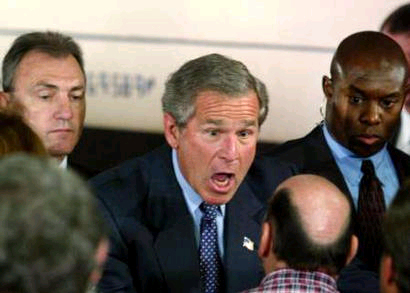
(Photo source.)

Saturday, February 17, 2007

Bits and Pieces from Our Leaders' Crazy Fact-Baseless World

Big Media's need to push water-carrying over, like, accurate journalism, from that worthless rag, the N.Y. Times:
A sharply divided House of Representatives passed a resolution on Friday formally repudiating President Bush’s decision to send more than 20,000 new combat troops to Iraq.
Well, no, it wasn't a "sharply divided" House, it was essentially partisan vote with a significant number of Republicans acting like rats (unfortunately, probably) or persons of principal (unlikely but one never knows).

But, you know, the American electorate already voted their resolution: overwhelmingly against... well, the most charitable thing one could say is that they voted against Our Leaders' relentless series of failed policies in and lies about Iraq.

And then there's this, which is freaking scary:
To win approval of a deal with North Korea that has been assailed by conservatives inside and outside the administration, Secretary of State Condoleezza Rice bypassed layers of government policy review that had derailed past efforts to negotiate an agreement, several senior administration officials said this week.

After a meeting in Berlin in mid-January with her top negotiator on North Korea, Christopher R. Hill, who had just held lengthy sessions with his North Korean counterparts, Ms. Rice called back to Washington to describe the outlines of the deal to Stephen J. Hadley, the national security adviser, and then to President Bush.

But to some, it seemed the usual procedures were cut short — vetting the details though an interagency process that ordinarily would have brought in Vice President Dick Cheney’s office, the Defense Department and aides at the White House and other agencies who had previously objected to rewarding North Korea before it gives up its weapons.

In other words, in the normal course, Our Leaders have set up a system guaranteed to assure dysfunction and failure.

Word to Dick Cheney: If you're so pro-strong presidency you're doing an excellent job promoting the need for a weak presidency.

And note that it took six years and going behind the backs of numerous nutjobs to get the deal that could have been there six-odd years ago. You know, before North Korea made significant progress with nuclear weapons of mass destruction. Once again, Our Beloved Leaders succeed in making our nation and the world safer -- not. (The reader may join possible Next Leader Rudy Giuliani and thank God that George W. Bush is president.)

And then there's this too -- Our Leaders' parodistic respect for a system of law:
A United States attorney in Arkansas who was dismissed from his job last year by the Justice Department was ousted after Harriet E. Miers, the former White House counsel, intervened on behalf of the man who replaced him, according to Congressional aides briefed on the matter.

Ms. Miers, the aides said, phoned an aide to Attorney General Alberto R. Gonzales suggesting the appointment of J. Timothy Griffin, a former military and civilian prosecutor who was a political director for the Republican National Committee and a deputy to Karl Rove, the White House political adviser.

(Griffin has since declined the appointment now that it will require Constitution-mandated public hearing.)

A Former Iraq Commander's Thoughts; The Short Version: Victory is Not an Option

Thanks, in part, to Our Leader's leadership. (But look at the general's bio, below: an obvious unreconstructed America-hating Marxist.)
Victory Is Not an Option
The Mission Can't Be Accomplished -- It's Time for a New Strategy
By William E. Odom
Sunday, February 11, 2007; B01

The new National Intelligence Estimate on Iraq starkly delineates the gulf that separates President Bush's illusions from the realities of the war. Victory, as the president sees it, requires a stable liberal democracy in Iraq that is pro-American. The NIE describes a war that has no chance of producing that result. In this critical respect, the NIE, the consensus judgment of all the U.S. intelligence agencies, is a declaration of defeat.

Its gloomy implications -- hedged, as intelligence agencies prefer, in rubbery language that cannot soften its impact -- put the intelligence community and the American public on the same page. The public awakened to the reality of failure in Iraq last year and turned the Republicans out of control of Congress to wake it up. But a majority of its members are still asleep, or only half-awake to their new writ to end the war soon.

Perhaps this is not surprising. Americans do not warm to defeat or failure, and our politicians are famously reluctant to admit their own responsibility for anything resembling those un-American outcomes. So they beat around the bush, wringing hands and debating "nonbinding resolutions" that oppose the president's plan to increase the number of U.S. troops in Iraq.

For the moment, the collision of the public's clarity of mind, the president's relentless pursuit of defeat and Congress's anxiety has paralyzed us. We may be doomed to two more years of chasing the mirage of democracy in Iraq and possibly widening the war to Iran. But this is not inevitable. A Congress, or a president, prepared to quit the game of "who gets the blame" could begin to alter American strategy in ways that will vastly improve the prospects of a more stable Middle East.

No task is more important to the well-being of the United States. We face great peril in that troubled region, and improving our prospects will be difficult. First of all, it will require, from Congress at least, public acknowledgment that the president's policy is based on illusions, not realities. There never has been any right way to invade and transform Iraq. Most Americans need no further convincing, but two truths ought to put the matter beyond question:

First, the assumption that the United States could create a liberal, constitutional democracy in Iraq defies just about everything known by professional students of the topic. Of the more than 40 democracies created since World War II, fewer than 10 can be considered truly "constitutional" -- meaning that their domestic order is protected by a broadly accepted rule of law, and has survived for at least a generation. None is a country with Arabic and Muslim political cultures. None has deep sectarian and ethnic fissures like those in Iraq.

Strangely, American political scientists whose business it is to know these things have been irresponsibly quiet. In the lead-up to the March 2003 invasion, neoconservative agitators shouted insults at anyone who dared to mention the many findings of academic research on how democracies evolve. They also ignored our own struggles over two centuries to create the democracy Americans enjoy today. Somehow Iraqis are now expected to create a constitutional order in a country with no conditions favoring it.

This is not to say that Arabs cannot become liberal democrats. When they immigrate to the United States, many do so quickly. But it is to say that Arab countries, as well as a large majority of all countries, find creating a stable constitutional democracy beyond their capacities.

Second, to expect any Iraqi leader who can hold his country together to be pro-American, or to share American goals, is to abandon common sense. It took the United States more than a century to get over its hostility toward British occupation. (In 1914, a majority of the public favored supporting Germany against Britain.) Every month of the U.S. occupation, polls have recorded Iraqis' rising animosity toward the United States. Even supporters of an American military presence say that it is acceptable temporarily and only to prevent either of the warring sides in Iraq from winning. Today the Iraqi government survives only because its senior members and their families live within the heavily guarded Green Zone, which houses the U.S. Embassy and military command.

As Congress awakens to these realities -- and a few members have bravely pointed them out -- will it act on them? Not necessarily. Too many lawmakers have fallen for the myths that are invoked to try to sell the president's new war aims. Let us consider the most pernicious of them.

1) We must continue the war to prevent the terrible aftermath that will occur if our forces are withdrawn soon. Reflect on the double-think of this formulation. We are now fighting to prevent what our invasion made inevitable! Undoubtedly we will leave a mess -- the mess we created, which has become worse each year we have remained. Lawmakers gravely proclaim their opposition to the war, but in the next breath express fear that quitting it will leave a blood bath, a civil war, a terrorist haven, a "failed state," or some other horror. But this "aftermath" is already upon us; a prolonged U.S. occupation cannot prevent what already exists.

2) We must continue the war to prevent Iran's influence from growing in Iraq. This is another absurd notion. One of the president's initial war aims, the creation of a democracy in Iraq, ensured increased Iranian influence, both in Iraq and the region. Electoral democracy, predictably, would put Shiite groups in power -- groups supported by Iran since Saddam Hussein repressed them in 1991. Why are so many members of Congress swallowing the claim that prolonging the war is now supposed to prevent precisely what starting the war inexorably and predictably caused? Fear that Congress will confront this contradiction helps explain the administration and neocon drumbeat we now hear for expanding the war to Iran.

Here we see shades of the Nixon-Kissinger strategy in Vietnam: widen the war into Cambodia and Laos. Only this time, the adverse consequences would be far greater. Iran's ability to hurt U.S. forces in Iraq are not trivial. And the anti-American backlash in the region would be larger, and have more lasting consequences.

3) We must prevent the emergence of a new haven for al-Qaeda in Iraq. But it was the U.S. invasion that opened Iraq's doors to al-Qaeda. The longer U.S. forces have remained there, the stronger al-Qaeda has become. Yet its strength within the Kurdish and Shiite areas is trivial. After a U.S. withdrawal, it will probably play a continuing role in helping the Sunni groups against the Shiites and the Kurds. Whether such foreign elements could remain or thrive in Iraq after the resolution of civil war is open to question. Meanwhile, continuing the war will not push al-Qaeda outside Iraq. On the contrary, the American presence is the glue that holds al-Qaeda there now.

4) We must continue to fight in order to "support the troops." This argument effectively paralyzes almost all members of Congress. Lawmakers proclaim in grave tones a litany of problems in Iraq sufficient to justify a rapid pullout. Then they reject that logical conclusion, insisting we cannot do so because we must support the troops. Has anybody asked the troops?

During their first tours, most may well have favored "staying the course" -- whatever that meant to them -- but now in their second, third and fourth tours, many are changing their minds. We see evidence of that in the many news stories about unhappy troops being sent back to Iraq. Veterans groups are beginning to make public the case for bringing them home. Soldiers and officers in Iraq are speaking out critically to reporters on the ground.

But the strangest aspect of this rationale for continuing the war is the implication that the troops are somehow responsible for deciding to continue the president's course. That political and moral responsibility belongs to the president, not the troops. Did not President Harry S. Truman make it clear that "the buck stops" in the Oval Office? If the president keeps dodging it, where does it stop? With Congress?

Embracing the four myths gives Congress excuses not to exercise its power of the purse to end the war and open the way for a strategy that might actually bear fruit.

The first and most critical step is to recognize that fighting on now simply prolongs our losses and blocks the way to a new strategy. Getting out of Iraq is the pre-condition for creating new strategic options. Withdrawal will take away the conditions that allow our enemies in the region to enjoy our pain. It will awaken those European states reluctant to collaborate with us in Iraq and the region.

Second, we must recognize that the United States alone cannot stabilize the Middle East.

Third, we must acknowledge that most of our policies are actually destabilizing the region. Spreading democracy, using sticks to try to prevent nuclear proliferation, threatening "regime change," using the hysterical rhetoric of the "global war on terrorism" -- all undermine the stability we so desperately need in the Middle East.

Fourth, we must redefine our purpose. It must be a stable region, not primarily a democratic Iraq. We must redirect our military operations so they enhance rather than undermine stability. We can write off the war as a "tactical draw" and make "regional stability" our measure of "victory." That single step would dramatically realign the opposing forces in the region, where most states want stability. Even many in the angry mobs of young Arabs shouting profanities against the United States want predictable order, albeit on better social and economic terms than they now have.

Realigning our diplomacy and military capabilities to achieve order will hugely reduce the numbers of our enemies and gain us new and important allies. This cannot happen, however, until our forces are moving out of Iraq. Why should Iran negotiate to relieve our pain as long as we are increasing its influence in Iraq and beyond? Withdrawal will awaken most leaders in the region to their own need for U.S.-led diplomacy to stabilize their neighborhood.

If Bush truly wanted to rescue something of his historical legacy, he would seize the initiative to implement this kind of strategy. He would eventually be held up as a leader capable of reversing direction by turning an imminent, tragic defeat into strategic recovery.

If he stays on his present course, he will leave Congress the opportunity to earn the credit for such a turnaround. It is already too late to wait for some presidential candidate for 2008 to retrieve the situation. If Congress cannot act, it, too, will live in infamy.

diane@hudson.org

William E. Odom, a retired Army lieutenant general, was head of Army intelligence and director of the National Security Agency under Ronald Reagan. He served on the National Security Council staff under Jimmy Carter. A West Point graduate with a PhD from Columbia, Odom teaches at Yale and is a fellow of the Hudson Institute.
Link.

Periodic Micro$oft Bashing

Who needs Vista? No one:
First-week retail sales of boxed copies of Windows Vista were almost 60% below sales of boxed copies of Windows XP in the week after its 2001 launch, according to one leading market research group.
If you need it, the safer, better, proven version for safety and features is OS X 10.4 and Parallels. It's not like Vista is particularly safe or plays particularly well with devices and apps. And it's overpriced.

Link
.

And then there's this:

Over the years, I have very rarely caught Steve Ballmer saying anything factually accurate.

So here's his crock of the day:
Microsoft Corp. CEO Steve Ballmer believes that sales forecasts for the company's new Vista operating system may be "overly aggressive."
Link.

Let's break this down with a single, simple question:

These analysts based their too high numbers primarily on information from what source -- spelled Microsoft?

God bless the modern monopoly....

How Brave and Pricipaled the Wingnuts Are

Not really, no, not at all, really.

Glenn Greenwald makes the case.

Forget His Popularity Ratings: What Americans Really Think of Our Beloved Leader

Twice a year, pollsters for the Pew Research Center ask Americans to say the "one word that best describes" their "impression of George W. Bush." As late as February 2005, the top two volunteered responses were "honest" and "good." The new top two: "incompetent" and "arrogant."

"Honest" has fallen to No. 3. Rounding out the top 10: "good," "idiot," "integrity," "leader," "strong," "stupid" and "ignorant." "Ass" checks in at No. 13, "president" sits at No. 18, and "unconfident" brings up the rear at No. 32.
(Emphasis added.)

Link.

Friday, February 16, 2007

Belated Valentine, But With Wishes that Will Last All Year (and the Year After and After...)

From the troops in Iraq to Our Beloved Leader:


Link.

A Warning?

Wake Up! The Next War Is Coming
By Ray McGovern
TomPaine.com

Monday 12 February 2007

An understated headline moved me yesterday; it was atop AP's explosively formed story about the "explosively formed penetrators" traced to Iran that are killing our troops in Iraq: "Democrats Skeptical of Starting Row With Iran." Yawn.

Webster's: "row" - "a noisy disturbance or quarrel." Yawn.

What about starting another unwinnable war - this time with Iran? If you are a member of Congress, does it suffice to be "skeptical" about that? Hello?

On January 19, Senator Jay Rockefeller, D-W. Va., chair of the Senate Intelligence Committee, told The New York Times he believes the White House is developing a case for taking action against Iran, even though U.S. intelligence is not well informed about politics in Iran. "To be quite honest, I'm concerned that it's Iraq again," said Rockefeller. "This whole concept of moving against Iran is bizarre."

Ten days later he told Wolf Blitzer, "I have a great deal of worry that this [escalation of the war in Iraq] could expand...into some kind of action with respect to Iran, which I think would be an enormous mistake."

Then why not stop it, Senator Rockefeller? Stop the war against Iran before it starts. You are chair of the intelligence committee. You don't have to be stonewalled, as previous chair Senator Bob Graham was in September 2002. Yes, he voted against the war in Iraq because he knew of the games being played with the intelligence. But he failed to play a leadership role; he didn't tell his 99 colleagues they were being diddled. It's time for some leadership.

Several of your colleague senators were reeking of red herring when they arrived home from yesterday's talk shows. Many of them allowed the administration to divert attention from the main issue with Iran - its nuclear development plans. Instead, the focus was on explosive technology Iran is reported to be giving to Shiite elements to blow up U.S. vehicles on the roads of Iraq. This transport problem is compounded by the unfriendly skies there, where a handful of U.S. helicopters have been shot down in recent weeks. So the problem with "explosively formed penetrators" in improvised explosive devices (IEDs) at roadside is real enough.

Why not take the Army's PowerPoint show-and-tell to Tehran, confront the Iranian leaders and demand they stop? Sorry, I forgot: we don't talk with bad people. Well, we might try it, just this once.

The real fly in the ointment - the real aim of the U.S. military buildup in the Persian Gulf and of threatening gestures elsewhere - has to do with Iran's nuclear plans. Recent revelations that the Bush administration summarily rejected Iranian overtures in 2003 to include this neuralgic topic among others in a broad bilateral discussion strengthens the impression that President George W. Bush and Vice President Dick Cheney actually prefer the military option to destroy Iranian nuclear-related facilities. In any case, the recent hype and provocative actions are likely to end up with an attack on Iran, unless Congress moves quickly to head it off.

Show Me the Intelligence

Where is the National Intelligence Estimate (NIE) on prospects for Iran's nuclear capability? You, Senator Rockefeller now have the power to ensure that such estimates are done regularly and in a timely way. An estimate is said to be under way, but at a seemingly leisurely pace completely inappropriate to the circumstances. And there has been no NIE on this key issue since spring 2005.

As you know, the Bush/Cheney administration is no fan of NIEs, unless they can get the likes of former Pentagon functionary Douglas Feith and former CIA director George Tenet to fix the estimate to the policy - as the recent Defense Department Inspector General report's proved.

In any case, the 2005 NIE concluded that Iran would not be able to produce enough highly enriched uranium for a nuclear weapon until "early to mid-next decade," with general consensus that 2015 would probably be the earliest. Interestingly, since 1995, U.S. intelligence officials continually estimated Iran to be "within five years" of the capability to make nuclear weapons.

The new NIE in 2005, though, was the first key estimate managed by widely respected Thomas Fingar, the State Department officer who took leadership of the National Intelligence Council earlier that year. Its key judgments were not welcome downtown, however, since they were issued at a time when Vice President Dick Cheney was warning of a "fairly robust new nuclear program," in Iran, and was painting the threat - and particularly the danger to Israel - as far more imminent.

Several patriotic truth tellers (aka leakers) told The Washington Post of the NIE's main judgments. The exposure of the intelligence judgments came amid credible reports that the vice president had ordered up contingency plans for a large-scale air assault on Iran, that included tactical nuclear weapons to take out hardened underground nuclear facilities.

The 2005 estimate noted indications that Iran was conducting clandestine work, but there was no information linking those projects directly to a nuclear weapons program. The International Atomic Energy Agency (IAEA) still has found no conclusive evidence that Iran is tying to build nuclear weapons. (Does that bring back painful memories of Iraq four years ago?) But unlike Iraq, which had been frightened into awarding full cooperation with U.N. inspectors in early 2003, Iran was far less than candid in responding to IAEA questions, and the agency has suspended some aid to Iran and criticized it for concealing certain nuclear-related activities.

The ambiguities are such that, if we bombed Iran, we would once again be going to war in the subjunctive mood.

The dearth of hard evidence shines through some of the more disingenuous pleading of senior administration officials - Vice President Dick Cheney and Secretary of State Condoleezza Rice, in particular, who have argued that with all the oil at Iran's disposal it does not need nuclear energy. The trouble is that when Cheney was President Gerald Ford's chief of staff, he and then-Defense Secretary Donald Rumsfeld persuaded Ford to give the Shah a nuclear program to meet its future energy requirements. There is even more credibility to that claim now. Energy experts note that oil extraction in Iran is already near peak and that the country will need alternatives to oil in the coming decades.

In 1976, Ford reluctantly signed a directive offering Iran a deal that would have brought at least $5.4 billion for U.S. corporations like Westinghouse and General Electric, had not the Shah been unceremoniously ousted three years later. The offer included a reprocessing facility for a complete nuclear-fuels cycle - essentially the same capability that the United States, Israel and other countries now insist Iran cannot be allowed to acquire. This is, of course, no secret to Khomeini's successors.

What Can Be Said

What Iran is seeking is an enrichment capability, and that capability would allow it eventually to produce nuclear weapons. Whether the Iranians intend to use that technology in the near term for that purpose is open to debate. But if they can develop a commercial/civilian enrichment capability, they will have what Israel calls the "nuclear option." What cannot be honestly said at this point is what Nicholas Burns, number three in the State Department, has been saying: "There is no doubt Iran is seeking nuclear weapons." You would think they would take care not to use the exact same phrases they used just four years ago making spurious charges regarding "Iraq's nuclear program."

One can argue, as French President Jacques Chirac did in a recent moment of candor, that Iran's possession of a nuclear weapon would not be "very dangerous," because Iran is well aware that if it fired it at Israel, Tehran would be immediately "razed." And the post-WWII experience saw mutual deterrence work for 45 years. But the suggestion that the Israeli government try to relax into the concept of deterrence in view of the formidable nuclear arsenal Israel already has, tends to fall on deaf ears. And, given memories of the Holocaust and the ranting of Iran's current president, this is in some degree understandable.

But there is an equally compelling reason to dissuade Iran from going nuclear. And that is the nuclear proliferation to which that would inevitably lead in the Middle East. The U.S. needs to engage in direct talks with Tehran; we do have common interests and concerns, and we could work toward devising ways to alleviate Israeli fears. But, given the testosterone and myopia that color the Bush administration's behavior in that region, appeals to those realities and approaches seem to fall on deaf ears.

Congress Must Act

Please, Senator Rockefeller, the National Intelligence Estimate on Iran's nuclear situation is said to be targeted for completion in March. That's too late; you need to read it before the bombs and missiles start falling on Iran.

An attack on Iran would bring catastrophe. Americans would want to know our reasons for doing so. "Explosively formed penetrators" are unlikely to persuade. Nor will a nuclear threat to the U.S. 10 years hence be found convincing. Iran poses no immediate threat to America. It is right that we be concerned about the security of Israel, but the burden of proof should be on those who argue that deterrence cannot work in that situation.

Most important, bilateral talks with Iran are a sine qua non. Given the circumstances, including heightened tensions and the danger of miscalculation, avoiding face-to-face encounters makes little sense.
Link.

Meet Your Leaders: Dick Cheney's Admirable Son-in-Law; a Hero

Our Leaders really do want to make the country (or "homeland") safer. Here's one of the men working on it.
The man who married straight daughter Liz Cheney is a sharp conservative lawyer named Philip Perry. Like his wife, who serves as deputy assistant secretary of state for Near Eastern affairs, Perry has held a series of high-level patronage appointments in the Bush administration. Not long after his father-in-law took office in 2001, President Bush appointed Perry to the third-ranking position in the Justice Department; from there he moved to the top legal position in the Office of Management and Budget and later became general counsel to the Department of Homeland Security, with intermittent stints in the private sector.

But the true scandal of Perry's career in government and law is less about blatant nepotism and more about corporate cronyism.

As the Washington Monthly reveals in its current issue, Perry has spent the past few years at DHS obstructing federal and state regulation of the nation's chemical industry, which still remains vulnerable to a devastating terrorist attack -- and which has paid millions of dollars to Latham & Watkins, the Washington law firm where he has been a partner and lobbyist, earning as much as $700,000 a year. (Having just resigned from Homeland Security last month, Perry could soon return to Latham, thus completing his third circuit through the revolving door.)
The rest of this heart-warming story is here.

Thursday, February 15, 2007

Moments in Great Leadership

Lesson for Sen. Lindsey Graham: next time you bash a ghost, make sure she’s not in the audience.

Monday night, the South Carolina Republican joined Sen. Edward Kennedy (D., Mass.) for a panel discussion following a Washington screening of “Ghosts of Abu Ghraib,” an HBO documentary made by Kennedy’s niece, Rory Kennedy, about the 2004 abuse scandal in the Iraqi prison run by U.S. forces. As a veteran Air Force lawyer, Graham has spoken with authority on military law issues, and seemingly sought to navigate a course between President Bush’s claims of absolute power over enemy prisoners and humanitarian law concerns over compliance with the Geneva Conventions, the Convention Against Torture and other treaties.

Kennedy
Kennedy complained that low-ranking soldiers took the fall for Abu Ghraib, while high-level officials got a pass. Graham wouldn’t go that far, but he did take credit for blocking Bush’s nomination of an architect of the prisoner policy, Pentagon General Counsel William J. Haynes II, to a federal appeals court. And he added that the military police commander in Baghdad, Brig. Gen. Janis Karpinski, got off easy with a demotion to colonel. She should have faced a court-martial, he declared.
Apparently unbeknownst to Graham — he arrived a few minutes after formal introductions pointed her out — Karpinski, who is interviewed in the documentary, was a guest at the screening. And moderator Jeffrey Toobin, the New Yorker magazine’s legal correspondent, invited her to reply.

“Sen. Graham…I consider you as cowardly as Rumsfeld, as Sanchez, and Miller and all of them,” said Karpinski, who has long claimed to be a scapegoat for superiors including former Defense Secretary Donald Rumsfeld, Lt. Gen. Ricardo Sanchez and Maj. Gen. Geoffrey Miller.

Graham replied that those higher-ups deserved a share of the blame, but “this was going on unchecked for weeks and months, and Rumsfeld was in Washington and you were on the ground, so I stand by my statement.” Noting that Karpinski happens to reside in South Carolina, he acknowledged, “I’ve probably lost your vote.” –Jess Bravin
Link.

And the victim herself says:
Tuesday night's private screening of Rory Kennedy's Ghosts of Abu Ghraib in Washington may serve to haunt Senator Lindsey Graham for many days to come. It was such a great opportunity and Senator Graham was such a great target, but he has only himself to thank. It is so sad and unfortunate for him to say the things he said, not so much because he thought he could simply say what he did against me not knowing I was there, but because it made everybody painfully aware of his inability to comprehend what he saw in the movie and his ignorance of the big picture.

He condemns the complicity of Miller, Sanchez, Rumsfeld et al., including a remark against the President, but sidesteps his responsibility in pinning medals on each one of them and letting them retire.
His first comment was about me -- his dismay over not having the chance to court martial me. Did he read even one page of all of the investigations, or perhaps not even bother because he was well aware it was a sham and a farce from the get go. The movie is so good at tying all of the parts and the real evidence together. He just refuses to get it, or maybe he is just not intelligent enough to get any of it.

I stand by my remarks about him being a coward. A coward condemns people in public ONLY when he believes there will be no opposition. What a pitiful example of a Senator. At one point, he was acknowledging the need for torture and told us we did not even want us to know what all of what they did to Khalid Shiek Mohammed because it was just so awful, but he assured us Khalid Sheik Mohammed provided "really great" information. Then, unbelievably, he tried desperately to assure us "most Americans think this is an unfortunate necessity in the global war on terrorism." Where is he taking the survey??

I am a resident of South Carolina and I do not like Senator Graham. He is a fake and a fraud and claims he has military experience so he has the right to condemn military actions and/or failures. He is and always was, a JAG Officer -- a lawyer, spending his military time in a plush office somewhere and never seeing harm's way anywhere, but never hesitating to send Soldiers into harm's way -- ill equipped, ill informed and ill prepared to face hostile actions every hour of every day of their lives in Iraq and Afghanistan. It is an understatement to say, as he did, "Well then, I guess I lost your vote."

Other attendees were great afterwards and generously supportive. It is my experience American people are far more intelligent and perceptive than the likes of Senator Lindsey Graham gives them credit for being. They understood the movie and they are annoyed with the idiotic comments he made. More importantly, they are annoyed with him and the Administration he represents. When Ghosts of Abu Ghraib is broadcast across the country next week, I hope Americans are so annoyed and angry from watching the movie, it stimulates a renewal of demands for the truth and an independent commission to review the facts and render truthful conclusions.

What's Wrong with Our Leaders in Nearly the Fewest Possible Words

Neoconservatives hate liberty as much as they love war.

Too much.

Wednesday, February 14, 2007

Checking Out The Times' "Pinch" Schulzberger: Yup, Still an Asshole

Arthur Sulzberger Jr., the publisher of the New York Times, has taken some flack for sounding a bit glum about the prospects for print journalism at the World Economic Conference, held last month in Davos.

On Feb. 8, the newspaper Ha'aretz quoted Mr. Sulzberger thusly, responding to a question about whether the Times will still be printed on paper in five years:

"I really don't know whether we'll be printing the Times in five years, and you know what? I don't care either."
On Wednesday, in a speech to Times employees, Mr. Sulzberger plans to clarify the message attributed to him in Ha'aretz. The Times supplied the Observer with a portion of his text in advance:

"We are continuing to invest in our newspapers, for we believe that they will be around for a very long time. This point of view is not about nostalgia or a love of newsprint. Instead, it is rooted in fundamental business realities: Our powerful and trusted print brands continue to draw educated and affluent audiences.

"Traditional print newspaper audiences are still significantly larger than their Web counterparts. Print continues to command high levels of reader engagement. And, of course, we still make most of our money from print advertising and circulation revenue. And yes, I remember what I said here last year and what I was supposed to have said last month at Davos about not having a printed product in five years time.

"So let me clear the air on this issue. It is my heartfelt view that newspapers will be around--in print--for a long time. But I also believe that we must be prepared for that judgment to be wrong. My five-year timeframe is about being ready to support our news, advertising and other critical operations on digital revenue alone ...whenever that time comes."
Link. I'm sure someday someone will explain that he's brilliant but just doesn't know how to speak or act in public. But otherwise a genius.

How the Lying Rightwing Scumbags Do it, Abetted by Big Media Stooges

The current $mear on Speaker Pelosi is a case study in how the right-wing $mear machine operates. The right has been working to spread a lie that Speaker Pelosi "demanded" a "luxury jet" to fly herself and "supporters" and "contributors" around. The lie is effective because it ties a current event to a deeper, long-term resentment narrative about "limousine liberals" that the right has been pushing for years. It is spreading across the country because it is passed through a prepared pipe to the places where the general public receives their information.

The facts are simple: since 9/11, for obvious security reasons, the Speaker of the House of Representatives (who is next in line behind the Vice President to become President) has flown on government rather than commercial aircraft. Speaker Pelosi is from California, so with the House now back to a five-day workweek the Sergeant-at-Arms of the House of Representatives requested a jet that can make it to California non-stop. According to the Sergeant-at-Arms,

"The fact that Speaker Pelosi lives in California compelled me to request an aircraft that is capable of making non-stop flights for security purposes, unless such an aircraft is unavailable."
That is the entire story, period. But the right's propaganda machine has been working to blow this up into a story that supports their "limousine liberal" resentment narrative, adding various embellishments with each passing day. According to this narrative, liberals are rich "elitists" from the coasts who think they are smarter and generally superior to the "regular people" in "the heartland." This is meant to create a resentment backlash, bringing votes to conservative candidates so they can get into office ... and give tax cuts to rich elitists.

Over several days, the "Pelosi plane" story has been expanded into a fable that has Speaker Pelosi "demanding" a "floating pleasure palace," a "luxury 757" with two beds, a bar, and 40 first-class seats, so she can "transport her political cronies, favorite Members of Congress, congressional staffers, friends and relatives."

An interesting point to note about this story is that such government planes do exist. The Bush administration has actually purchased such planes for use by executive branch officials and military brass. But this "use of luxury aircraft at taxpayer's expense" is not objected to in the retelling of this story. The objection is to their use by Speaker of the House Pelosi in particular. So perhaps part of the right's anger driving this issue can be laid to authoritarian resentment about a member of Congress - "the People's House" - a female Speaker, no less - being "demanding" enough to possibly gain use of one of "their" luxury planes.

As so many $mears do, this one originated with the Reverend Moon's Washington Times and was quickly spread across the right's echo chamber. Though the Reverend Moon preaches that Christianity must be "torn down" because he is the true Prophet and our "True Parent," the Christian Coalition again joined forces with him to condemn Pelosi,

***

Others joined forces with Moon's efforts. The New York Post wrote in the story,
AIR-OGANT NANCY, DEMANDS 22G-AN-HOUR JET OF SAME TYPE VEEP GETS,

House Speaker Nancy Pelosi is demanding regular use of the military's "Lincoln Bedroom" in the sky - a luxurious aircraft of the same type that carries Vice President Dick Cheney and First Lady Laura Bush on official trips, officials said yesterday.
In a development that has some Republicans and defense officials fuming, Pelosi recently asked the Pentagon to give her access to the Air Force's super-opulent C-32 for flights to her San Francisco home and other official trips.
The floating pleasure palace is a reconfigured Boeing 757 stored at Andrews Air Force Base with Air Force One and the rest of the fleet of executive aircraft.

The aircraft has a game room, stateroom, showers, a communications center and seats 42 to 50 people, according to the Air Force.

It costs taxpayers $22,000 an hour to operate, according to military and congressional sources.
"It will be a flying Lincoln Bedroom," said House GOP Whip Rep. Roy Blunt (R-Mo.).
"This shows an unprecedented sense of entitlement. This is a symbol of hypocrisy, this is a symbol of excess and this is a symbol of arrogance," said a member of the House Republican Conference.

Far-right outlets like NewsMax echoed and amplified the $mear. The Republican Party itself put up a web page titled, "Non-Stop" Nancy Seeks Flight Of Fancy, claiming,

Speaker Nancy Pelosi (D-CA) Wants Non-Stop Military Aircraft For Herself, Staff, Family, And Other Members In California Delegation
And right-wing talk radio has, of course, echoed the $mear all day, every day.

But the right's "echo chamber" reaches far beyond newspapers, TV and radio. People receive information in lots of ways, and the conservative machine has studied them and puts them to use. Online message boards and e-mail chain-forwarding, for example, can be a useful barometer of right-wing smear-planting operations. The same wording repeated at many boards often indicates that something is going on. The number of examples resulting from a Google search for the phrase "Nancy Pelosi's Gas Guzzling 757 Flying Bedroom", for example, demonstrates that this may be occurring.

***

Even though no facts supported Reverend Moon's smear, the $mear quickly migrated to the corporate media, as documented by Media Matters and Think Progress, with CBS News (and here), Nightline, CNN, NBC's Today, MSNBC, and , as the right's Media Research Center bragged, others. (Media Matters covers this topic in detail here.)

Right-wing weblogs also helped spread the story....

***

A final note - Newsweek today continues the circulation of the lie, complete with conservative narrative reinforcement, writing, (with a big, red down-arrow):
"Sure Hastert had military jet, but seeking bigger one (to go nonstop) makes her sound like a 757 liberal."
The rest is here.

Tuesday, February 13, 2007

About Rudy

On one hand, he's a mind-boggling scumbag -- even for a pol. OTOH, there's always been a slight honesty about him (not enough to justify electing him to anything). Here's a relatively honest evaluation of him, prepared by his own people, in '93. It even includes my favorite: His leadership of a racist riot that would make a Klansman weep with envy as well has his love of serving in 'Nam (not).

Monday, February 12, 2007

The Wingnuts Give the Love

Last I saw, them and their Big Media enablers were hopeful of Tim Johnson resigning over, like, terminal vegetable-hood (not that that's been a problem for Our Leaders).

Except....
Washington - Sen. Tim Johnson is reading news clippings and starting to do some office work from the hospital, almost two months after suffering a life-threatening brain hemorrhage. "At this point, he has requested more contact with office and is looking for updates from staff," his office said in a statement Friday.

Spokeswoman Julianne Fisher said the South Dakota Democrat is starting slowly.

"We do not anticipate him back (in the Senate) for several weeks," Fisher said. "We are bringing work to him rather than him coming to us. His first priority still is rehabilitation."
Link.

It's a tough time to be a wingnut....

How Microsoft Makes its Money

Good old fashioned extortion. In Capitalism, marketing is the heart of the source of making money. And when you have crap products, you have to force them on people.

But with Windows, M$ learned that forcing stuff on people is the only way they can count on making money. Nothing at M$ is significantly profitable other than the monopolies....
LinuxWorld: Now the reason that you left Novell has to do with Microsoft and Novell setting up a deal to in effect pay Microsoft a patent royalty on copies of Linux sold.

Allison: That’s right. I mean essentially, it’s a patent cross license. They don’t call it that. They call it a covenant not to sue with customers. But when you boil it down, and you look at it really closely, it is a patent cross license. And section seven of the GPL specifically states that you can’t cut yourself a special patent cross license deal. Essentially it’s one of those situations where everyone has to hang together not separately, as it were. So, in other words, you can’t cut yourself special deals. And as I said, I wanted to like the deal. I had no objections. People were claiming, "oh, we just hate Microsoft." And this is not true. I actually had no objections whatsoever to any of the parts of the deal other than this one. But this one just killed it for me -- totally and completely I’m afraid.

LinuxWorld: Other parts of the deal -- was there anything in there that was actually relevant to improving interoperability between --?

Allison: No, I’m sorry. I know what you’re going to ask. I mean that part I found amusing rather than anything else because the whole point of it was saying that, oh, we’re going to improve interoperability. But if you look at it closely, I think it covers some very specific federated directory things, which essentially very few people in the world actually care about.

What people really want is a second source Active Directory replacement. Let’s just say Novell was doing interesting work. That’s what Samba 4 is about, and they’re always doing a lot of interesting work there. But people who think that Microsoft will now give the information that is needed in order to do that to Novell just because of this deal are delusional. What you have to think about is that essentially Microsoft has been fighting tooth and nail not to give away any of this information to free software projects. So, they may think that just because they signed some patent cross licensing deal with Novell -- even though Microsoft really, really wanted the patent cross licensing deal, just because they signed that, do you think they’re going to give away stuff that they essentially have fought absolutely and completely against the EU and paid billions of dollars in fines to avoid. So, no, that’s not going to happen.

LinuxWorld: One of the persistent rumors that’s going around is that certain large IT customers have already been paying Microsoft for patent licensing to cover their use of Linux, Samba and other free software projects. And the Novell deal -- isn’t it just taking that and doing the same kind of thing wholesale?

Allison: Yes, that’s true, actually. I mean I have had people come up to me and essentially off the record admit that they had been threatened by Microsoft and had got patent cross license and had essentially taken out a license for Microsoft patents on the free software that they were using, which they then cannot redistribute. I think that would be the restriction. I would have to look quite carefully. So, essentially that’s not allowed. But they’re not telling anyone about it. They’re completely doing it off the record.

The problem with the Novell deal is -- Novell gave Microsoft what Microsoft dearly wanted, which is a public admission that they think that Linux violates the Microsoft patent. So, that’s the difference between this and the sort of off-the-record quiet deals. This one is public. This one is Novell admitting, "yes, we think that Linux violates Microsoft patents." Now, of course, Novell has come out and said, "no, that’s not what we said at all. We don’t think that." To which, of course, Microsoft publicly humiliated them and said, "oh, yes, that’s really what you were saying." It’s kind of funny. They couldn’t even wait until the press conference was over to start threatening users with a Linux system.

LinuxWorld: Watching Novell management being subjected to this was like watching a child eating a bug for money. It’s embarrassing. Allison: It is humiliating. I was horrified to say. It was humiliating. Yes. It really is like, "Go on. Eat a bug. Go on. Go on. Here’s some money. Eat a bug." Yes, sad but true.
Link.

Sunday, February 11, 2007

With Friends Like These....

Who needs enemies when your friends want you dead?
Helping Israel Die

Ray McGovern

February 09, 2007

Ray McGovern works with Tell the Word, the publishing arm of the ecumenical Church of the Saviour in Washington, D.C. He was a CIA analyst for 27 years and is on the Steering Group of Veteran Intelligence Professionals for Sanity (VIPS).

President George W. Bush and Vice President Dick Cheney are unwittingly playing Dr. Jack Kevorkian in helping the state of Israel commit suicide. For this is the inevitable consequence of the planned air and missile attack on Iran. The pockmarked, littered landscape in Iraq, Lebanon and Afghanistan and the endless applicant queues at al-Qaeda and other terrorist recruiting stations testify eloquently to the unintended consequences of myopic policymakers in Washington and Tel Aviv.

Mesmerized. Sadly, this is the best word to describe those of us awake to the inexorable march of folly to war with Iran and the growing danger to Israel’s security, especially over the medium and long term. An American and/or Israeli attack on Iran will let slip the dogs of war. Those dogs never went to obedience school. They will not be denied their chance to bite, and Israel’s arsenal of nuclear weapons will be powerless to muzzle them.

In my view, not since 1948 has the very existence of Israel hung so much in the balance. Can Bush/Cheney and the Israeli leaders not see it? Pity that no one seems to have read our first president’s warning on the noxious effects of entangling alliances. The supreme irony is that in their fervor to help, as well as use, Israel, Bush and Cheney seem blissfully unaware that they are leading it down a garden path and off a cliff.

Provoke and Pre-empt

Whether it is putting the kibosh on direct talks with Iran or between Israel and Syria, the influence and motives of the vice president are more transparent than those of Bush. Sure, Cheney told CNN’s Wolf Blitzer recently that the administration’s Iraq policy would be “an enormous success story,” but do not believe those who dismiss Cheney as “delusional.” He and his neoconservative friends are crazy like a fox. They have been pushing for confrontation with Iran for many years, and saw the invasion of Iraq in that context. Alluding to recent U.S. military moves, Robert Dreyfuss rightly describes the neocons as “crossing their fingers in the hope that Iran will respond provocatively, making what is now a low-grade cold war inexorably heat up.”

But what about the president? How to explain his fixation with fixing Iran’s wagon? Cheney’s influence over Bush has been shown to be considerable ever since the one-man search committee for the 2000 vice presidential candidate picked Cheney. The vice president can play Bush like a violin. But what strings is he using here? Where is the resonance?

Experience has shown the president to be an impressionable sort with a roulette penchant for putting great premium on initial impressions and latching onto people believed to be kindred souls—be it Russian President Vladimir Putin (trust at first sight), hail-fellow-well-met CIA director George Tenet or oozing-testosterone-from-every-pore former Israeli Prime Minister Ariel Sharon. Of particular concern was his relationship with Sharon. Retired Gen. Brent Scowcroft, a master of discretion with the media, saw fit to tell London’s Financial Times two and a half years ago that Sharon had Bush “mesmerized” and “wrapped around his little finger.”

As chair of the prestigious President’s Foreign Intelligence Advisory Board under George W. Bush and national security adviser to his father, Scowcroft was uniquely positioned to know—and to draw comparisons. He was summarily fired after making the comments about Sharon and is now persona non grata at the White House.

Compassion Deficit Disorder

George W. Bush first met Sharon in 1998, when the Texas governor was taken on a tour of the Middle East by Matthew Brooks, then executive director of the Republican Jewish Coalition. Sharon was foreign minister and took Bush on a helicopter tour over the Israeli occupied territories. An Aug. 3, 2006 McClatchy wire story by Ron Hutcheson quotes Matthew Brooks:

If there’s a starting point for George W. Bush’s attachment to Israel, it’s the day in late 1998, when he stood on a hilltop where Jesus delivered the Sermon on the Mount, and, with eyes brimming with tears, read aloud from his favorite hymn, ‘Amazing Grace.’ He was very emotional. It was a tear-filled experience. He brought Israel back home with him in his heart. I think he came away profoundly moved.

Bush made gratuitous but revealing reference to that trip at the first meeting of his National Security Council (NSC) on Jan. 30, 2001. After announcing he would abandon the decades-long role of honest broker between Israelis and Palestinians and would tilt pronouncedly toward Israel, Bush said he would let Sharon resolve the dispute however he saw fit. At that point he brought up his trip to Israel with the Republican Jewish Coalition and the flight over Palestinian camps, but there was no sense of concern for the lot of the Palestinians. In A Pretext for War James Bamford quotes Bush: “Looked real bad down there,” he said with a frown. Then he said it was time to end America’s efforts in the region. “I don’t see much we can do over there at this point,” he said.

So much for the Sermon on the Mount. The version I read puts a premium on actively working for justice. There is no suggestion that tears suffice.

Then-Secretary of the Treasury Paul O’Neill, who was at the NSC meeting, reported that Colin Powell, the newly-minted but nominal secretary of state, was taken completely by surprise at this nonchalant jettisoning of longstanding policy. Powell demurred, warning that this would unleash Sharon and “the consequences could be dire, especially for the Palestinians.” But according to O’Neill, Bush just shrugged, saying, “Sometimes a show of strength by one side can really clarify things.” O’Neill says that Powell seemed “startled.” It is a safe bet that the vice president was in no way startled.

A similar account reflecting Bush’s compassion deficit disorder leaps from the pages of Ron Susskind’s The One Percent Doctrine . Crown Prince Abdullah, Saudi Arabia’s de facto leader was in high dudgeon in April 2002 when he arrived in Crawford to take issue with Bush’s decision to tilt toward Israel and scrap the American role of honest broker in the Israeli-Palestinian conflict. With Bush’s freshly bestowed “man-of-peace” epithet for Sharon still ringing in his ear, Abdullah began by insisting that the president and his aides watch a 15-minute video. It showed the mayhem on the West Bank, American-made tanks, bloodied and dead children, screaming mothers. Then, still wordless, they all filed into another room where the Saudis proceeded to make specific demands, but Bush appeared distracted and was non-responsive. After a few minutes, the president turned to Abdullah and said, “Let’s go for a drive. Just you and me. I’ll show you the ranch.”

Bush was so obviously unprepared to discuss substance with his Saudi guests that some of the president’s aides checked into what had happened. The briefing packet for the president had been diverted to Cheney’s office. Bush never got it, so he was totally unaware of what the Saudis hoped to accomplish in making the trip to Crawford. (There is little doubt that this has been a common experience over the past six years and that there are, in effect, two “deciders” in the White House, one of them controlling the paper flow.)

Not that Bush was starved for background briefings. Indeed, he showed a preference to get them from Prime Minister Sharon who, with his senior military aide, Gen. Yoav Galant, briefed the president both in Crawford (in 2005) and the Oval Office (in 2003) on Iran’s “nuclear weapons program.” Sorry if I find that odd. That used to be our job at the CIA. I’ll bet Sharon and Galant packed a bigger punch.

There is, no doubt, more at play in Bush’s attitude and behavior regarding Israel and Palestine. One need not be a psychologist to see ample evidence of oedipal tendencies. It is no secret that the president has been privately critical of what he perceives to be his father’s mistakes. Susskind notes, for example, that Bush defended his tilt toward Israel by telling an old foreign policy hand, “I’m not going to be supportive of my father and all his Arab buddies!” And it seems certain that Ariel Sharon gave the young Bush an earful about the efforts of James Baker, his father’s secretary of state, to do the unthinkable; i.e., crank Arab grievances into deals he tried to broker between Israel and the Palestinians. It seems clear that this is one reason the Baker-Hamilton report was dead on arrival.

With Friends Like This...

George W. Bush may have the best of intentions in his zeal to defend Israel, but he and Cheney have the most myopic of policies. Israeli leaders risk much if they take reassurance from the president’s rhetoric, particularly vis-à-vis Iran. I am constantly amazed to find, as I speak around the country, that the vast majority of educated Americans believe we have a defense treaty with Israel. We don’t, but one can readily see how it is they are misled. Listen to the president exactly two years ago:

Clearly, if I was the leader of Israel and I’d listened to some of the statements b y the Iranian ayatollahs that regarded the security of my country, I’d be concerned about Iran having a nuclear weapon as well. And, in that Israel is our ally [sic]—and in that we’ve made a very strong commitment to support Israel—we will support Israel if her security is threatened.

We do no favors for Israeli leaders in giving them the impression they have carte blanche in their neighborhood—especially as regards Iran—and that we will bail them out, no matter what. Have they learned nothing from the recent past? Far from enhancing Israel’s security, the U.S. invasion of Iraq and Washington’s encouragement of Israel’s feckless attack on Lebanon last summer resulted in more breeding ground for terrorist activity against Israel. This will seem child’s play compared to what would be in store, should the US and/or Israel bomb Iran.

Bottom line: there is a growing threat to Israel from suicide bombers. The most dangerous two work in the White House.
Link.

Ideas from the Nutjobs Our Leaders Listen to

As the young people say, this is so fucked:
The Washington Defense of Marriage Alliance seeks to defend equal marriage in this state by challenging the Washington Supreme Court’s ruling on Andersen v. King County. This decision, given in July 2006, declared that a “legitimate state interest” allows the Legislature to limit marriage to those couples able to have and raise children together. Because of this “legitimate state interest,” it is permissible to bar same-sex couples from legal marriage.

The way we are challenging Andersen is unusual: using the initiative, we are working to put the Court’s ruling into law. We will do this through three initiatives. The first would make procreation a requirement for legal marriage. The second would prohibit divorce or legal separation when there are children. The third would make the act of having a child together the legal equivalent of a marriage ceremony.
Link to the insanity.

Sunday Activity

Vote for the worst president ever.

But read this first so you can vote intelligently
.

And not that I'm trying to push a specific vote... portraits of one candidate....


Freedom Spreads in America

Not.
If Sen. Arlen Specter (R-PA) is to be believed, no one in the Senate, not even himself, realized that the law had been changed governing the nomination of U.S. Attorneys -- a change that gave the administration the power to appoint federal prosecutors indefinitely without Senate confirmation.

In later remarks during this morning's hearing, Specter explained to Sen. Dianne Feinstein (D-CA) that he didn't know about the provision until she approached him on the floor and asked about it recently. He then asked his chief counsel, Michael O'Neill, who explained that the provision had been inserted into the USA PATRIOT Improvement and Reauthorization Act at the request of the Department of Justice.

So Specter is angry at the insinuation that he "slipped in" the change... but not even he knew that his own staff member had made the change.

Checking in with Our Next Leaders

McCain likes bloggers too -- the demented lying kind. Apparently they go well with straight talk. The dementia is using assholes like these almost makes one ready to believe the 2000 rumors from Our Leader's primary campaign that maybe Sen. Straight Talk is, well, nuts.

Rudy, meanwhile, to his credit, never made a big deal about being an exemplar of honesty.

So he's free to be an utter and complete liar
. Look look look! And he can get away with it too -- proving the societal value of the bullshit that passes as Big Media journalism.

Or maybe he's a student of Malcolm X: "By any means necessary."

Tom DeLay, who must be awaiting rehabilitation, doesn't like Rudy or Sen. Straight Talk but not for any reasons that matter.

The Trouble with Big Media Journalism

If you're a journalist, and a very senior White House official calls you up on the phone, what do you do? Do you try to get the official to address issues of urgent concern so that you can then relate that information to the public?

Not if you're NBC Washington bureau chief Tim Russert.

When then-vice presidential chief of staff Scooter Libby called Russert on July 10, 2003, to complain that his name was being unfairly bandied about by MSNBC host Chris Matthews, Russert apparently asked him nothing.

And get this: According to Russert's testimony yesterday at Libby's trial, when any senior government official calls him, they are presumptively off the record.

That's not reporting, that's enabling.

That's how you treat your friends when you're having an innocent chat, not the people you're supposed to be holding accountable.
Link.

Brown nosing instead of reporting may not actually be attractive to the audience. Maybe that's why the audience is shrinking? Russert-style ersatz journalism is great for Big Media's owner but maybe not so wonderful or necessary for the audience.... WaPo wants it both ways -- it publishes stuff like this buried at the website not in the paper, let alone prominently.

What We're Missing

Molly, in Her Own Words

[from the February 26, 2007 issue]

There is the mainstream press and then there was Molly Ivins, who always swam against the tide, and who died January 31 at 62 after a brave battle with breast cancer. Molly was... well, rather than tell you what Molly was--others throughout the land have done that--why don't we just show you? Herewith, from our own pages, a Molly Ivins sampler:

"The bill to make English the Official State Language came to naught, which is just as well since we'd have had to deport the entire state leadership if it was passed. Clements [the governor of Texas]...said he knows the N.C.A.A. has a hard task and he 'commensurates' with 'em and he hopes they 'secede.'" (August 15/22, 1987)

"Former Congressman Tom Loeffler is now the Reagan Administration's new point man...for lobbying on aid to the contras. Loeffler...is the guy who thinks you get AIDS through your feet, as we learned when he wore shower caps on his while on a trip to San Francisco, lest he acquire the disease from the bathroom tile." (August 15/22, 1987)

"In the line of journalistic duty, I attended the God and Country Rally featuring Phyllis Schlafly, Pat Robertson and Pat Boone, and am filing a worker's compensation claim against The Nation." (September 14, 1992)

On the State Attorney General (Jim Mattox): "He's so mean he wouldn't spit in your ear if your brains were on fire." (February 7, 1994)

"I have always claimed that being a literate Texan is like being bilingual." (July 3, 1995)

"We are also pleased to announce the re-election of Senator Drew Nixon of Carthage: Nixon is the fellow who was found by Dallas police in a car with not one but three prostitutes. He explained he thought they were asking for directions." (November 25, 1996)

"We also elected some railroad commissioners, who more or less--mostly less--regulate the oil bidness, and that makes as much sense as anything else in this Great State."

(November 25, 1996)

"I know what kind of governor this guy has been--if you expect him to do for the nation what he has for Texas, we need to talk." (January 3, 2000)
And Amy Goodman, who really and truly fights the good fight and is one of the all around truly righteous, writes:
Bang pots and pans for Molly Ivins
Thursday, February 8, 2007
AMY GOODMAN

Molly, I hardly knew ye.

The untimely death of Molly Ivins last week, after a long battle with breast cancer, has provoked a surge of impassioned eulogies -- yes, that would be the appropriate use of the term "surge."

Ivins was first and foremost a journalist, in the highest and best sense of the word. She spent the time, did the digging. She had a remarkable gift for words, a command of English coupled with her flamboyant Texas wit. She directed her reportorial skill at the powerful, holding to account the elected and the self-appointed. She first questioned authority, then skewered it.

I had the good fortune to meet Molly, but on too few occasions. I went to Austin, Texas, for the 50th anniversary celebration of The Texas Observer, the plucky, progressive news magazine that was Molly's journalistic home for so long. Texas' former governor, Ann Richards, was there. Richards, a Democrat, was not immune to Molly's practiced barbs. The governor said of the writer:

"I know it's been a shock to all of us, but over the last 10 or 15 years our girl Molly Ivins has learned to dress, run a comb through her hair now and then and give a fairly decent speech. A truly remarkable woman who goes around America making speeches and telling lies about me. And I welcome her attentions any time. May God bless this woman who has more survivor blood in her veins than anyone I have ever known."

Richards preceded Molly in death by cancer by just a few months.

Molly's legacy rings out, clarion calls to action from the beyond. After she was diagnosed with cancer in 1999, she implored her readers: "Get. The. Damn. Mammogram. Now." The American Cancer Society predicts that there will be more than 40,000 breast cancer deaths in the U.S. in 2007. Death rates are declining, although detection and survival rates are lower for women of color. Improvements can be attributed in part to women following Molly's advice: "Get. The. Damn. Mammogram. Now."

In her final column, titled "Stand Up Against the Surge," Molly wrote:

"We are the deciders. And every single day, every single one of us needs to step outside and take some action to help stop this war. Raise hell. ... We need people in the streets, banging pots and pans and demanding, 'Stop it, now!' "

Her hallmark was to call it as she saw it, and on Iraq she was clear: "It is not a matter of whether we will lose or we are losing. We have lost." She took Sen. John McCain to task for supporting the "surge." The coordinated acts of civil disobedience at his Senate offices in Washington, D.C., and in Arizona on Feb. 5 were a fitting tribute to Molly. Meanwhile, houston.indymedia.org announced the formation of The Molly Ivins Brigade, to protest the war with pots and pans.

I asked Molly about The Texas Observer. "As we watch the concentration of ownership of mass media," she said, "it's more and more important to keep these little independent voices alive. I think that's where the hope of journalism lies."

Fighting cancer. Fighting to stop the war. Fighting fiercely to protect independent media institutions such as The Texas Observer. Molly, while I hardly knew ye, we know you by your good works. Molly has died, but the fight goes on. She asked that donations be made to the non-profit Texas Observer, texasobserver.org. In this time of the Clear Channeling of America, it is pennies well spent.

The final performer at The Texas Observer anniversary event was the venerable Willie Nelson, whose sonorous voice and trenchant lyrics have become synonymous with Texas. He sang:

"Fly on, fly on past the speed of sound ...

Leave me if you need to

I will still remember

Angel flying too close to the ground."

Molly has made her sound in the world. Now it's up to us to bang those pots and pans.