Wednesday, February 07, 2007

History Lesson: How Congress Ended One War and Can End Another

We already voted against the Iraq fandango; why can't the Congress we elected?
As the war in Vietnam progressed, however, and the military situation deteriorated, a few Democrats used the power of congressional investigation to force the administration into a contentious public debate. The most significant proceedings were Fulbright's Foreign Relations Committee hearings in February 1966. Eighteen months after passage of the Gulf of Tonkin Resolution, Fulbright decided that he could no longer stand by the president in a war he opposed. He was worried, as were most members of his committee, that the administration's optimistic assessments were wrong and that a huge buildup of troops would be required in the coming years. He also felt personally betrayed by the president, who had promised to act with restraint.

Fred Friendly, who headed CBS News, convinced his superiors to cover some of Fulbright's hearings live and to preempt the normally scheduled shows (such as the popular children's program Captain Kangaroo). In response, the administration scheduled events to distract public attention. The president held a summit with the South Vietnamese leadership in Hawaii the evening before the hearings started. Nonetheless, the Fulbright hearings provided the nation with the first glimpse of such administration officials as Secretary of State Dean Rusk, George Kennan, and former Ambassador to South Vietnam General Maxwell Taylor confronting difficult challenges about the war. When Rusk told the committee that, if the United States did not stand firm militarily, "then the prospect for peace disappears," Fulbright challenged almost all of his assertions. The senator insisted that there was no need to escalate operations in Vietnam because the conflict did not involve the vital interests of America and could easily be a "trigger for world war." The president personally called Stanton to pressure him to take the highly rated hearings off the air. CBS, also concerned about the financial cost of preempting popular shows, obliged.

Johnson came to hate Fulbright, whom he privately mocked as "Senator Halfbright." But the hearings stung the president. Although public opinion remained in favor of the war, Fulbright emerged as a key figure in the growing anti-war forces, though the courtly Southern aristocrat had little if anything in common with the demonstrators increasingly taking to the streets. Indeed, precisely because of his establishment imprimatur, his investigations and statements helped give antiwar protest a certain degree of legitimacy. The hearings also ensured that the mainstream media covered criticism about the war. Fulbright biographer Randall Bennett Woods explained that "the February hearings, in short, opened a psychological door for the great American middle class ... if the administration intended to wage the war in Vietnam from the political center in America, the 1966 hearings were indeed a blow to that effort." Over the next two years, Democrats conducted further hearings, not only on the war but on such related issues as the draft.

Congress also forced the administration to deal with the budgetary consequences of the war. In this case, the pressure came from conservative Democrats. While Johnson believed he could fund both domestic and wartime spending, some members of Congress forced him to make difficult choices. In January 1967, Johnson agreed with his economic advisors to propose a tax surcharge to quell the inflationary pressures caused by the war's overheating of the economy, and to raise enough funds so that he could continue paying for his War on Poverty initiative. But Representative Wilbur Mills, the powerful House Ways and Means Chairman, objected. Mills, a southern fiscal conservative, insisted that if the administration wanted to raise taxes, it would also have to cut domestic spending. Mills feared that the tax reductions of 1962 and 1964 would end in the "Vietnam jungle." According to Mills, Johnson would have to decide between guns and butter.

Because Democrats had lost 47 seats in the House, the conservative coalition had increased its strength, and Mills felt emboldened. While the administration agreed to spending cuts, it did not want to go as far as Mills did. The confrontation escalated in 1968 when an international financial crisis put intense pressure on the United States to reduce its deficit. The Johnson administration finally acquiesced that year and accepted $6 billion in budget cuts in exchange for the tax surcharge. While conservatives were not happy with the tax hike, they were eager to curb the deficit and strike a blow against Johnson's Great Society. At the same time, the tax surcharge "made many doves," as Dean Rusk explained, by making it painfully clear that there were costs to fighting this war. Previously, many liberals had believed that America could support "guns and butter." By 1968, they no longer thought so, and were willing to forego the war to save their ambitious domestic agenda.

* * *
By the time Richard Nixon was elected president in November 1968, the antiwar coalition had expanded in Congress to include such former hawks as Missouri Democratic Senator Stuart Symington and northeastern liberal Republicans like Senator Jacob Javits. Bipartisan alliances were common in this era, since party discipline was weak and the committee system encouraged legislators to work across party lines.

In one respect, the antiwar coalition scored its most important victory when, upon taking office, President Nixon announced his policy of Vietnamization: The United States would gradually withdraw its forces from Vietnam to let the South fight the ground war on its own. Nixon's decision was as political as it was strategic: He had become convinced that he had to end the ground war if he hoped to undermine the liberal media and the Democratic Congress. Nixon's goal was to somehow "break the back of the establishment and Democratic leadership ... [and] then build a strong defense in [our] second term." Initially, his strategy worked. "The president has joined us," Church boasted, "he is now on the same perch with the doves ..."

Notwithstanding this huge policy shift -- and also because it took Nixon four full years to withdraw U.S. ground forces from Vietnam -- Democrats continued to challenge the administration. Nixon's aggressive claims about executive power goaded the opposition. On June 25, 1969, the Senate, by a resounding vote of 70 to 16, passed a "national commitments" resolution that stated that the Senate needed to repair the balance between the branches of government when dealing with foreign policy. That summer, Fulbright demanded that the administration admit there was a secret plan whereby the United States would help fight any insurgency in Thailand. Under pressure, Nixon announced a reduction of the U.S. military presence there. Following a two-week trip to South Asia, Mansfield began to demand that Nixon start reducing the size of U.S. military forces in the region. Some Republicans joined in. New York Representative Charles Goodell proposed a bill that would establish a deadline of December 1970 to pull troops out of Vietnam.

On December 16, 1969, Congress finally used the power of the purse. In a closed floor session, Church and Cooper offered an amendment to a defense spending bill to prevent the further use of money in Laos or Thailand. The amendment received the support of 73 senators. Church called the amendment a "reassertion of congressional prerogatives" on foreign policy. It survived the House-Senate conference committee, and Nixon signed the legislation.

But in the spring of 1970, Church and Cooper became concerned that Nixon was planning to use military force to support General Lon Nol, who had recently taken over Cambodia in a coup. Following Nixon's televised speech on April 30, in which he revealed that he had authorized a bombing attack on Vietnamese forces in Cambodia, Church and Cooper offered a new amendment that extended the 1969 prohibition to include Cambodia.

The administration mounted an intense lobbying effort to keep legislators from supporting the amendment. The American Legion sent letters to senators warning against such action. Historian Robert David Johnson has found that White House Chief of Staff H.R. Haldeman authorized what Haldeman in his notes called "inflammatory types [such as Senators Robert Dole and Barry Goldwater] to attack Senate doves -- for knife in back disloyalty -- lack of patriotism." Nixon told his advisors to "hit ‘em in the gut."

Following an intense seven weeks of floor debate over the constitutional balance of power, the Senate voted on June 30, 1970 to pass the Church-Cooper amendment with 58 votes. The amendment stipulated that the administration could not spend funds for soldiers, combat assistance, advisors, or bombing operations in Cambodia. To broaden support for the measure, the sponsors agreed to alter the language so that the amendment aimed to work "in concert" with the administration's policies. They also declared the amendment did not deny any constitutional powers to the president.

Nixon warned that the amendment would "affect the president's exercise of his lawful responsibilities as commander in chief of the armed forces." In contrast to the seven-week debate in the Senate, it took the House less than an hour to table a motion instructing House conferees to agree to the Church-Cooper amendment. In response, Church and Cooper compromised on several key matters, including a provision to limit the amendment to ground troops and not air strikes. They then attached the amendment to a supplemental-aid bill that passed both the House and Senate. While the authors understood that Nixon was already taking troops out of Cambodia, and that the measure would have limited effect, Church still believed the amendment would "draw the purse strings tight against a deepening American involvement in Cambodia." Congress sent the measure to the president in late December. While some antiwar critics preferred the amendment proposed by South Dakota Democrat George McGovern and Oregon Republican Mark Hatfield, which would have required a withdrawal of forces from Vietnam by the end of the next year, the passage of the Church-Cooper amendment marked the first successful use of congressional budgetary authority to limit the war.

The legislative pressure behind the amendment convinced Nixon that he would have to restrict ground operations in Cambodia and elsewhere. State Department official William Bundy recalled that "the Cooper-Church Amendment, and the sentiment it represented, continued to hang over the White House." Nixon National Security Council staffer John Lehman later said that "the impact on executive policies actually ran much deeper. It ... narrowed the parameters of future options to be considered. Everyone was aware that ground had been yielded and public tolerance eroded."

The proposals to restrict funds and force withdrawal produced intense pressure on Nixon to bring an end to the war on his own terms before his legislative opponents gained too much ground. During Nixon's first term, there were 80 roll call votes on the war in Congress; there had only been 14 between 1966 and 1968. In 1971, Mansfield attached an amendment to three pieces of legislation that required withdrawal of U.S. forces nine months after Congress passed the legislation. The White House warned that the president would not abide by this declaration. Congress agreed to pass the amendment but only after deleting the withdrawal date and declaring it to be a sense-of-Congress resolution, rather than a policy declaration, which was stronger. While the Senate had watered down the amendment, the expanding number of votes in support of it made the administration well aware of an increasingly active and oppositional Congress.

In 1972, Church and Senator Clifford Case of New Jersey were able to push through the Senate an amendment to foreign-aid legislation that would end funding for all U.S. military operations in Southeast Asia except for withdrawal (subject to the release of all prisoners of war). Senate passage of the legislation, with the amendment, marked the first time that either chamber had passed a provision establishing a cutoff of funds for continuing the war. Though House and Senate conferees failed to reach an agreement on the measure, the support for the amendment was seen by the administration as another sign that antiwar forces were gaining strength. The McGovern-Hatfield amendment was enormously popular with the public. A January 1971 Gallup poll showed that public support for the amendment stood at 73 percent.

During the final negotiations with the Vietnamese over ending the war, culminating with the 1972 Christmas Bombings and the Paris Peace Accords in January 1973, the president knew that he only had a limited amount of time before Congress finally used the power of the purse to bring the war to an end -- regardless of what the administration wanted. Indeed, to make certain that the president could not reverse course, in June 1973 Congress passed legislation that included an amendment sponsored by Church and Case to prohibit the use of more funds in Southeast Asia after August 15. Sixty-four senators voted in favor. When the House assented, its vote marked the first time that chamber had agreed to cut off funds, too.

Most importantly, Congress passed the War Powers Act in 1973 over Nixon's veto. The legislation imposed a series of restrictions on the executive branch to ensure that the president would have to consult with the House and Senate before authorizing the troops for long periods of time.

* * *
For the remainder of the decade, congress continued to legislate its ideas about U.S. conduct in the Cold War and to restrict the authority of the executive branch. In 1975, Congress refused President Gerald Ford's last-minute request to increase aid to South Vietnam by $300 million, just weeks before it fell to communist control. Few legislators had taken the request seriously; many conservative Republicans and hawkish Democrats agreed by then that Vietnam was lost and that the expenditure would have been a waste.

Nor did Congress restrict its actions to Southeast Asia. Congress passed an amendment in 1976 that banned the use of funds to fight communist forces in Angola. Frustrated with these decisions, Henry Kissinger complained that "we are living in a nihilistic nightmare. It proves that Vietnam is not an aberration but our normal attitude." Angola fell to communists. Although Democrats were not happy with the outcome, most remained convinced that Americans did not want to enter another protracted conflict. One cartoonist at the time quipped: "If you liked Vietnam, you'll love ... Angola."

Congress also tackled the important national security issues of covert operations and intelligence. Hearings by Church pressured Ford into issuing an executive order that imposed restrictions on the CIA, including a ban on assassinations. Ford agreed to issue the order, rather than waiting for inevitable congressional reforms, after then–Chief of Staff Dick Cheney told him such action would protect the CIA from "irresponsible attack" and protect presidential authority. In 1978, Congress passed the Foreign Intelligence Surveillance Act, which required court-supervised monitoring of domestic surveillance operations by the federal government. The reforms were a response to revelations that the government had rampantly abused its power throughout the Cold War.

In sum, Congress played a very important role in building opposition to an unpopular and failed Cold War intervention. Legislators emerged as major voices of skepticism, criticism, and outright opposition to Vietnam. They checked the hawks in the administration who refused to believe the facts on the ground. Congress was ultimately pivotal to placing pressure on the Nixon administration to end a conflict that cost approximately 58,000 American lives.

Today, members from both parties would benefit by looking back at the history of Congress in the Vietnam era. As Congress struggles over how to correct a failed military policy and how to deal with an administration that is refusing to change course, legislators need to draw on their resources -- in the tradition of Fulbright, Church, McGovern, Cooper, Hatfield, and others -- despite the political risks. The real risk would be for Congress to capitulate and fail to act on its disagreement with the administration. The costs of the war in Iraq have been enormous, as financial and military resources, and human lives, are drained away. If voters go the polls in 2008 with the same fire in their bellies they had in 2006, the electoral costs will also be high for incumbents who failed to act on their beliefs.
More here.

Jane Smiley (who I worship) thinks victory isn't an option.

I disagree.

Victory is an option. There is no right alternative.

But Our Leaders have no interest in doing what has to be done. What has to be done is against their beliefs. And it's hard work.

Monday, February 05, 2007

When Will Our Leaders Bring Freedom and Restore Democracy to America?

Not yet.

Our Leader was Right Once

At least in Vietnam, Our Leader had an exit strategy and it worked.

The Gulf of Tonkin 2: Najaf 2007

(Wiki or Google "Gulf of Tonkin".)

It couldn't of happened at a more convenient time for Our Leaders and their surge.
So far, there are 2 things that we can say with certainty about the massacre of 250 Iraqis outside Najaf on Monday. First, we know that there is no solid evidence to support the official version of events. And, second, we know that every media outlet in the United States slavishly provided the government’s version to their readers without fact-checking or providing eyewitness testimony.

This proves that those who argue that mainstream news is “filtered” are sadly mistaken. There is no filter between the military and media; it’s a direct channel. In fact, all of the traditional obstacles have been swept away so the fairy tales which originate at the Pentagon end up on America’s front pages with as little interference as possible.
More here.

Saturday, February 03, 2007

Funeral of a Hero; Millions Mourn, Pay their Respects


Link.

Today's Look at Iraq

A new National Intelligence Estimate:
The last time the CIA produced a National Intelligence Estimate on Iraq, George W. Bush said the agency was "just guessing as to what conditions might be like" in the country. That was in 2004, and the Bush administration has been dragging its feet on a new NIE ever since. As Ken Silverstein reported for Harper's last July, John Negroponte had put the brakes on the production of a new NIE because he knew that "any honest take on the situation would produce an NIE even more pessimistic than the 2004 version" that Bush had rejected.
Link.

But pray tell (or WTF) does this mean "Bush rejected"? How does one without direct knowledge "reject" research findings? I mean, you know, if policy was made on the basis of anything other than simple beliefs, shibboleths, prejudices, biases, etc. -- anything other than facts.

(Of course, we all know the solution is out there: the solution for an insurgency is to do as much as possible to deal with the bases, that is, what's getting the insurgents, or at least their supporters and sources of future insurgents pissed. Of course, in Iraq's case, the primary basis is tribal hatred and intolerance. That's a bitch to deal with, particularly with a weak mis-structured government but a "surge" is no solution to nothing.)

And my God, how quickly a weakened and scared GOP turns on its leaders from yesterday. Here -- massive flip-flopping from the paragons of principle, including our straight talking Next Leader.

And what our former Supreme Commander for All Things Iraq has to say for himself as he tries for the final pre-retirement post of Chief of Staff.

Friday, February 02, 2007

Molly Ivins' Last Words

Stand Up Against the "Surge"
By Molly Ivins, AlterNet
Posted on January 12, 2007

The purpose of this old-fashioned newspaper crusade to stop the war is not to make George W. Bush look like the dumbest president ever. People have done dumber things. What were they thinking when they bought into the Bay of Pigs fiasco? How dumb was the Egypt-Suez war? How massively stupid was the entire war in Vietnam? Even at that, the challenge with this misbegotten adventure is that we simply cannot let it continue.

It is not a matter of whether we will lose or we are losing. We have lost. Gen. John P. Abizaid, until recently the senior commander in the Middle East, insists that the answer to our problems there is not military. "You have to internationalize the problem. You have to attack it diplomatically, geo-strategically," he said.

His assessment is supported by Gen. George W. Casey Jr., the senior American commander in Iraq, and the Joint Chiefs of Staff, who only recommend releasing forces with a clear definition of the goals for the additional troops.

Bush's call for a "surge" or "escalation" also goes against the Iraq Study Group. Talk is that the White House has planned to do anything but what the group suggested after months of investigation and proposals based on much broader strategic implications.

About the only politician out there besides Bush actively calling for a surge is Sen. John McCain. In a recent opinion piece, he wrote: "The presence of additional coalition forces would allow the Iraqi government to do what it cannot accomplish today on its own -- impose its rule throughout the country. ... By surging troops and bringing security to Baghdad and other areas, we will give the Iraqis the best possible chance to succeed." But with all due respect to the senator from Arizona, that ship has long since sailed.

A surge is not acceptable to the people in this country -- we have voted overwhelmingly against this war in polls (about 80 percent of the public is against escalation, and a recent Military Times poll shows only 38 percent of active military want more troops sent) and at the polls. We know this is wrong. The people understand, the people have the right to make this decision, and the people have the obligation to make sure our will is implemented.

Congress must work for the people in the resolution of this fiasco. Ted Kennedy's proposal to control the money and tighten oversight is a welcome first step. And if Republicans want to continue to rubber-stamp this administration's idiotic "plans" and go against the will of the people, they should be thrown out as soon as possible, to join their recent colleagues.

Anyone who wants to talk knowledgably about our Iraq misadventure should pick up Rajiv Chandrasekaran's "Imperial Life in the Emerald City: Inside Iraq's Green Zone." It's like reading a horror novel. You just want to put your face down and moan: How could we have let this happen? How could we have been so stupid?

As The Washington Post's review notes, Chandrasekaran's book "methodically documents the baffling ineptitude that dominated U.S. attempts to influence Iraq's fiendish politics, rebuild the electrical grid, privatize the economy, run the oil industry, recruit expert staff or instill a modicum of normalcy to the lives of Iraqis."

We are the people who run this country. We are the deciders. And every single day, every single one of us needs to step outside and take some action to help stop this war. Raise hell. Think of something to make the ridiculous look ridiculous. Make our troops know we're for them and trying to get them out of there. Hit the streets to protest Bush's proposed surge. If you can, go to the peace march in Washington on Jan. 27. We need people in the streets, banging pots and pans and demanding, "Stop it, now!"


Link.

Today's Iraq Round-Up

Look look look!! There are benchmarks. Of course, question is: Are we doing anything to enable the nascent Iraq government to meet them? (And if so, what?)

Spot the Difference

President Hugo Chavez was granted free rein Wednesday to accelerate changes in broad areas of society by presidential decree, a move critics said propels Venezuela toward dictatorship.
Link.
Given the Bush administration’s record of ignoring scientific findings that don’t match its ideological views, the public should be skeptical of President Bush’s directive last week ordering that political appointees run the regulatory policy offices at federal agencies. * * * ...Rep. Henry Waxman, D-Calif., chairman of the Committee on Oversight and Government Reform, told the New York Times that "the executive order allows the political staff at the White House to dictate decisions on health and safety issues, even if the government’s own impartial experts disagree. This is a terrible way to govern, but great news for special interests."
Link.

An answer of sorts is here.

But the short answer: Our Leaders are just perfect even if they hate everything about the US except the opportunity to engage in absolute greed.

Thursday, February 01, 2007

State of Our Leader; How He's Looking

Not so good....


Link.

Today's Video: Our Next Leader Lies When He Refers to his "Straight Talk Express"; First Hint: Flip Flopping is not Straight Talk

Link.

Even the New Military Head of the Iraq Fandango Doesn't Fully Agree with Our Leaders

Link.

The Real Surge is Already Here

The Bush Administration is employing private armies to fight in Iraq. These "private military contractors," that is, mercenaries, are often ex-U.S. special forces soldiers with additional paramilitary training operating below the radar. Their legal status in Iraq falls under neither civilian nor military jurisdiction, and they earn far more money than American troops.

This may sound crazy, but it's all true. Not all "contractors" are civilian truck drivers or mechanics.

The five Americans killed in the helicopter incident last week were employed by the largest military contractor company and war-profiteer, Blackwater, just like the contractors killed and mutilated on the Fallujah bridge in 2004. In his movie "Iraq for Sale," Robert Greenwald exposes the shady dealings between Blackwater and the government. The company was founded by Erik Prince, a former Navy SEAL and heir to a billion-dollar fortune, and who also happens to be an ultra-Christian Republican campaign donor. Blackwater is still operating under a $300 million State Department no-bid contract to guard administrator L. Paul Bremer in Iraq, among other contracts.

The problem is that there is zero transparency with such private companies since their actions, costs, and casualties are not reported like military information is. Often their work takes place under multiple layers of sub-contracting. According to Jeremy Scahill of the Nation Institute, there are about 100,000 contractors in Iraq, of which 48,000 work as private soldiers. The Myrtle Beach Sun-News reported on 12/26/06 that as of last October, a whopping 646 U.S.-financed contractors had been killed in Iraq, a relatively high percentage of troop deaths. Further, every private contractor is insured by the U.S. taxpayers because of two WWII-era laws.

But it's not just about the money; it's about what these mercenaries are doing when nobody is watching. On 1/11/07 the Virginian-Pilot reported that a Blackwater contractor shot and killed an Iraqi security officer, but that no charges were ever filed. In fact, no private contractor has ever been charged for any illegal conduct in Iraq, in part because of "a legal gray area, in which it's uncertain whether they're subject to civilian law, military law or neither."

The problem of out of control contractors has become such a problem that U.S. Rep. David Price (D-NC) has introduced legislation to bring transparency and accountability to private contractors, and subjects them to oversight in civilian courts. "The lack of a legal framework for battlefield contracting has allowed certain rogue contractor employees to perpetrate heinous criminal acts without the threat of prosecution," Price said.

It turns out that the Fallujah incident itself also has some question marks behind it. On 9/29/06 the Raleigh News & Observer reported that congressional testimony regarding the incident revealed that the Army had not actually authorized Blackwater to guard convoys or carry weapons. "One unsolved mystery at the hearing," the newspaper notes, "was whether Blackwater . . . was ultimately working for U.S. taxpayers when its contractors were killed." The families of the Fallujah victims are currently suing Blackwater for wrongful death.

With tens of thousands of completely unregulated American mercenaries at his disposal, George Bush commands a considerably larger military presence in Iraq than most people realize. It is important to remember that each of these people are American citizens - at least one of the recent helicopter casualties was fresh out of the Marines. However, there are serious problems with subcontracting national defense to private corporations under secretive conditions with no oversight.
Link.

How Our Leaders Care for Iraq Vets

He died of wounds received during his seven-month tour of duty in Iraq, wounds different from the ones that earned Schulze two purple hearts. This young man died of Post-Traumatic Stress Disorder, of wounds to the soul and not the flesh. He died because the government that was there to send him far away to fight in 2004 wasn't there for him when he got home.

Schulze had a harrowing time in Iraq, spending time in the heated battles of Ramadi in April, 2004. While he was there, 35 Marines in his unit were killed, including 17 of them in just 48 hours of combat.

The young Marine was wounded twice in battle but returned home to rebuild his life and to cope with the things he had seen, things he had done and friends he had lost. But, by the time he was discharged from the Marines in late 2005, he was deeply troubled with images of combat and violence that he could not get out of his mind.

According to Minnesota press reports, Schulze went to the Veterans Administration (VA) center in Minneapolis on December 14, 2006, met with a psychiatrist and was told that he could only be admitted for treatment four months later, in March.

On January 11, 2007, accompanied by his parents, he went to the VA hospital in St. Cloud, Minnesota and told people at that VA facility that he was thinking of killing himself. They told Schulze that they could not admit him as a patient and sent him on his way.

The next day, January 12, Schulze called the VA, reiterating that he was feeling suicidal. He was told that he was number 26 on the waiting list.
Link.

Wednesday, January 31, 2007

The Spread of Freedom in America

Political operatives in control of day-to-day activities at every federal agency? Wonderful! So Soviet!

Actually, it's a means to put government-financed lobbyists in every %$#&ing federal agency:
President George W. Bush has signed a directive that gives the White House much greater control over the rules and policy statements that the government develops regarding public health, safety, the environment, civil rights and privacy.

In an executive order published last week in the Federal Register, Bush said that each agency must have a regulatory policy office run by a political appointee, to supervise the development of rules and documents providing guidance to regulated industries. The White House will thus have a gatekeeper in each agency to analyze the costs and the benefits of new rules and to make sure the agencies carry out the president's priorities.

Link.

Let's Visit Iraq: Heckuva Job, Our Leaders!

Our success in Iraq is destabilizing Lebanon. Maybe we're not bringing an enlightened era of democracy throughout the Mid-East, huh?

Maybe the Iraqi forces' success in Najaf last weekend wasn't very successful after all? Well, maybe they were headed to certain failure but for the assistance of our forces?

The Enemy of Your Enemey Can Be Your Enemy Too

Chuck Hagel: Do we need this guy in our corner?
Voted NO on $100M to reduce teen pregnancy by education & contraceptives. (Mar 2005)
Voted YES on recommending Constitutional ban on flag desecration.
Voted NO on repealing tax subsidy for companies which move US jobs offshore. (Mar 2005)
Voted NO on shifting $11B from corporate tax loopholes to education. (Mar 2005)
Voted NO on banning drilling in the Arctic National Wildlife Refuge. (Mar 2005)
Voted NO on funding for National Endowment for the Arts. (Aug 1999)
Voted NO on favoring 1997 McCain-Feingold overhaul of campaign finance. (Oct 1997)
Voted YES on prohibiting lawsuits against gun manufacturers. (Jul 2005)
Voted YES on limiting medical liability lawsuits to $250,000. (May 2006)
Voted YES on reauthorizing the PATRIOT Act. (Mar 2006)
Voted NO on raising the minimum wage to $7.25 rather than $6.25. (Mar 2005)
Voted YES on permanently repealing the 'death tax.' (Jun 2006)

Had enough? No? Then check out these statistics:

Rated 0% by NARAL, indicating a pro-life voting record. (Dec 2003)
Rated 36% by the NEA, indicating a mixed record on public education. (Dec 2003)
Rated 0% by the [League of Conservation Voters], indicating anti-environment votes. (Dec 2003)
Rated 100% by the Christian Coalition: a pro-family voting record. (Dec 2003)
Rated A by the NRA, indicating a pro-gun rights voting record. (Dec 2003)
Rated 12% by the [American Public Health Association], indicating an anti-public health voting record. (Dec 2003)
Rated 8% by the AFL-CIO, indicating an anti-union voting record. (Dec 2003)
Rated 22% by the [Alliance of Retired Americans], indicating an anti-senior voting record. (Dec 2003)

And, finally, the right-wing pieces de re.sis.tance:

90% conservative voting record; 95% support of Pres. Bush. (Dec 2006)
Link.

Tuesday, January 30, 2007

Signs of Victory in Iraq

Is this a battle or just, well, um, a skirmish? And is it still true that winning a battle is not the same as winning the war? And Israel has successfully and permanently crushed its insurgency, hasn't it? Hasn't it?

And we go to all this trouble to install a puppet gummint in Iraq and what does it do? Invite Iran in to take care of security and help it achieve stability and peace which we are failing to do four years after the invasion and overthrowing the government. Remember, though; Our Leaders do not believe in nation building and they are ever proving that their beliefs have not changed.

And here's another POV of our, um, delayed success.

Really, as I've noted, it is something of a shame how we get, well, bored of a war, ignoring maybe the necessity of the war. But four years into an absolutely pointless war and things continue to get worse... well, sometimes boredom is right and understandable.

But in this case it's actually cool. If there is not real progress by 2008 -- there won't be, Our Leaders are incapable of it -- the Republican "brand" will 10 times more toxic than it is now.

Signs of Victory in Iraq

Is this a battle or just, well, um, a skirmish? And is it still true that winning a battle is not the same as winning the war? And Israel has successfully and permanently crushed its insurgency, hasn't it? Hasn't it?

And we go to all this trouble to install a puppet gummint in Iraq and what does it do? Invite Iran in to take care of security and help it achieve stability and peace which we are failing to do four years after the invasion and overthrowing the government. Remember, though; Our Leaders do not believe in nation building and they are ever proving that their beliefs have not changed.

Florida Has its Priorities Straight

At least they can't do something dangerous to society like vote:
Hundreds of criminals were able to obtain concealed weapons permits in Florida because of loopholes, errors and miscommunication, a newspaper reported Sunday.
Link.

Well Qualified to Succeed Our Leaders

Mitt* Romney:
Federal law limits how much money individuals can give to presidential candidates -- $2,300 per election. But what about Compuware Inc. founder Peter Karmanos? Last year, he gave $250,000 to presidential aspirant and former Massachusetts Gov. Mitt Romney. Since 2004, 15 other Romney backers have sunk at least $100,000 each into the Republican's coffers, sometimes with a series of checks issued on a single day.

Because he doesn't hold federal office, Mr. Romney became subject to the federal rules only after he set up a presidential exploratory committee earlier this month. Until then, his team took advantage of a little-noticed gap between federal and state law. While most states limit political donations, about a dozen don't. Mr. Romney's political team set up fund-raising committees in three of those: Michigan, Iowa and Alabama. During that time, his political action committees raised $7 million.


Link.

(*A "mitt" is what male youths use to satisfy themselves into.)

Monday, January 29, 2007

Lies Our Leader Tells Us

Truth: Our Leaders are still doing poorly on the "homeland security" front:
1. "We stopped an al Qaeda plot to fly a hijacked airplane into the tallest building on the West Coast."

An October 8, 2005, LA Times story, headlined "Scope of Plots Bush Says Were Foiled Is Questioned," cited "several counter-terrorism officials" as saying that "the plot never progressed past the planning stages.... 'To take that and make it into a disrupted plot is just ludicrous,' said one senior FBI official...At most it was a plan that was stopped in its initial stages and was not an operational plot that had been disrupted by authorities."

On Feb. 10, 2006, the LA Times quoted a "US official familiar with the operational aspects of the war on terrorism," who said that "the Library Tower plot was one of many Al Qaeda operations that had not gone much past the conceptual stage....The official spoke on the condition of anonymity, saying that those familiar with the plot feared political retaliation for providing a different characterization of the plan that that of the president."

Michael Scheuer, an al Qaeda expert in the CIA's counter-terrorism center, told the Voice of America: "This doesn't sound like anything that I would recall as a major threat, or as a major success in stopping it....My impression [was that the National Security Council] culled through information to look for something that resembled a serious threat in 2002. It doesn't strike me, either as someone who was there or as someone who has followed al Qaeda pretty closely, that this was really a serious sort of effort."

A February 10, 2006 Washington Post story cited "several U.S. intelligence officials" who "said there is deep disagreement within the intelligence community over the seriousness of the Library Tower scheme and whether it was ever much more than talk."

A February 10, 2006, New York Daily News story cited one senior counterterrorism official who said: "There was no definitive plot. It never materialized or got past the thought stage."

Back on June 17, 2004, the New York Daily News quoted John Pistole, the FBI's counterterrorism director. Asked to comment on a CIA agent's statement that "I think we've probably prevented a few aviation attacks against both the East and West coasts," Pistole at first said he was "not sure what [the CIA] was referring to." The Daily News reported that "Even after consulting CIA officials, Pistole still would not call the alleged threat uncovered in the summer of 2003 an advanced plot."

2. "We uncovered an al Qaeda cell developing anthrax to be used in attacks against America."

An October 31, 2006, Washington Post article describes al Qaeda's efforts as well short of "developing" and the case to tie them to the anthrax attacks in the United States as leading nowhere. A September 25, 2006, Washington Post article describes the FBI's investigation of the anthrax attacks in the United States as still open, but just barely active. If that investigation has reached any conclusion, or if Bush has discovered a plot of some other attacks that were prevented, he should produce evidence of such.

3. "Just last August, British authorities uncovered a plot to blow up passenger planes bound for America over the Atlantic Ocean."

Well, the British "authorities" did arrest two dozen people at the insistence of the Bush Administration, but numerous reports found consensus among experts that those arrested could not have possibly mixed together on an airplane the liquid explosives they allegedly planned to use. And common sense suggested that if they had managed such a sophisticated plot, it was unlikely anyone else was working on the same thing (the assumption that prevents us all from traveling with toothpaste and deodorant unless sealed in a proper protective plastic bag, and leads to government employees carelessly tossing deadly dangerous toothpaste tubes into trashcans in the middle of unsuspecting crowds).

Craig Murray, former British Ambassador to Uzbekistan, summed this case up well:

"None of the alleged terrorists had made a bomb. None had bought a plane ticket. Many did not even have passports, which given the efficiency of the UK Passport Agency would mean they couldn't be a plane bomber for quite some time. In the absence of bombs and airline tickets, and in many cases passports, it could be pretty difficult to convince a jury beyond reasonable doubt that individuals intended to go through with suicide bombings, whatever rash stuff they may have bragged in internet chat rooms.

"What is more, many of those arrested had been under surveillance for over a year - like thousands of other British Muslims. And not just Muslims. Like me. Nothing from that surveillance had indicated the need for early arrests. Then an interrogation in Pakistan revealed the details of this amazing plot to blow up multiple planes - which, rather extraordinarily, had not turned up in a year of surveillance. Of course, the interrogators of the Pakistani dictator have their ways of making people sing like canaries. As I witnessed in Uzbekistan, you can get the most extraordinary information this way. Trouble is it always tends to give the interrogators all they might want, and more, in a desperate effort to stop or avert torture. What it doesn't give is the truth."

4. "We broke up a Southeast Asian terror cell grooming operatives for attacks inside the United States."

Was this the one broken up in 1995, before Bush, when we still had much of our Bill of Rights intact? Is this the "tallest building on the West Coast" story by another name in order to expand the list? I've seen a lot of reports on Bush's speech, but no explanation of what he's talking about here.

What We're Fighting for in Iraq and Why We're Not Winning Yet

Oil, it's only about oil:
Since our invasion in 2003, the US has encouraged Iraq to come up with an oil law that would turn the state-owned oil system over to foreign oil companies. Such a law would allow Production Sharing Agreements, called PSAs to be signed with Exxon, Chevron, BP and Shell to capture and control all the oil production from new fields and reap a large share of the profits for the next 15 to 30 years.

So long as a well-organized insurgency has seriously challenged foreign occupation, there has seemed little chance that the major oil companies would risk bringing their exploration, drilling and production crews into this dangerous and unstable country. The very divided government in Baghdad made little progress for three years towards such a law that would divide up future oil revenues amongst the contending factions and spell out what share of the profits could be safely handed over to foreign exploiters without getting government officials hanged in the streets. The N.Y. Times now reports (20 January 2007)[1] that a cabinet level committee in Baghdad has finally produced a draft oil law that offers up Iraq's vast oil fields for foreign exploitation. US and Iraqi officials are moving for quick approval by parliament. The draft has been prepared in secret, and has not been published or debated in parliament. While only members of a small cabinet committee have actually even seen the draft, contending factions such as the Kurdish Regional Government[2] and the Iraq Trade Unions Council[3] have already begun to denounce it.

Sunday, January 28, 2007

What CBS News Doesn't Want You to See and Learn About

Everything is here.

Our Other Next Leader's Plan for Success

Here.

Our Next Leader

This is precious. Apparently Sen. John McCain (R-AZ) is going to go after outgoing Iraq commander Gen. George Casey in his nomination hearings to become the next Chief of Staff of the Army.

Said Sen. McCain: ""I have very serious concerns about General Casey's nomination. I'm concerned about failed leadership, the message that sends to the rest of the military."

'Failed leadership' here, of course, is code for toeing the Bush line for the last two years and then resisting the new effort to dig the US even deeper into the mess of Iraq. In other words, Casey becomes the lamb in whose blood the sins of the Iraq War dead-enders (Bush, McCain, et al.) are washed clean.

Comic, Orwellian, so many possible descriptions.
Link.
Who Wanted To Eliminate The Federal Minimum Wage?

Here are the Republican Senators who voted for the measure killed in the Senate yesterday that would have eliminated the Federal Minimum Wage entirely:

Alexander (R-TN)
Allard (R-CO)
Bennett (R-UT)
Bond (R-MO)
Brownback (R-KS)
Bunning (R-KY)
Burr (R-NC)
Chambliss (R-GA)
Coburn (R-OK)
Cochran (R-MS)
Cornyn (R-TX)
Craig (R-ID)
Crapo (R-ID)
DeMint (R-SC)
Ensign (R-NV)
Enzi (R-WY)
Graham (R-SC)
Gregg (R-NH)
Hagel (R-NE)
Hatch (R-UT)
Inhofe (R-OK)
Isakson (R-GA)
Kyl (R-AZ)
Lott (R-MS)
McCain (R-AZ)
McConnell (R-KY)
Sununu (R-NH)
Thomas (R-WY)

For the record, those running for reelection in 2008 are Alexander, Bennett, Chambliss, Cochran, Cornyn, Craig, Enzi, Graham, Hagel, Inhofe, McConnell and Sununu.
Link.

It's good to know that Our Leaders will be succeeded equal competence and leadership.

A System of Law, not Fiat

Not here. Here, Our Leaders rule by fiat.

That's "Beloved" Leader

Public fatigue over the war in the Iraq is not reflected solely in the president’s numbers, however.
Link.

Public fatigue unfortunately comes with any war to a degree. People are anxious for an end, maybe any end. Cutting and running was pretty popular by the end of our exit from Vietnam.

But in the case of Iraq: Almost four years after destroying that nation, Our Leaders have no significant success to show.

In this case, public fatigue is completely understandable.

Meet One of Our Beloved Leader's Supporters

ON MILITARY SERVICE

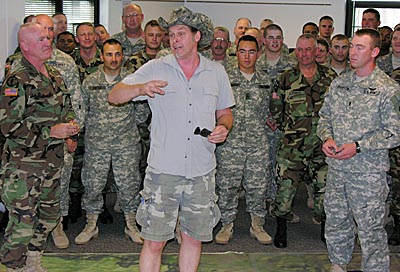
[Ted Nugent] claims that 30 days before his draft board physical, he stopped all forms of personal hygiene. The last 10 days, he ingested nothing but Vienna sausages and Pepsi; and a week before his physical, he stopped using bathrooms altogether, virtually living inside pants caked with his own excrement, stained by his urine. That spectacle won Nugent a deferment, he says. "... but if I would have gone over there, I'd have been killed, or I'd have killed, or I'd killed all the hippies in the foxholes...I would have killed everybody." - Detroit Free Press Magazine , July 15, 1990

Link.


(Link to photo.)

Meet a Big Media Lapdog

Flashed on the courtroom computer screens were her notes from 2004 about how Cheney could respond to allegations that the Bush administration had played fast and loose with evidence of Iraq's nuclear ambitions. Option 1: "MTP-VP," she wrote, then listed the pros and cons of a vice presidential appearance on the Sunday show. Under "pro," she wrote: "control message."
"I suggested we put the vice president on 'Meet the Press,' which was a tactic we often used," Martin testified. "It's our best format."
Link.

And this is the real reason the press is in trouble: People can only take so many lies. When a paper is so full of shit, people simply stop being interested in paying for non- and false information.

(Link to photo.)

And here is an analysis of Big Media's accuracy assessing Pelosi.

A Historical Note

War by insurgency is so bad that it was used in our own war of liberation in the 1770-80s. But of course losers always and fall back on excuses for their failures. (Link to photo.)

The Future of America

Or probably just the future enablers of Our Leaders' next generation of Beloved Leaders.


Link.

Our Pro-Life Leader

If you can publicly condemn the terrorist attacks of 9/11 and yet do nothing to implement the recommendations of the 9/11 Commission to protect this country from future attacks, then you are not pro-life.

If you can use the attacks of 9/11 as an excuse to launch a war of aggression, based on lies, against an unarmed country that posed no threat to us, killing countless innocent civilians, then you are not pro-life.

If you can send other people's children (but never your own) into that unnecessary and unjustified war without the equipment they need to protect themselves, then you are not pro-life.

If you can add insult to injury by telling our brave troops to their faces that "you have to go to war with the army you have, not the army you want", then you are not pro-life.

If you can thumb your nose at the Geneva Conventions and other international and domestic humanitarian laws and standards, and play semantic games to justify the denial of due process and the abuse and torture of human beings, then you are not pro-life.

If you can insist on tax cuts for multi-millionaires, while 13 million children in this country suffer from hunger due to poverty, then you are not pro-life.

If you can spend your time protecting pharmaceutical companies' profits by keeping drug prices high and preventing foreign (even Canadian) competition, while 12 million seniors are forced to choose between medicine and food, then you are not pro-life.

If you can pull strings for corporations that pollute the environment, censor the scientists, and deny the threat to the health of our children and our planet, then you are not pro-life.

If you can insist on abstinence-only sex education, and thereby deny the critical disease prevention information that our young people need to avoid AIDS and other sexually transmitted diseases should they succomb to their hormones and stray from your mandated path of abstinence, then you are not pro-life.

If you can deny funding for stem cell research that would ease the suffering of countless victims of Alzheimer's, Parkinson's, and other diseases, even though the needed stem cells would come from embryonic remains that would otherwise be tossed into the trash, then you are not pro-life.

If you can casually sign death warrants while ignoring mitigating evidence, and publicly mock death row inmates who plead for clemency, as George W. Bush did while governor of Texas, then you are not pro-life.
Link.

Saturday, January 27, 2007

Just in Case There Was Any Doubt that Bipartisanship is a Stupid Idea that Will Not and Can Not Work

One rightwing drug addict and sex pervert and someone with whom we are expected (by the wingnuts and their courtiers in Big Media) to compromise speaks:
Building Bipartisanship? Not Limbaugh's Problem

***

He has absolutely no interest in crossing the divide and forging compromise — and good reasons not to do so.
Link.

What I Wonder About....

I wonder... these private security personnel in Iraq... nay of them doing anything combat-like? And if so, how many? In other words, as Our Leader is about to suurrrgge, how many combat forces are already there, whether public or private? (I suppose the next thing to wonder about is how much the private forces cost and who's paying?)

Great Leadership -- None Here

Our Leaders -- W all the way down -- have been wrong on every single aspect of Iraq, they have been wrong with every decision and every "correction" just exacerbates things. Someone even agrees with me.

But in addition, in a continuing effort to show that our radical right wingnut leaders refuse to learn the correct lessons of Vietnam, still ignore all matters about winning hearts and minds. Our Leaders, as they're successfully doing here in the US of A, are succeeding in alienating people. In Iraq, that leads to more domestic terrorist violence. Which, unless I miss something, doesn't help bring stability to the country.

Really, Who Decides?

My skepticism that Our Leader actually leads continues unabated. This is as unpersuasive as anything:
If you liked George W. Bush as "the decider," you're going to love him as "the decision maker."

Meeting today with Lt. Gen. David Petraeus and other military leaders, the president said that he has "picked the plan" that he thinks is "most likely to succeed" in Iraq, and he complained -- as he has before -- that members of Congress are criticizing his new way forward "before it's even had a chance to work."

"I'm the decision maker," he said. "I had to come up with a way forward that precluded disaster."
Link.

What About the War?

I wonder about stuff like this every time I read about one of our guys getting killed: what actually happened?
When insurgents disguised as American troops attacked an Iraqi government facility in Karbala last weekend, the U.S. military issued a statement in which it said that five U.S. soldiers had been killed while "repelling" the attack. A U.S. military spokesman specifically denied a report that some U.S. soldiers had been kidnapped.

Like so much the government has said about the war in Iraq, that wasn't exactly true. As the Associated Press reports, Iraqi officials and two senior U.S. military officials now say that four of the five U.S. soldiers who died were in fact "captured and taken away from the governor's compound alive."
Link.

Thursday, January 25, 2007

"D'uh" Headline


Bush: "America Must Not Fail In Iraq"

Link.

News to me that after what we did to Iraq that there was any alternative. Thank you, Mr. President for the profound insight. This ability to open our eyes is what makes you Our Beloved Leader.

We Have Succeeded in Bringing a Healthy Democracy to Iraq!

The New York Times checks in on democracy in Iraq, where "nearly every session" of the parliament has been adjourned since November... because as few as 65 of the 275 members there showed up.

Why? It's irrelevant: "Deals on important legislation, most recently the oil law, now take place largely out of public view, with Parliament — when it meets — rubber-stamping the final decisions." Also, the country is very dangerous, and despite the $120,000 salary, the members say they can't afford adequate protection -- one member says that he uses 40 guards when he's in Iraq, and the salary only buys 20. And, well, there's the fact that the job has inevitably disappointed members who "were here for the game, for prestige, for the money,” as one puts it.
Link.

Our Leader's Wacky Supporters Show that They Love America and What it Represents

In early January, Families First on Immigration sent letters to President George W. Bush and to leaders of the new Democratic controlled Congress urging them "to adopt a grand compromise on the divisive issue that includes strong border security, an amnesty for illegals already here who are relatives of citizens and an end to birthright citizenship," the Washington Times reported.

"Our position really is consistent with Christian teachings and with the rule of law," said Manuel Miranda, chairman of the Third Branch Conference (as of January 9, the group's website "is currently under construction") a coalition of over 150 grasstop leaders, who has brought together more than 30 top shelf conservatives on this issue.

"Out of concern for keeping families together, the religious leaders propose granting citizenship to any illegal aliens in the country who are related to U.S. citizens. This would include anyone who has had a child born here, often referred to as an 'anchor baby,'" the Washington Times reported.

"In return, the federal government would end birthright citizenship, which automatically grants U.S. citizenship to anyone born here, regardless of his parents' legal status. The 14th Amendment says 'all persons born or naturalized in the United States ... are citizens of the United States.'"

"This is a real compromise," Miranda claimed. "On the one hand, there is legalization of a large number of people, but conservatives get the settlement of the thorniest issue for them in the immigration debate."

Earlier Miranda, the former judicial nominations counsel to then Senate Majority Leader Bill Frist (R-TN) and to the Senate Judiciary Committee, and a man who has known his fair share of controversy, told CBN: "Until now, religious leaders have been criticized for staying uninvolved in the immigration debate . . . This coalition gets them involved, they offer to come to the table and offer ideas they can eventually support. Previously, the White House did not invite their participation, and they did not offer their help. With certain results, a wider participation may get the President wider support to allow Republicans and Democrats to obtain a coherent reform. This new coalition is bigger and broader than the Secure Border Coalition that dominated the debate on the right in the last go round."

***

"It's a disingenuous attempt to appear to be not anti-Latino while at the same time pandering to their right wing base," Mark Potok, the Director of the Southern Poverty Law Center's Intelligence Project, told Media Transparency in a telephone interview. "These leaders are desperately trying to hold their coalition together that very likely cannot stay together. It is essentially a cynical ploy and would appear to have no chance in a Democratic controlled congress."
Link.

Handy-Dandy State of the Union Analysis

Short version: it's all too bogus to really matter anyway so why care what Our Leader was told to say?

Somewhat longer version:
There was that tongue again. When the President lies he's got this weird nervous tick: He sticks the tip of his tongue out between his lips. Like a little boy who knows he's fibbing. Like a snake licking a rat.

In his State of the Union tonight the President did his tongue thing 124 times -- my kids kept count.

But it wasn't all rat-licking lies.

Most pundits concentrated on Iraq and wacky health insurance stuff. But that's just bubbles and blather. The real agenda is in the small stuff. The little razors in the policy apple, the nasty little pieces of policy shrapnel that whiz by between the appearances of the Presidential tongue.

First, there was the announcement the regime will, "give employers the tools to verify the legal status of their workers." In case you missed that one, the President is talking about creating a federal citizen profile database.

There's a problem with that idea. It's against the law. The law in question is the United States Constitution. The Founding Fathers thought the government had no right to keep track on a citizen unless there is evidence they have committed, or planned to commit, a crime.

But the Founding Fathers didn't imagine there were millions and billions of dollars to be made by private contractors ready to perform this KGB operation for the Department of Homeland Security, tracking each and every one of us to keep tabs on our "status."

These work databases will tie into "voter verification" databases required by the Help America Vote Act. And these will tie to the databases on citizenship and so on.

Will Big Brother abuse these snoop lists? The biggest purveyor of such hit lists is Choice Point, Inc. – those characters who, before the 2000 election, helped Jeb Bush purge innocent voters as "felons" from Florida voter rolls. Will they abuse the new super-lists? Does Dick Cheney shoot in the woods?

There were several other little IEDs (improvised execrable policy devices) planted in the State of the Union. Did you catch the one about doubling the Strategic Petroleum Reserve? If you're unfamiliar with the SPR, it is supposed to be the stash of oil we keep in case the price of crude gets too high.

Well, the price of oil has been horribly high but Dick Cheney, the official who sits on the Reserve's spigots, has refused to release the oil into the market.

Instead of unleashing the Reserve and busting Big Oil's price gouging Bush will double the Reserve, which will require buying three-quarters of a billion barrels of oil. This is a nice $40 billion pay-out to Big Oil from the US Treasury. Compare this to the President's health insurance plan which will be "revenue neutral" -- that is, have a net investment of zero.

But the $40 billion in loot the oilmen will get from us taxpayers for doubling the Reserve is nothing compared to the boost in the worldwide price of crude caused by this massive, mad purchase. While the Congressional audience didn't even bother polite applause for the reserve purchase plan, there's no doubt they were whooping it up in Saudi Arabia. Clearly, the state of the Saudi-Bush union is still pretty good.
Link.

At least the smirk was back and the look of fear was gone....

How to Obey Our Leader and be a Patriotic War Supporter


Link.

Wednesday, January 24, 2007

Saddam's in Heaven Now


Link.

Sheriff Andy on the PATRIOT ACT

He's ag'in it. Here's why.

The Private Sector Does a Better Job Protecting Us than Our Government Does -- Not!

"Clear" Registered Traveller Program

CLEAR, a private service that prescreens travelers for a $100 annual fee, has come to Kennedy International Airport. To benefit from the Clear Registered Traveler program, which is run by Verified Identity Pass, a person must fill out an application, let the service capture his fingerprints and iris pattern and present two forms of identification. If the traveler passes a federal background check, he will be given a card that allows him to pass quickly through airport security.

Sounds great, but it’s actually two ideas rolled into one: one clever and one very stupid.
The clever idea is allowing people to pay for better service. Clear has been in operation at the Orlando International Airport since July 2005, and members have passed through security checkpoints faster simply because they are segregated from less experienced fliers who don’t know the drill.

Now, at Kennedy and other airports, Clear is purchasing and installing federally approved technology that will further speed up the screening process: scanners that will eliminate the need for cardholders to remove their shoes, and explosives detection machines that will eliminate the need for them to remove their coats and jackets. There are also Clear employees at the checkpoints who, although they can’t screen cardholders, can guide members through the security process. Clear has not yet paid airports for an extra security lane or the Transportation Security Administration for extra screening personnel, but both of those enhancements are on the table if enough people sign up.

I fly more than 200,000 miles per year and would gladly pay $100 a year to get through airport security faster.

But the stupid idea is the background check. When first conceived, traveler programs focused on prescreening. Pre-approved travelers would pass through security checkpoints with less screening, and resources would be focused on everyone else. Sounds reasonable, but it would leave us all less safe.

Background checks are based on the dangerous myth that we can somehow pick terrorists out of a crowd if we could identify everyone. Unfortunately, there isn’t any terrorist profile that prescreening can uncover. Timothy McVeigh could probably have gotten one of these cards. So could have Eric Rudolph, the pipe bomber at the 1996 Olympic Games in Atlanta. There isn’t even a good list of known terrorists to check people against; the government list used by the airlines has been the butt of jokes for years.
Link.

Open Letter to American Big Bidness: You Don't Have to F*ck American Workers

Minimum Wage Rises, Sky Does Not Fall

Tuesday, January 23, 2007

Our Leader's Dear Friend

Reverend Moon. Like Our Leader, he believes in a free press and an honest press.

Sunday, January 21, 2007

The Growth of the American Democracy

Read it and weep, from a Talking Points Media site:
TPM Reader JO, on the U.S. Attorney purges:

A lot of people seem to be getting snowed by the dodge that some of the acting US Attorneys will go through the confirmation process as if it gets rid of the problem, but it really doesn't.

Before they changed the statute, the President had no effective way to put a political stooge in as US Attorney for more than 4 months without buy-in from another branch of government (or a year at most via a recess appointment). But now he can, and putting the stooge up for confirmation is a no-lose proposition. If the Senate confirms, great. If they never give the nominee a hearing, they only prolong his tenure. And if they reject the nominee, he can still stay in office until a new nominee is appointed -- which might never happen.

This is a serious blow to effective law-enforcement, and it's going to make morale plummet in prosecutors' offices all over the country.

Has anyone introduced legislation yet to strip this misguided provision from the Patriot Act?

Update: The answer is yes. Senators Feinstein, Leahy, and Pryor have introduced the Preserving United States Attorney Independence Act, which would restore to the District Courts the power to appoint interim U.S. Attorneys.
(Emphasis added.)

Well, this obscenity is still the law....

Sunday Round-Up

The 50 most loathsome people? Not quite dead on, but close.... And Our Leader is only #3.

Cheney is despised but Our Leader more so.

"Straight talk" my ass. Dunno whether Our Next Leader is particularly dishonest but he's damn close. John McLain: Certified liar -- and that's the straight talk.

Maliki thinks Condi helps the terrorists -- the insurgents -- inside his country. He isn't the most accurate person in the world about things inside Iraq but I do believe him on this one. Dissing the government in charge to the enemy's betterment and success is one of the many lessons of Vietnam Our Leaders have yet to learn.

When Slick Willy's popularity dropped below 50%, the wing nuts thought he should resign
. So I guess since he didn't, Our far less popular Leader gets a pass and needn't resign. (Not that it wouldn't accomplish anything. Policies wouldn't change. And Dick would not be any more successful selling dementia than Our Leader's been recently. A Leader no one follows....)

Our Leader's goal vis a vis Iraq? All he cares is that he's loved by the Iraqis. Such depth of purpose and intellect. Well we've a faith-based administration so Our Leader can keep dreaming.

The Key to Victory; The Plan that will Succeed!


Link.

The Face of Confidnce


Link. Is Our Leader scared of himself and his "leadership"???

Inspirational Portrait of Our Leader

The New Yorker still has a little of its cover mojo....

Saturday, January 20, 2007

The Next Holiday


Link.

The Genius of Our Next Leader

John McCain's been all over the map when it comes to Iraq for a long time. Cliff Schecter notes that way back in 1990, two and a half weeks after Iraq had invaded Kuwait, McCain said that Americans shouldn't support a ground war in the Middle East because "we cannot even contemplate, in my view, trading American blood for Iraqi blood." Less than two months later, though, McCain not only contemplated the possibility, he voted to go to war on behalf of Kuwait.

As the war drums sounded for the current fiasco, McCain, echoing Dick Cheney and the administration's legion of half-baked neocons, promised a cakewalk. In September of 2002, he warned us that there might be a few casualties: "As successful as I believe we will be, and I believe that the success will be fairly easy, we will still lose some American young men or women." That same month, he told CNN, "We're not going to get into house-to-house fighting in Baghdad … we're not going to have a bloodletting of trading American bodies for Iraqi bodies." And in early 2003, he promised viewers of MCNBC, "We will win this conflict. We will win it easily."

This month, though, he told MSNBC that he knew all along the Iraq war was "probably going to be long and hard and tough," and that he was "sorry" for those who voted for the war believing it would be "some kind of an easy task." "Maybe they didn't know what they were voting for," he said.

In October, John McCain was just as sure that 20,000 more U.S. troops would do the trick in Iraq -- bringing about stability, democracy and prosperity, and restoring America's image in the world (or something) -- as he had been about the ease with which it would be prosecuted in 2003. When reporters asked him to elaborate on his statement about the need for more combat troops in Iraq to quell a "classic insurgency," McCain said: "Another 20,000 troops in Iraq, but that means expanding the Army and the Marine Corps."

In November, McCain said again: "I believe victory is still attainable," adding: "But without additional combat forces, we will not win this war."

***

But if McCain thought that he was safe in advocating a troop buildup -- safe because Bush would never be insane enough to call for escalating an unpopular war just a couple of months after American voters delivered his party a powerful message that they had lost confidence in those running it -- he underestimated the president's capacity for stubborn self-delusion.

When it became clear that Bush was in fact going to call for an increase in troops, John Edwards, sensing an opportunity to get out ahead of the curve on McCain, who's considered a strong challenger for the 2008 GOP presidential nomination, termed the escalation the "McCain Doctrine," effectively hanging the policy around the senator's neck.

And McCain's been squirming ever since. In early January, he said that the plan would require, specifically, 30,000 troops, adding, "a small size [deployment] would be the worst of all options to exercise, in my view." Just a day later, he went to the American Enterprise Institute with his friend Joe Lieberman and said: "We are not specific on numbers, we don't have -- we are talking about three or four combat brigades, in Baghdad, and one or two more in Anbar province. We are not that much detailed-oriented."

As blogger Steve Benen points out, McCain's been moving the goalposts in an attempt to preemptively distance himself from a policy that's all but guaranteed to fail.
Link.

Our Leader's Legacy, Today, in One Word

Loser.

But like all ne'er-do-wells, it us -- everyone but him -- who will suffer from his legacy.

Lucky us to have lived under the current regime.

He cannot possibly, and will likely not, suffer enough.

Thursday, January 18, 2007

Questions for Our Leader

Of course, he hates questions and being questioned....
Mr. President, Sir, when reporter Bob Woodward asked you if you had consulted with your father before ordering our army into Iraq you said, "No, he's not the father you call on a decision like this. I talked to my heavenly Father above." My question, Mr. President: If God asked you to bombard, invade and occupy Iraq for four years, why did he send an opposite message to the Pope? Did you not know that your father, George Bush, Sr., his Secretary of State James Baker and his National Security Advisor General Scowcroft were all opposed to your invasion? Wouldn't you, our troops, the American people and the Iraqis all be much better off if you had listened to your more experienced elders including your earthly father? Instead of blaming God for the awful catastrophe you have unleashed in Iraq, wouldn't it have been less self-righteous if you had fallen back on the oft-quoted explanation of wrongdoing, "The devil made me do it?"

And Mr. President, after the 9/11 hit against the Twin Towers in New York, which gained us the sympathy and support of the entire world, why did you then order the invasion of Iraq, which had nothing to do with 9/11? Are you aware that your actions destroyed the international reservoir of good will towards the United States? What is the cost to America of shattering the standing and influence of our country in the eyes of the world?

Why, Mr. President did you pressure the CIA to report falsely that Iraq was building weapons of mass destruction including nuclear weapons? And when you ordered your Secretary of State, Colin Powell, to go to New York and present to the UN the Administration's "evidence" that Iraq was an imminent nuclear threat to the United States, were you aware that after reading this deceitful statement to the UN, Mr. Powell told an aid that the so-called evidence was "bullshit"?

Is it reasonable to you, President Bush, that Colin Powell told you near the end of your first term that he would not be in your Administration if you were to receive a second term? What decent person could survive two full terms of forced lying and deceit?

And Mr. President, how do you enjoy your leisure time, and how can you sleep at night knowing that 3,014 young Americans have died in a war you mistakenly ordered? What do you say to the 48,000 young Americans who have been crippled for life in mind or body? What is your reaction to the conclusion of the leading British medical journal (Lancet) that since you ordered the bombardment and occupation of Iraq four years ago, 600,000 Iraqi men, women and children have been killed? What do you think of the destruction of the Iraqi's homes, their electrical and water systems, their public buildings?

And Mr. Bush and Mr. Cheney, while neither of you has ever been in combat (Mr. Cheney asking and receiving five deferments from the Vietnam War), have you not at least read or been briefed on the terrible costs of that ill-advised and seemingly endless American war in tiny Vietnam? Do you realize that another Texas President, Lyndon Baines Johnson, declined to seek a second term in part because he had lost his credibility over the disastrous war in Vietnam? Are you aware that one of the chief architects of that war, Secretary of Defense Robert McNamara, resigned his office and years later published a book declaring that the war was all a tragic mistake? Do you know this recent history in which 58,000 young Americans died in the process of killing 2 million Vietnamese men, women and children? If you do not know about this terrible blunder in Vietnam, are you not ignoring the conclusion of one of our great philosophers: "Those who are ignorant of history are condemned to repeat it." And, Mr. President, in your ignorance of the lessons of Vietnam, are you not condemning our troops and our people to repeat the same tragedy in Iraq?

During the long years between 1963 and 1975 when I fought to end the American war in Vietnam, first as a US Senator from South Dakota and then as my party's nominee for President, my four daughters ganged up on my one night. "Dad, why don't you give up this battle? You've been speaking out against this crazy war since we were little kids. When you won the Democratic presidential nomination, you got snowed under by President Nixon." In reply I said, "Just remember that sometimes in history even a tragic mistake produces something good. The good about Vietnam is that it is such a terrible blunder, we'll never go down that road again." Mr. President, we're going down that road again. So, what do I tell my daughters? And what do you tell your daughters?

Mr. President, I do not speak either as a pacifist or a draft dodger. I speak as one who after the attack on Pearl Harbor, volunteered at the age of nineteen for the Army Air Corps and flew thirty-five missions as a B-24 bomber. I believed in that war then and I still do sixty-five years later. And so did the rest of America. Mr. President, are you missing the intellectual and moral capacity to know the difference between a justified war and a war of folly in Vietnam or Iraq?

Public opinion polls indicate that two-thirds of the American people think that the war in Iraq has been a mistake on your part. It is widely believed that this war was the central reason Democrats captured control of both houses of Congress. Polls among the people of Iraq indicate that nearly all Iraqis want our military presence in their country for the last four years to end now. Why do you persist in defying public opinion in both the United States and Iraq and throughout the other countries around the globe? Do you see yourself as omniscient? What is your view of the doctrine of self-determination, which we Americans hold dear?

And wonder of wonders, Mr. President, after such needless death and destruction, first in the Vietnamese jungle and now in the Arabian desert, how can you order 21,500 more American troops to Iraq? Are you aware that as the war in Vietnam went from bad to worse, our leaders sent in more troops and wasted more billions of dollars until we had 550,000 US troops in that little country? It makes me shudder as an aging bomber pilot to remember that we dropped more bombs on the Vietnamese and their country than the total of all the bombs dropped by all the air forces around the world in World War II. Do you, Mr. President, honestly believe that we need tens of thousands of additional troops plus a supplemental military appropriation of $200 billion before we can bring our troops home from this nightmare in ancient Baghdad?

In your initial campaign for the Presidency, Mr. Bush, you described yourself as a "compassionate conservative". What is compassionate about consigning America's youth to a needless and seemingly endless war that has now lasted longer than World War II? And what is conservative about reducing the taxes needed to finance this war and instead running our national debt to nine trillion dollars with money borrowed from China, Japan, Germany and Britain? Is this wild deficit financing your idea of conservatism? Mr. President, how can a true conservative be indifferent to the steadily rising cost of a war that claims over $7 billion a month, $237 million every day? Are you troubled to know as a conservative that just the interest on our skyrocketing national debt is $760,000 every day. Mr. President, our Nobel Prize-winning economist, Joseph Stiglitz, estimates that if the war were to continue until 2010 as you have indicated it might, the cost would be over a trillion dollars.

Perhaps, Mr. President, you should ponder the words of a genuine conservative - England's nineteenth-century member of Parliament, Edmund Burke: "A conscientious man would be cautious how he dealt in blood".

And, Mr. President at a time when your most respected generals have concluded that the chaos and conflict in Iraq cannot be resolved by more American dollars and more American young bodies, do you ever consider the needs here at home of our own anxious and troubled society? What about the words of another true conservative, General and President Dwight Eisenhower who said that, "Every gun that is made, every warship launched, every rocket fired signifies in the final sense, a theft from those who hunger and are not fed, those who are cold and not clothed."

And, Mr. President, would not you and all the rest of us do well to ponder the farewell words of President Eisenhower: "In the councils of government, we must guard against the acquisition of the unwarranted influence of the military-industrial complex. The potential for the disastrous rise of misplaced power exists and will persist."

Finally, Mr. President, I ask have you kept your oath of office to uphold the Constitution when you use what you call the war on terrorism to undermine the Bill of Rights? On what constitutional theory do you seize and imprison suspects without charge, sometimes torturing them in foreign jails? On what constitutional or legal basis have you tapped the phones of Americans without approval of the courts as required by law? Are you above the Constitution, above the law, and above the Geneva accords? If we are fighting for freedom in Iraq as you say, why are you so indifferent to protecting liberty here in America?
Link.

Oh; Or: Unsceptical Sceptic

Fact Checking 101
How Skeptic magazine was Duped
by an Environmental Activist Group
by Michael Shermer

In last week’s eSkeptic , we published highlights from a press release issued by PEER (Public Employees for Environmental Responsibility), a Washington D.C.-based environmental watchdog group. That press release, dated December 28, 2006, was headlined:
HOW OLD IS THE GRAND CANYON? PARK SERVICE WON’T SAY
Orders to Cater to Creationists Makes National Park Agnostic on Geology
The first sentence of the release reads:
Washington, DC — Grand Canyon National Park is not permitted to give an official estimate of the geologic age of its principal feature, due to pressure from Bush administration appointees.
Unfortunately, in our eagerness to find additional examples of the inappropriate intrusion of religion in American public life (as if we actually needed more), we accepted this claim by PEER without calling the National Park Service (NPS) or the Grand Canyon National Park (GCNP) to check it. As a testimony to the quality of our readers, however, dozens immediately phoned both NPS and GCNP, only to discover that the claim is absolutely false. Callers were told that the Grand Canyon is millions of years old, that no one is being pressured from Bush administration appointees — or by anyone else — to withhold scientific information, and all were referred to a statement by David Barna, Chief of Public Affairs, National Park Service as to the park’s official position. “Therefore, our interpretive talks, way-side exhibits, visitor center films, etc. use the following explanation for the age of the geologic features at Grand Canyon,” the document explains.
If asked the age of the Grand Canyon, our rangers use the following answer: ‘The principal consensus among geologists is that the Colorado River basin has developed in the past 40 million years and that the Grand Canyon itself is probably less than five to six million years old. The result of all this erosion is one of the most complete geologic columns on the planet.’
Understandably, many of our readers were outraged by both the duplicity of the claim and our failure to fact check it. One park ranger wrote us:
You’re a day late and a dollar short on this one. As a national park ranger, I found most of PEER’s findings to be bogus. So have others: http://parkrangerx.blogspot.com
A Grand Canyon park interpreter wrote:
This is incorrect. I have NEVER been told to present non-science based programs. In fact, I received “talking points” demanding that Grand Canyon employees present programs BASED ON SCIENCE and that we must use the scientific version supported by the National Science Foundation and the National Academy of Sciences. As an interpreter I have shared the “creation” story of the Hopi people and the Paiute people because it is culturally relative. I used these stories as a tool to introduce the scientific story. Be confident there are good people running government, too.
One of our readers directly challenged Jeff Ruch, the Executive Director of PEER:
When I challenged that PEER guy to show me some evidence and provided him evidence to the contrary, he didn’t have much. I would say PEER did more than jump the gun. I’d say they are spreading misinformation.
Another Grand Canyon park interpreter offered this explanation:
Ruch’s attempts to insinuate a conspiratorial link between the NPS and organized religion are misguided and founded in fervent anti-Christian opposition, not reason or the law. Ruch’s anti-Judeo-Christian bias is evidence by his lack of opposition to GCA’s selling of Native American creation myths. His misinformation campaign aims to tarnish the reputation of the NPS to leverage his position that creationism books should not be sold in the GCA bookstore. I’ve emailed a few of my contacts at GRCA, and so far, all deny any conspiracy and all freely give the canyon’s age in education programs (as does all official GRCA print material). I’ll post updates as information becomes available. Until then, don’t believe everything you read.
The reference to the creationism book being sold in the Grand Canyon bookstore — Grand Canyon: A Different View by Tom Vail — is true. It is sold in the “inspiration” section of the bookstore, alongside other books of myth and spirituality. In any case, the story is an old one now, and completely irrelevant to the claim that NPS employees are withholding information about the age of the canyon, and/or are being pressured to do so by Bush administration appointees.
Embarrassed and angered by all of this, I promptly phoned Jeff Ruch myself and inquired what evidence he has to support this claim. He initially pointed to the creationism book and the fact that the NPS has failed to address numerous challenges to the sale of same in their bookstore. When I pointed out that this is irrelevant to the claim in the press release, he then reminded me of the biblical passages that have been posted at places along the rim of the canyon. Again, I admonished, this is not evidence for his central claim. We went round and round on the phone until I finally gave up and hung up, convinced that he simply made up the claim out of whole cloth.
Not wishing to simply call Ruch a liar, and allowing myself to calm down a bit, I emailed him and asked:
Can you tell us who in the Bush administration put pressure on park service employees? Can you name one person in the GCNP staff who says that they are not permitted to give the official estimate of the age of the canyon?
He responded:
I do not know — it is at the Director’s level or above. We have been trying to find out for three years.
Julie Cart, Los Angeles Times.
I contacted Julie Cart at the Los Angeles Times, who was out of town on assignment, and got her editor, Frank Clifford, on the phone. Clifford knew all about the creationism book and the biblical passages on the rim of the canyon, but said that he had heard nothing about this new claim of Bush administration appointees silencing park service staff, and that if Julie knew of such a thing the Times would be most interested in following up with the story. I then reached Julie by email, who said that she too knew of no such silence on the part of park staffers regarding the age of the canyon.
Once again outraged and enraged , I emailed Ruch to ask him why he referenced Cart, who denied his central claim. He responded:
I referred you to Julie because of the response she got from the superintendent’s office when she covered the issue earlier — not for any new claim.
Thanks a lot. I wasted several hours tracking down that false lead. Now at my wit’s end with this guy, I point blank asked him if he made it all up. He responded:
The interpretive staff at GCNP we are working with do not want to be identified and have gone into deep underground as the atmosphere at the park is now somewhat volatile.
Well, it would have been nice (not to mention ethical) if he would have said so in the first place. (I have now wasted about 10 hours of research time on this instead of other projects.) The referencing of sources who wish to remain anonymous is quite common in journalism and, in fact, there are laws protecting whistleblowers . The fact that no such reference was made until I pointedly accused Ruch of flatout lying makes me, well, skeptical of this explanation. His final statement to me doesn’t make me any less skeptical:
We are issuing an amended release today that
deletes reference to what interpretive staff can and cannot say and
features the NPS official statement that they provide geological information to the public.
Then why did PEER issue that statement in the first place? In my opinion, this is why:
PEER is an anti-Bush, anti-religion liberal activist watchdog group in search of demons to exorcise and dragons to slay. On one level, that’s how the system works in a free society, and there are plenty of pro-Bush, pro-religion conservative activist watchdog groups who do the same thing on the other side. Maybe in a Hegelian process of thesis-antithesis-synthesis we find truth that way; at least at the level of talk radio. But journalistic standards and scholarly ethics still hold sway at all levels of discourse that matter, and to that end I believe we were duped by an activist group who at the very least exaggerated a claim and published it in order to gain notoriety for itself, or worse, simply made it up.
To that end I apologize to all of our readers for not fact checking this story before publishing it on eSkeptic and www.skeptic.com. Shame on us. But shame on you too, Mr. Ruch, and shame on PEER, for this egregious display of poor judgment and unethical behavior.
Michael Shermer
Publisher, Skeptic magazine
Executive Director, the Skeptics Society
mshermer@skeptic.com

Meet Your Next President!

McCain's political colleagues, however, know another side of the action hero -- a volatile man with a hair-trigger temper, who shouted at Sen. Ted Kennedy on the Senate floor to "shut up," called his fellow Republican senators "shithead," "fucking jerk," "asshole," and joked in 1998 at a Republican fundraiser about the teenage daughter of President Clinton, "Do you know why Chelsea Clinton is so ugly? Because Janet Reno is her father." As recently as a few months ago, McCain suddenly rushed up to a friend of mine, a prominent Washington attorney, at a social event, and threatened to beat him up because he represented a client McCain happened to dislike, and then, just as suddenly, profusely and tearfully apologized.

Within the Republican Party nearly everyone who has had serious dealings with McCain distrusts him (including traditional Republican moderates, not just conservatives). While taking right-wing positions on social issues like abortion and gay marriage, his simmering resentment of Bush led him to virtually caucus with the Democrats in early 2001 (before Sept. 11), using the Democratic Leadership Council as his back channel. Then, abruptly, he rushed to embrace Bush.

McCain's political advisors believe that though he would easily be elected president in 2008 if he captured the nomination, he might not get the nomination. In 2000, McCain did not win a primary state where the voting was restricted only to Republicans. So McCain decided to let the general election take care of itself as he won over the party faithful. He campaigned enthusiastically for Bush in 2004. He sought to reconcile with the religious right, whose leaders he had called "agents of intolerance" in 2000, speaking on May 13, 2006, at the Rev. Jerry Falwell's Liberty University, and hiring its debate coach as a communications aide.

McCain had belatedly taken the lead in opposing Bush's torture policy, an issue that could not be more personal for him. But after the Supreme Court last year declared Bush's secret tribunals for detainees and use of extreme interrogation techniques illegal, Bush sought congressional approval of his revised version of the program. At first, McCain fought Bush, but the right attacked him, in a campaign some of his advisors said they had reason to believe Karl Rove had whipped up. McCain quickly capitulated, even agreeing to suspension of habeas corpus. McCain, as someone close to him explained to me, figured he could continue to play the issue when he became chairman of the Senate Armed Services Committee in the next Congress. Asked about the chance the Democrats might take control, McCain declared, "I think I'd just commit suicide."

As the neoconservatives abandoned Bush's sinking ship, McCain welcomed them aboard. "McCain began reading The Weekly Standard and conferring with its editors, particularly Bill Kristol," the New Republic magazine reported. And he hired a board member of the neocon Project for the New American Century, Randy Scheunemann, as his foreign policy aide.

McCain positioned himself as consistently belligerent, even to Bush's right: in favor of bombing Iran and North Korea. He also proposed a "surge" of troops into Iraq, an idea gleaned from the neocons. If Bush adopted the Iraq Study Group's approach of diplomacy and redeployment, which McCain assailed as "dispiriting," the right would hail McCain as a prophet with honor. Unfortunately, McCain's strategy depended on Bush's not adopting his proposal. Importuned by the same neocons who had sold it to McCain, Bush seized upon the "surge."

McCain had trapped himself. And he has finally succeeded in chaining himself to Bush. As Bush's war has escalated, McCain's popularity has nose-dived. Still the front-runner for the Republican nomination, he might have made himself more acceptable to the base, but his political strategy has shattered his own myth. Bearing the burden of Bush he may have become unelectable.
Link.

Monday, January 15, 2007

Image du Jour

Link.
Whatever I might believe about the degree to which Our Beloved Leader actually leads -- I don't buy that he is really the "decider" of anything important -- (yes, yes, I'm faith-based on this issue!), this cartoon has some truth to it; that I do no doubt....

Sunday, January 14, 2007

The Face of Liberty in Our Nation

Is it this it -- obviously, Our Leaders' preference...


(Must click to enlarge) -- or this?


(Both photos off of worth1000.com.)

Presidential Portrait

This is the correct image of Our Leader, not those posted the other day....

Our Leaders Hate America

An administration lawyer who is against criminal defendants having competent counsel. Of course, Our Leaders do not believe in the American system of law of their personal Randian system of fiat.